
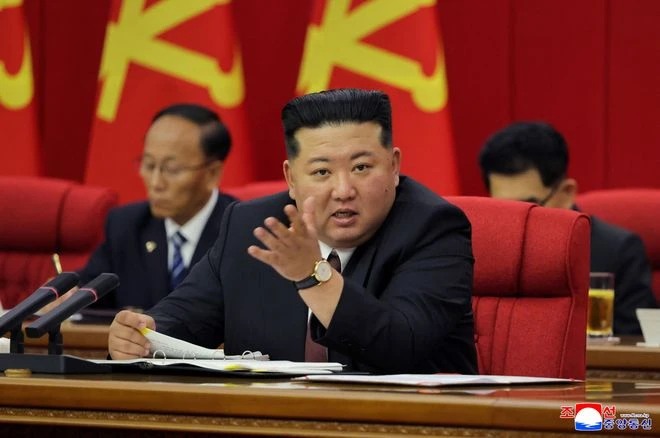
Pyongyang just shut the door on every denuclearization framework still on the table in Seoul and Washington — including the phased proposal South Korean President Lee Jae Myung floated to Donald Trump at the G7 less than a week ago.
Kim Jong Un told a Workers’ Party Central Committee meeting that running from Saturday through Monday that nuclear status is no longer a bargaining chip. It is the operating premise. Any future talks, he made clear through the party’s own state media, would start from North Korea’s position as a declared nuclear weapons state — not end there.
That single distinction reframes everything diplomats in Seoul and Washington have spent months trying to construct.
Yang Moo-jin, who studies the North at the University of North Korean Studies in Seoul, said the shift effectively closes the door on denuclearization as a starting point for negotiations. Pyongyang, he said, would now only sit down “as a nuclear weapons state on an equal footing” — terms that point toward arms reduction talks rather than the phased dismantlement Lee pitched to Trump on the sidelines of the G7.
Read also: Seoul Says Kim Jong Un Picks Teen Daughter As Heir
The mechanics matter here. Arms reduction assumes North Korea keeps a baseline arsenal and negotiates from there, with sanctions relief likely a precondition rather than a reward. Dismantlement assumed the opposite — that the weapons themselves were temporary, contingent on concessions still to come. Those are not two paths to the same destination. They are different destinations entirely, and Kim’s Central Committee remarks, as relayed by KCNA, point only toward the first.
According to KCNA’s account of the meeting, Kim framed the buildup as defensive necessity rather than provocation, describing a global security order destabilized by what he called the “gangster-like” greed of hegemonic powers. He pointed to Europe and the Middle East as evidence, blaming Washington for intensifying bloodshed in both regions, and described the resulting landscape as producing what state media quoted him calling “unimaginable, astonishing incidents and events.”
Washington featured again, more directly, when Kim turned to the peninsula itself.
He accused the United States and South Korea of steadily escalating their combined nuclear posture, telling the party gathering that the build-up serves no purpose beyond preparing an attack on his country. KCNA’s summary of his remarks went further, describing the continuous expansion of North Korea’s own nuclear forces as the only rational response to what it called an increasingly unpredictable and multidirectional international military and political environment.
Read also: N’Korea: Kim Orders ‘Drastic Boost’ In Production Of Missiles
Specifics were notably absent. KCNA gave no indication of what concrete steps might follow from that posture, leaving the scale and timeline of any nuclear expansion unstated.
What Kim did make concrete was conventional. He ordered an acceleration in the construction of a 10,000-ton strategic guided-missile cruiser and called for broader buildup of conventional forces alongside the nuclear program — a pairing that suggests Pyongyang is hedging its deterrent rather than betting everything on warheads alone.
Yang pointed to two specific irritants Pyongyang is using to justify the buildup: the U.S.-South Korea Nuclear Consultative Group, the bilateral mechanism built specifically to deter North Korean nuclear action, and Seoul’s own push to develop a nuclear-powered submarine. Both, he said, gave the party meeting convenient cover for framing expansion as response rather than initiative.
None of this is new in substance. North Korea has operated outside the United Nations and U.S. sanctions regimes imposed between 2006 and 2017 — measures specifically designed to halt its weapons and missile programs — for nearly two decades. It declared itself a nuclear state years ago and has said consistently that nothing will move it to surrender that status, through three successive rounds of diplomatic pressure from Washington, Beijing and Seoul.
What is new is the timing. Kim’s remarks landed days after Lee raised a phased approach directly with Trump, suggesting Pyongyang wanted its rejection on record before any momentum could build around the South Korean president’s framework.
The Central Committee meeting was not only about weapons. Kim also designated the modernization of the coal industry and the redevelopment of mining communities as a strategic priority, according to KCNA’s reporting on the session.
Coal remains North Korea’s principal domestic energy source, Yang said, and the push to upgrade the sector points to a country still managing chronic energy shortfalls even as it accelerates spending on cruisers and warheads. The contrast was not lost in the readout: a state simultaneously racing to expand its deterrent and struggling to keep the lights on.