
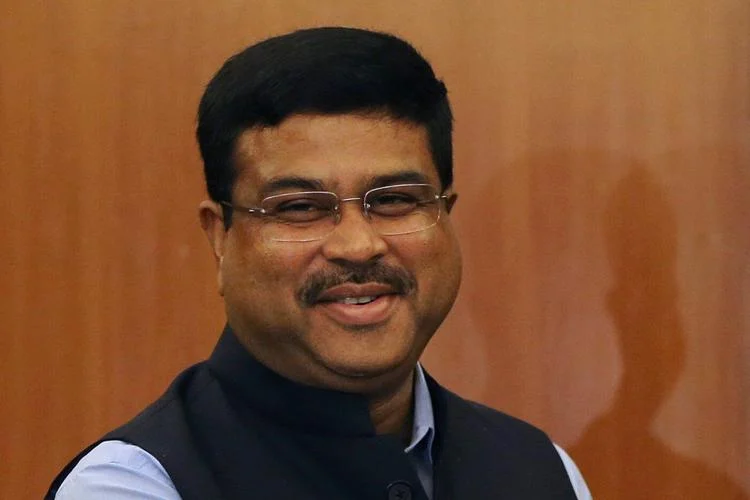
Indian Education Minister Dharmendra Pradhan resigned Saturday, handing a rare political defeat to Prime Minister Narendra Modi after five weeks of youth-led protests over a leaked medical school entrance exam forced the government’s first major concession of Modi’s third term.
Pradhan announced his departure on social platform X following talks with leaders of the youth-led Cockroach Janta Party. “I hold deep respect for the aspirations, sentiments, and rightful expectations of the youth of this country,” he wrote. The CJP called off its nationwide protests the same day after the government agreed to several of the movement’s other demands as well.
The scandal traced back to India’s National Eligibility cum Entrance Test, the gateway exam for medical school admission that roughly 2 million students sat for on May 3. Authorities later scrapped the exam after discovering its question papers had leaked, a cancellation that has been linked to about a dozen student suicides. Modi had earlier offered to set up fast-track courts to punish officials tied to the leak, but protest leaders said that measure fell well short of the accountability they were demanding.
Modi’s own gesture came a day earlier and proved insufficient on its own. Late Thursday, the 75-year-old prime minister posted a rare selfie video to Instagram saying he was pained by the protesters’ suffering and promising remedial steps. It did not satisfy demonstrators who had packed central Delhi, endured a police crackdown involving tear gas and batons days earlier, and inspired sympathy protests in Mumbai, Hyderabad, Bengaluru and Ahmedabad.
Read also: Sikh’s Killing: Tension As India Expels Canadian Diplomat
The CJP itself is barely two months old, founded May 16 by Abhijeet Dipke, a 30-year-old Boston University graduate, and named after a remark Chief Justice Surya Kant made comparing unemployed youth to cockroaches. The group amassed 22 million mostly Gen Z followers on Instagram within days of forming. It is not a registered political party, and Dipke has said no decision has been made on whether it will become one.
Sanjay Srivastava, an anthropology professor at SOAS University of London, said the demonstrations differ from past protest movements in a key respect. “A large number of people who were at the protest may actually be his supporters — and that’s quite different from other kinds of protests in the past,” Srivastava said, arguing that the real shift is a wider cross-section of Indians now willing to question whether Modi’s party is automatically good for the country.
Political analyst Amitabh Tiwari said the exam leak functioned mainly as a spark for deeper anxieties. Nearly 40% of Indian graduates aged 25 and under are unemployed, according to research from Azim Premji University, and many young people fear artificial intelligence could further erode job prospects in sectors such as IT back-office work, a mainstay of India’s services economy.
That frustration collides with a stark representation gap. Indians between 18 and 40 make up about 40% of the population but hold only around 10% of seats in Parliament’s lower house, down from more than double that share in the 1950s, according to Tiwari; the average age of Modi’s Cabinet exceeds 60. Senior minister Rajnath Singh said the government’s “top priority” was to understand students’ concerns and ensure they felt heard.
Read also: India And France Overhaul 1992 Tax Treaty In Strategic Reset
The protests carry political risk beyond the exam dispute. Opposition parties, though the CJP itself is not one, have moved to claim the students’ cause as their own ahead of elections next year in Uttar Pradesh, Punjab and Modi’s home state of Gujarat, the first two of which are run by Modi’s Bharatiya Janata Party. A bigger threat to Modi could emerge in the 2029 national election if the CJP evolves into a formal party. Young Indian voters have historically split along religious and caste lines in ways that have favored the BJP, though a recent election in Tamil Nadu, where an actor won the chief ministership on the strength of an Instagram-first youth following, suggests that pattern may be loosening.
Much of the movement’s reach traces to a platform gap the BJP has struggled to close. Author Anurag Minus Verma said the episode “shows how they are completely out of touch with what Gen Z wants,” noting that political conversation in India has shifted from X, long the BJP’s digital stronghold, toward Instagram, where younger users increasingly congregate. Despite ruling most of the country, the BJP has built just 10 million Instagram followers over several years, less than half what the CJP gained in a matter of days, compared with 23 million followers on X and 18 million on Facebook; Modi’s own personal accounts, by contrast, range from 60 million to more than 100 million followers across platforms. Columnist Santosh Desai said Instagram rewards a kind of authenticity that scripted political messaging cannot fake, noting that the platform’s dominant generation “has no reverence” for polish.
Modi’s government had for years resisted removing ministers under public pressure; Indian farmers protested for nearly a year before he repealed contentious agricultural laws in 2021. Tiwari said Saturday’s resignation suggests a shift in approach. “From now, a leader who listens is likely to do well,” he said. “And that is what Modi is trying to show.”