
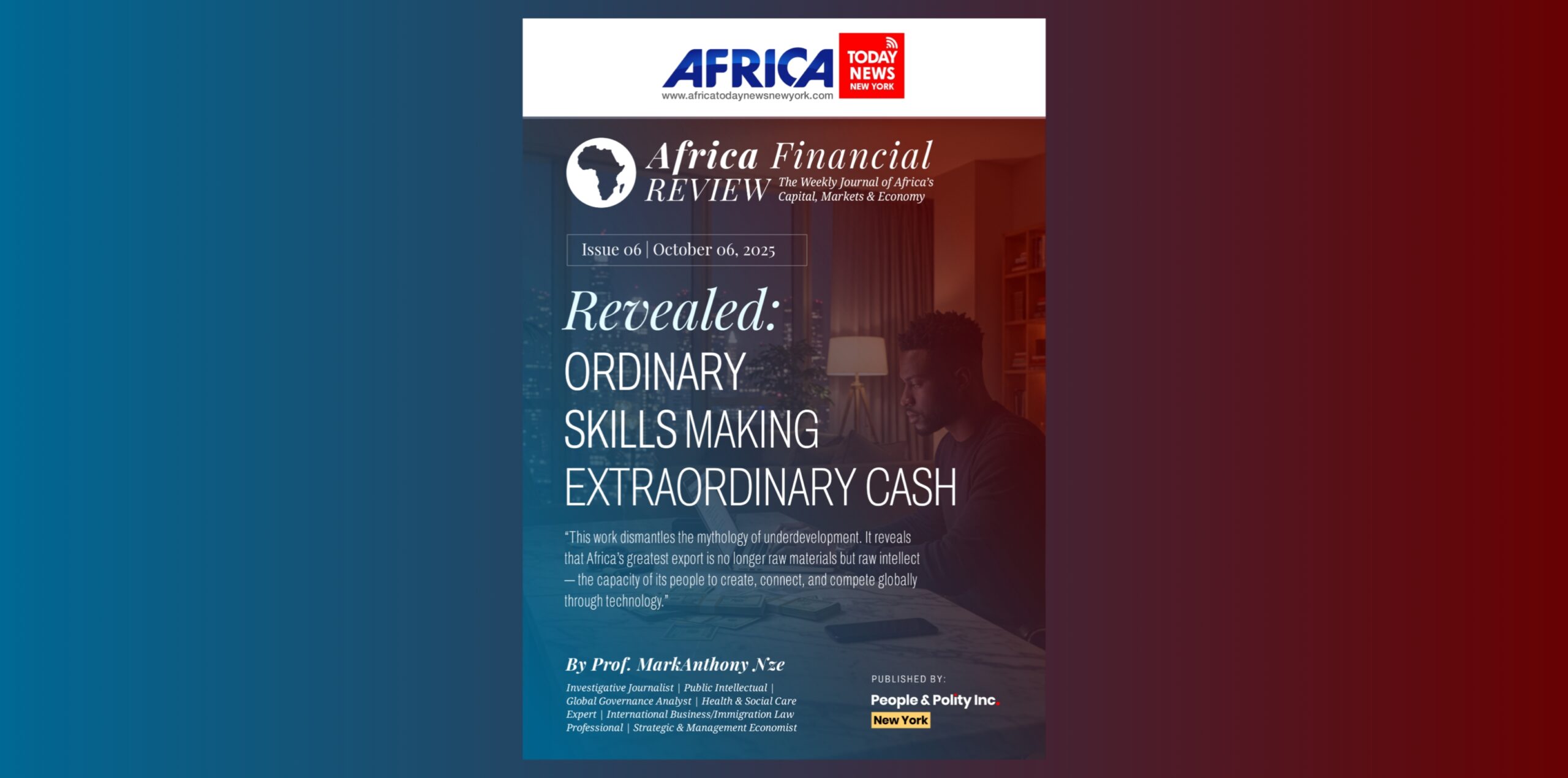
“This work dismantles the mythology of underdevelopment. It reveals that Africa’s greatest export is no longer raw materials but raw intellect — the capacity of its people to create, connect, and compete globally through technology.”
By Prof. MarkAnthony Nze
Investigative Journalist | Public Intellectual | Global Governance Analyst | Health & Social Care Expert | International Business/Immigration Law Professional | Strategic & Management Economist
Executive Summary
The future of work is no longer arriving — it has already begun, quietly and irrevocably, in living rooms, workshops, and Wi-Fi cafés around the world. Ordinary Skills, Extraordinary Cash captures the greatest transformation of the modern age: the shift from degrees to doing, from employment to empowerment, from local labor to global leverage.
Across six deeply researched essays, the series traces the rise of a new global class of self-directed workers — artisans, freelancers, creators, and digital entrepreneurs — who are redefining capitalism from the bottom up. It reveals that the next industrial revolution is not mechanical, but human; not driven by factories, but by skills.
Part 1, The Rise of the Everyday Millionaire, explores how the democratization of digital tools has transformed simple talents into scalable assets. It argues that the “skill economy” is the new frontier of wealth creation, where competence travels faster than capital and where education is measured not in diplomas but in deliverables.
Part 2, Hands That Build — The Blue-Collar Gold Rush, uncovers the renaissance of craftsmanship in a digital age obsessed with automation. As machines scale precision, humans rediscover purpose — turning manual skill into cultural capital and local artisans into global entrepreneurs.
Part 3, Clicks and Cashflow — The Digital Skill Explosion, examines the rise of the gig and freelance economies. It portrays millions of workers turning laptops into livelihoods, reshaping the very logic of labor. Here, geography dissolves, merit becomes measurable, and the internet emerges as the world’s largest employer.
Part 4, The Hustle Within — Mindset, Money, and Mastery, ventures into the psychology of resilience. It demonstrates that in an economy of uncertainty, the ultimate skill is self-mastery — the mental architecture that sustains creativity, focus, and financial independence. Work becomes an act of self-definition; discipline, the new wealth.
Part 5, Beyond Borders — How Global Platforms Empower Local Talents, analyzes how platforms such as Upwork, Fiverr, and LinkedIn have redefined globalization. Talent is no longer emigrating; it is uploading. Developing nations, once exporters of raw materials, are becoming exporters of intellect. A new form of sovereignty — digital sovereignty — is emerging, built on connectivity rather than territory.
Part 6, The Future of Work — From Degrees to Doing, closes the series by mapping the contours of the coming cognitive economy. Artificial intelligence, rather than replacing humanity, is renewing it. As machines automate the routine, humans are rediscovering the extraordinary — empathy, judgment, and imagination. The world is shifting from credential-based hierarchies to competence-based ecosystems, from linear careers to lifelong learning.
Across continents, a new social contract is forming — one in which education is perpetual, work is borderless, and purpose is personal. The future belongs not to the credentialed, but to the capable; not to the employed, but to the evolving.
What began as survival in a changing world has become sovereignty in a borderless one. In this quiet revolution of human skill and spirit, the greatest wealth is no longer inherited — it is learned, lived, and leveraged.