
A senior Azerbaijani official said Thursday that Azerbaijan and Armenia are living in a state of “real peace” and rebuilding trade ties after decades of conflict, but that Baku will not sign a final treaty until Armenia strips language from its constitution that Azerbaijan regards as a territorial claim.
Hikmet Hajiyev, an assistant to Azerbaijani President Ilham Aliyev and head of his foreign policy department, made the comments in an interview with Reuters on the sidelines of a forum in Shusha. He described the current relationship as genuine rather than merely declared on paper, pointing to growing direct contacts between the two governments and rising supplies of Azerbaijani oil products to Armenia.
The sticking point is the preamble of Armenia’s constitution, which references a Soviet-era declaration calling for the unification of Armenia with Nagorno-Karabakh, then an autonomous region inside Soviet Azerbaijan. Hajiyev said how Armenia removes that language is up to Yerevan, whether through a new constitution or another legal mechanism, but that the provisions themselves must go before a treaty can be signed. Aliyev made a similar demand at last year’s White House summit, saying a peace treaty could be signed “at any time” once Armenia’s constitution was amended accordingly.
Read also: Azerbaijan Jails Frenchman For 10 Years In Espionage Case
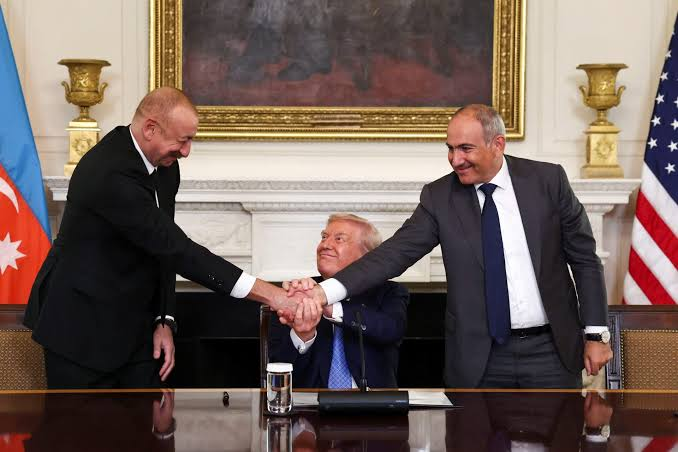
Nagorno-Karabakh had de facto independence under an ethnically Armenian administration for three decades before Azerbaijan retook the territory in a lightning offensive in September 2023, prompting most of its roughly 100,000 residents to flee to Armenia. The two countries had fought intermittently since the late 1980s over the mountainous enclave before reaching a preliminary, U.S.-brokered peace agreement at the White House on Aug. 8, 2025, when President Donald Trump hosted Aliyev and Armenian Prime Minister Nikol Pashinyan for the initialing of a 17-article draft treaty. Azerbaijan and Armenia jointly asked the OSCE that day to dissolve its Russia-led Minsk Group, the body that had mediated the conflict for decades; the OSCE formally closed the group weeks later, in September.
The same summit produced an agreement on the Trump Route for International Peace and Prosperity, a roughly 43-kilometer corridor that would cross southern Armenia to connect mainland Azerbaijan with its Nakhchivan exclave and, beyond it, Turkey. Under the arrangement, the corridor would remain Armenian sovereign territory governed by Armenian law, but Washington would hold exclusive development rights for 99 years, subleasing the land to a consortium expected to build rail, fiber-optic and pipeline infrastructure along the route. Hajiyev said Azerbaijan had received “serious and positive signals” from the United States that construction could begin this autumn, and that infrastructure on Azerbaijan’s side, in its southwestern Zangilan region, would be largely finished by the end of 2026, positioning it to connect with planned work in Armenia and Turkey. Alongside the corridor agreement, Azerbaijan’s state oil company SOCAR signed a memorandum of understanding with ExxonMobil, while Armenia struck a separate set of agreements with Washington on energy, transportation and artificial-intelligence cooperation under a program Yerevan has branded its “Crossroads of the World” initiative.
Read also: Azerbaijan Border Tensions: Four Armenian Soldiers Killed
Pashinyan has said he wants to hold a referendum on a new Armenian constitution, with a draft to be published by the end of this year. His Civil Contract party lacks the parliamentary supermajority needed to call that referendum on its own, and it remains unclear whether opposition lawmakers, many aligned with Russia, would support it. Hajiyev said publishing a draft would not be enough on its own to justify signing a peace deal.
The broader realignment has drawn criticism from several directions. Russia and Iran have both objected to Washington’s role in developing the transit corridor, calling it encroachment on a region they consider their sphere of influence. Aram Hamparian, executive director of the Armenian National Committee of America, has argued the peace framework legitimizes what he called Azerbaijan’s expulsion of Nagorno-Karabakh’s Armenian population without securing any right of return for those displaced.
A finished corridor would also compete with the existing Baku-Tbilisi-Kars railway through Georgia, which currently carries most regional freight; a 2026 European Commission study found the new Armenia route could cut travel times by as much as 25% compared with that line. Turkey, meanwhile, is building a new rail line linking the city of Kars to Dilucu on its border with Nakhchivan, intended to eventually connect into the corridor once construction on the Armenian and Azerbaijani sides is complete.