
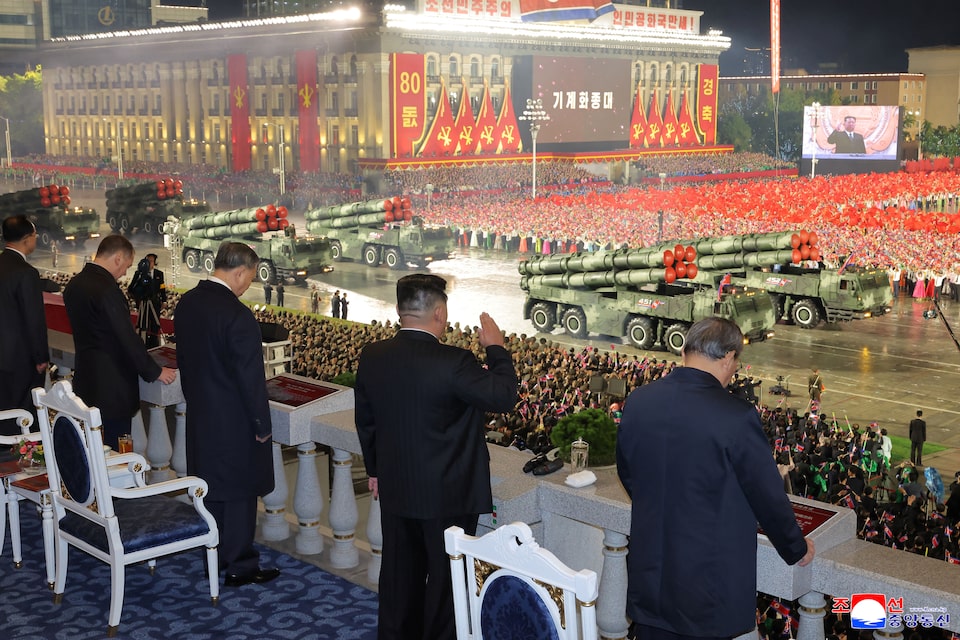
North Korea staged a high-profile military parade late Friday to mark the 80th anniversary of its ruling Workers’ Party, unveiling for the first time its new Hwasong-20 intercontinental ballistic missile (ICBM). Supreme Leader Kim Jong Un presided over the event, attended by foreign dignitaries including China’s Premier Li Qiang, Russia’s Dmitry Medvedev, and Vietnam’s Communist Party chief To Lam.
In unveiling the missile, state media KCNA described the Hwasong-20 as the country’s “strongest nuclear strategic weapon system.” The ICBM was mounted on an 11-axle launcher and displayed in a grand ritual of military might, flanked by troops and other advanced weapons including hypersonic missiles, cruise missiles, and drone launchers.
The Hwasong-20’s reveal shows North Korea’s ongoing push to advance its long-range nuclear delivery capabilities. ”The Hwasong-20 represents, for the moment, the apotheosis of North Korea’s ambitions for long-range nuclear delivery capabilities. We should expect to see the system tested before the end of this year,” said Ankit Panda of the Carnegie Endowment.
Despite the grand show, there are still uncertainties regarding the missile’s guidance precision and the ability of its warhead to survive atmospheric re-entry. But based on the parade and Kim Jong’s speech, there is a serious believe in it’s ability to carry out it’s task.
Read Also: Lecornu Returns As French PM After Macron’s Political Reset
Kim delivered a speech at the parade calling on the armed forces to become “an invincible entity that destroys all threats,” and he praised troops serving abroad, stating their heroism would extend beyond national defense to “outposts of socialist construction.” KCNA quoted him saying that the military should grow in discipline, political will, and technical strength.
The parade also served as a diplomatic stage. Earlier, Kim met with Dmitry Medvedev, who conveyed personal greetings from Russian President Vladimir Putin. According to KCNA, Medvedev asserted that the sacrifices of North Korean soldiers fighting alongside Russia in Ukraine reinforced the strength of the two nations’ alliance.
Kim responded by expressing his desire to deepen cooperation with Russia, emphasizing closer exchanges between the Workers’ Party and Russia’s United Russia party.
Simultaneously, Pyongyang announced agreements with Vietnam covering defense, foreign affairs, and health ministries, although official sources provided few details about the deals.