
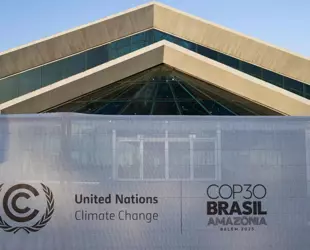
European Union environment ministers will make a final push Tuesday to rescue the bloc’s faltering climate leadership, racing to finalize emissions reduction targets before delegates descend on Brazil for UN climate talks next week.
“To come empty-handed to Belem would really undermine the EU’s credibility,” warned an EU diplomat, referring to the COP30 summit scheduled November 10-21. Negotiations among the 27 member states are expected to stretch deep into the night as capitals wrestle over two critical benchmarks: emissions cuts for 2035 and a more ambitious 2040 goal.
The urgency reflects how dramatically Europe’s political landscape has shifted. Once the undisputed climate leader among major economies—having already slashed emissions 37 percent below 1990 levels—the EU now finds environmental ambition colliding with right-wing electoral gains and anxiety over economic competitiveness and defense spending. Climate action, which dominated European politics just years ago, has been shunted aside.
Ministers face immediate pressure to unanimously approve a 2035 emissions target, known as a Nationally Determined Contribution, which Paris Agreement signatories are expected to present at the Brazil summit. Beyond that lies the heavier lift: securing weighted majority support for the European Commission’s July proposal to cut emissions 90 percent by 2040 compared to 1990 levels—a sweeping commitment en route to carbon neutrality by 2050.
That 2040 target, however, has sparked fierce resistance. Spain and Nordic countries back the plan, as does Germany with reservations. But Hungary, Poland, the Czech Republic and Italy remain opposed, arguing the timeline threatens their industrial bases with prohibitively expensive transformations at precisely the moment Europe faces economic headwinds and security challenges requiring massive defense expenditures.
Read also: EU, France Commit €10.2m To Bolster Nigeria’s Pharmaceutical
France, wielding enormous influence as the bloc’s second-largest economy, has kept its position deliberately ambiguous—drawing sharp criticism from environmental organizations. Paris has attached conditions to its support: guarantees that nuclear power wouldn’t be disadvantaged under green transition frameworks, dedicated funding for clean industries, and flexibility on emissions accounting should European forests absorb less carbon than climate models predict.
That list of French demands illustrates the deeper tension paralyzing EU climate policy. Member states increasingly view environmental targets through the lens of industrial competitiveness, fearing that aggressive decarbonization could drive energy-intensive manufacturing to countries with laxer standards—so-called carbon leakage that would harm European economies without reducing global emissions.
The political shift is unmistakable. Right-wing and far-right parties skeptical of climate regulation have gained ground across Europe, from Italy’s governing coalition to surging nationalist movements in France, Germany and the Netherlands. Those electoral results reflect voter anxiety about energy costs, deindustrialization, and the perceived economic sacrifices demanded by green transitions—concerns amplified by inflation and the Ukraine war’s disruption of energy markets.
The EU’s fourth-place global emissions ranking—behind China, the United States and India—gives it limited leverage in isolation. European officials have long argued the bloc’s role is demonstrating that wealthy economies can decarbonize without sacrificing prosperity, thereby proving the feasibility to larger emitters. But if Europe’s commitment wavers visibly, that demonstration effect collapses.
Arriving at COP30 without finalized targets would hand ammunition to countries resisting aggressive climate action, allowing them to argue that even Europe—historically the most committed major economy—is retreating from its pledges. That would undermine not just EU credibility but the broader architecture of international climate diplomacy, which depends on major economies setting ambitious examples.
Tuesday’s negotiations will test whether European capitals can compartmentalize competing priorities sufficiently to maintain climate leadership, or whether economic anxiety and political shifts have permanently relegated environmental ambition to secondary status. The outcome will signal how seriously the world’s developed economies still take the climate crisis amid mounting pressures to address more immediate concerns.