
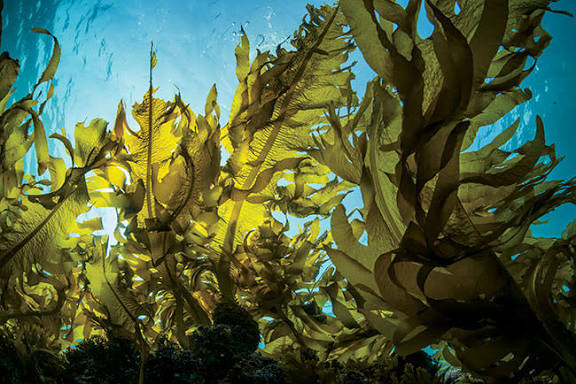
Pilot project off Norway’s Trøndelag coast, aims to capture CO₂ with fast-growing kelp, converting it to biochar for long-term carbon storage.
Off Norway’s Trøndelag coast, long lines of kelp are doing double duty: growing rapidly while capturing carbon from the atmosphere. A pilot farm near Frøya is testing whether this ancient crop can be transformed into a modern weapon against climate change.
The 20-hectare site, operated by the Joint Industry Project JIP Seaweed Carbon Solutions, holds up to 55,000 meters of kelp lines. First seedlings were planted last November 2024, with researchers aiming to demonstrate proof of concept before scaling operations. The project brings together SINTEF, DNV, Equinor, Aker BP, Wintershall Dea, and Ocean Rainforest, backed by a NOK 50 million ($4.9 million) budget.
After 8–10 months at sea, the initial harvest is expected to yield roughly 150 tons of kelp, which early estimates suggest could capture about 15 tons of CO₂. The project also tests converting harvested kelp into biochar, a process that stabilizes carbon for long-term storage and can improve soil quality on land.
Read Also: Zuckerberg’s Priscilla Leads $7B Mission To End Human
Norway’s history of seaweed cultivation stretches back to the 18th and 19th centuries, when kelp was used for fertilizer and feed. Modern techniques were developed in the 1930s, taking advantage of the country’s cold, nutrient-rich waters, which support species like Laminaria and Saccharina. The country’s well-established aquaculture sector provides expertise in scaling cultivation efficiently.
Commercial kelp farming in Norway received specific permits starting in 2014, and activity has expanded along several coastal counties. Scientists caution that large-scale operations carry risks, including genetic interaction with wild kelp, habitat disruption, disease, and space conflicts. Integrated Multi-Trophic Aquaculture, in which kelp grows alongside finfish farms, can recycle nutrients and reduce pressures on local ecosystems.
Looking ahead, engineers are developing offshore systems, such as the “Seaweed Carrier,” which allows kelp to move with waves in deeper waters. This design supports mechanical harvesting and industrial-scale output without occupying land, while also improving water quality by absorbing CO₂ and excess nutrients.
Though small in scale, the Frøya pilot links Norway’s kelp tradition with cutting-edge climate science. By combining fast-growing macroalgae, verified carbon accounting, and durable biochar storage, the project aims to create a replicable blueprint for ocean-based carbon removal—potentially offering a scalable solution to help nations meet climate targets.