
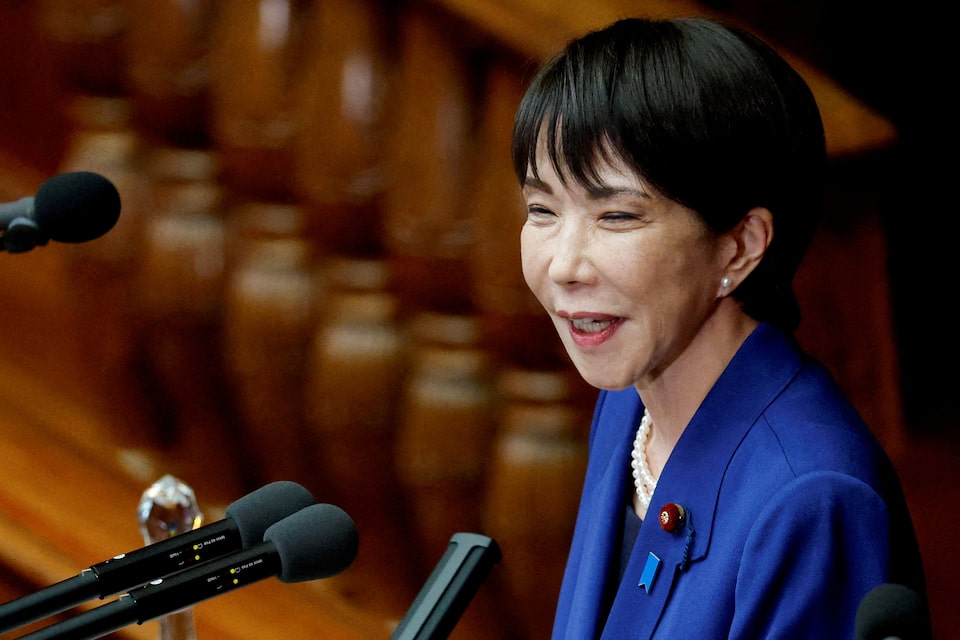
Japan moved on Monday to de-escalate a rapidly intensifying dispute with China after a comment by Prime Minister Sanae Takaichi about a potential Chinese attack on Taiwan prompted Beijing to issue a travel warning and launch a series of diplomatic protests.
The row began after Takaichi told lawmakers earlier this month that a Chinese assault on Taiwan that threatened Japan’s survival could trigger a Japanese military response. Her unusually direct statement broke with past administrations’ practice of avoiding public discussion of a Taiwan-related contingency in an effort not to provoke Beijing, which claims the self-ruled island as its territory.
In an effort to calm tensions, Masaaki Kanai, the Japanese foreign ministry’s top Asia and Oceania official, arrived in Beijing on Monday for talks with his Chinese counterpart, Liu Jinsong, according to footage published by Kyodo News.
Kanai is expected to reiterate that Japan’s security policy has not changed and urge Beijing to avoid steps that further strain bilateral ties, Japanese media reported.
Chief Cabinet Secretary Yoshimasa Hayashi told reporters that communication channels with China “remain open,” adding that Tokyo had formally asked Beijing to take “appropriate steps” in light of its travel warning. He said the advisory was inconsistent with Japan’s efforts to maintain “strategic, mutually beneficial” relations.
Read Also: Japan Taiwan Defense Poll: Public Split On Military Response
China signaled no easing of pressure ahead of this week’s G20 summit in South Africa. The Chinese foreign ministry said Premier Li Qiang has no plans to meet Takaichi on the sidelines.
Instead, spokesperson Mao Ning demanded that Japan retract what she called the prime minister’s “wrongful” remarks.
Taiwan President Lai Ching-te, speaking in New Taipei, accused Beijing of mounting a “multifaceted attack” on Japan. He urged the international community to monitor the situation and called on China to “exercise restraint and demonstrate the conduct befitting a major power.”
Analysts say the dispute is unlikely to resolve quickly. Kenji Minemura, a senior research fellow at the Canon Institute for Global Studies, said China knows Takaichi cannot withdraw her comment. “Its call for one isn’t to get a resolution, but to ramp up pressure on Japan,” he noted.
Tensions have risen steadily since Takaichi made the remark on November 7, shortly after meeting Chinese President Xi Jinping to discuss stabilizing ties. The following day, China’s consul general in Osaka, Xue Jian, wrote in a now-deleted post on X that “the dirty neck that sticks itself in must be cut off.”
Japan summoned China’s ambassador to protest the message, calling it “extremely inappropriate,” while several Japanese lawmakers urged Xue’s expulsion.
China then escalated the dispute by summoning Japan’s ambassador for the first time in more than two years to file a “strong protest.” On Friday, Beijing warned that Japan would suffer a “crushing” military defeat if it intervened over Taiwan and expressed “serious concerns” about Japan’s defense posture, including perceived ambiguity over its long-standing three non-nuclear principles.
The diplomatic strain has been accompanied by a rise in maritime and aerial activity around disputed areas. On Sunday, Chinese coast guard vessels sailed near the Senkaku/Diaoyu Islands, a contested East China Sea chain controlled by Japan. Tokyo said its coast guard repelled the ships.