
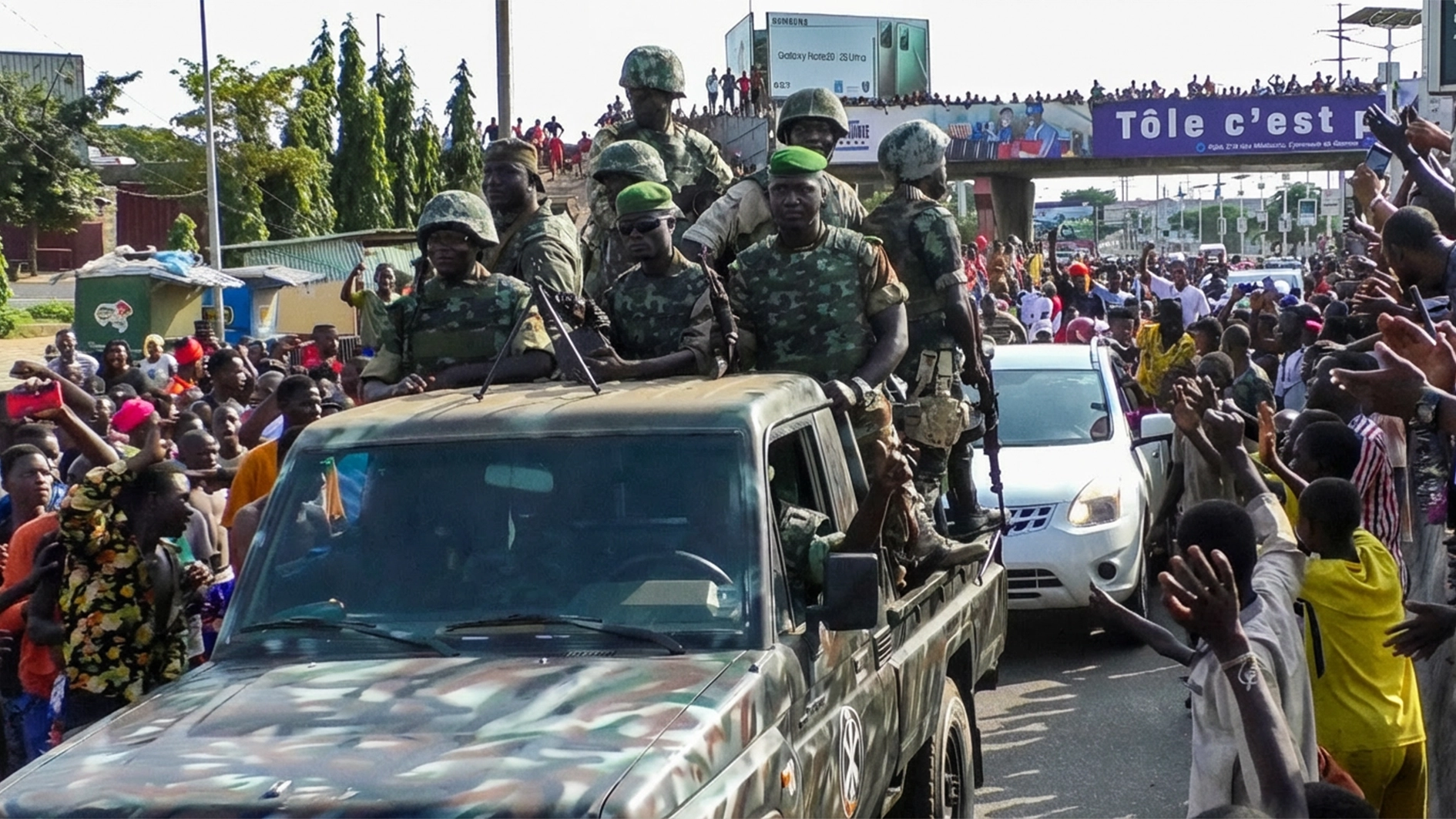
Nigeria deployed fighter jets and ground troops to neighboring Benin on Monday after a failed coup attempt, moving quickly to help restore order and prevent instability from spreading across a region already grappling with jihadist violence and political upheaval.
The operation marks Nigeria’s first foreign military intervention in nearly a decade and reflects Abuja’s concern that a hostile military regime in Benin could fuel cross-border insecurity along one of West Africa’s most critical trade corridors.
President Bola Tinubu ordered Nigerian jets into Benin’s airspace on Sunday as Benin’s leader, Patrice Talon, sought to suppress what officials described as an attempted takeover by a small faction of soldiers. Tinubu’s office said the deployment involved surveillance flights and rapid-response missions coordinated directly with Benin’s security forces.
The mission is expected to expand with support from Sierra Leone, Ivory Coast, and Ghana, operating under the regional bloc ECOWAS, officials said.
Nigeria last intervened militarily abroad in 2017, when ECOWAS forces pressured Gambian leader Yahya Jammeh to step down after losing an election. That operation ended without combat as Jammeh agreed to leave power.
While Nigeria has responded more cautiously to recent coups in Mali, Burkina Faso, and Niger, analysts say Benin is a different case entirely.
Benin shares a long, porous border with Nigeria, including areas repeatedly targeted by Islamist militants. For Abuja, a collapse of civilian authority in Cotonou risked pushing insecurity, arms trafficking, and criminal networks directly into southwestern Nigeria, a region central to the country’s economy.
“Benin and Nigeria share a long, porous border and extensive economic interdependence,” said Mucahid Durmaz, senior Africa analyst at Verisk Maplecroft. “A military coup and potential collapse of state order in Benin risk triggering cross-border insecurity… potentially destabilizing the southwest region, which the Nigerian economy is heavily reliant on.”
Durmaz added that a junta in Benin would leave Nigeria “surrounded by hostile and unpredictable neighbours,” following a wave of putsches that has reshaped West Africa’s political map since 2020.
Northern Benin has faced escalating militant violence in recent years, despite the government’s launch of Operation Mirador in 2022, which deployed thousands of troops to the borders with Nigeria, Niger, Burkina Faso and Togo.
Major jihadist attacks in January and April killed dozens of Beninese soldiers, contributing to deepening national anxiety about security. The coup plotters cited that insecurity as justification for their attempted takeover.
For Nigeria, however, any military-led government in Cotonou risked opening the door to further instability—and undermining the region’s already fragile counterterrorism efforts.
Read Also: Supreme Court FTC Firing Case Signals Major Power Shift
ECOWAS leaders have urged calm and pledged coordinated action to prevent further unrest. Officials in both Abuja and Cotonou say the situation remains under control, but security forces continue operations to ensure no renewed attempt at destabilizing the government.
The intervention underscores the growing pressure on West African states as they confront overlapping crises: rising militancy, weakening democratic institutions, and political tensions that have contributed to a surge in coups since 2020.