
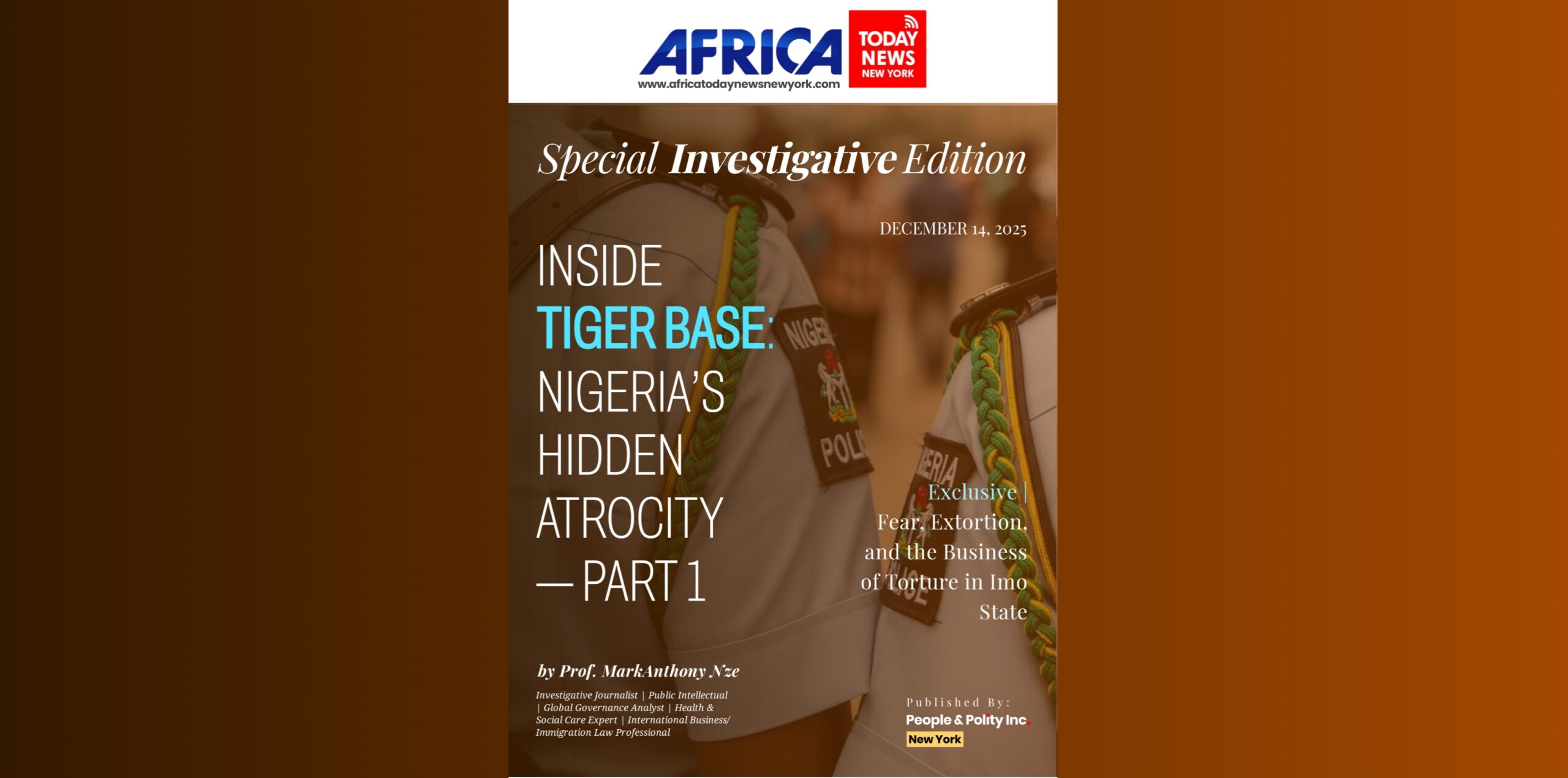
A dawn raid in Nempi village reveals how a police unit sworn to protect turned into a marketplace of fear, where citizens vanish into silence and reappear only as ransoms or corpses.
Before sunrise in Nempi village, the sound of engines broke the calm. A convoy of unmarked Hilux vans rolled through the red dust road, headlights off, tires whispering over gravel. Within minutes came the pounding on doors and the shouts that every family in this part of Imo State has learned to dread: “Open! Tiger Base!”
It happened just before five in the morning. By daylight, nine men were missing. Their phones lay scattered in the mud. The officers wore no name tags, no badges, only the black tactical vests of the Anti-Kidnapping Unit. In Nempi, that name no longer means protection. It means disappearance.
This was not an isolated raid. It was one frame in a long film of fear, a pattern of predawn operations across Imo State where police arrive without warrants, seize young men, and drive them toward Owerri. No record, no statement, no charge. Only the gate at the end of the road: a rusted wall of iron behind which, survivors say, people stop being citizens and start being currency.
The Taking
At the center of Nempi’s raid was a 29-year-old mechanic, here called Chuka. He had spent the evening watching football on a neighbor’s television. “They came from nowhere,” he recalled later. “One kicked me, another hit me with his gun. They said, ‘You will explain at Tiger Base.’ I asked what I did. They said, ‘You breathe.’”
Chuka and eight others were shoved into a van. After half an hour, they reached a compound that smelled of diesel and decay. The gate bore a faint tiger’s head, half peeled by rust. “I had seen it in pictures online,” he said quietly. “That’s when I knew we were finished.”
Inside the Compound
Tiger Base is hidden in plain sight — a low, gray compound wedged between mechanic workshops and warehouses on Port Harcourt Road. From outside, it looks abandoned. Inside, it functions as a detention and extortion center.
Former detainees describe three small cells, each no larger than a shop. Every cell holds up to eighty people, bodies pressed so tightly that men sleep crouched against one another. Buckets overflow, the stench thick enough to choke. Air hardly moves. “The walls sweat,” said one survivor. “People faint and are stepped on until they stop moving.”
There are no charge sheets, no lawyers, no formal interviews. The only question that matters is financial: Who can pay for you?
The Currency of Freedom
What happens next follows a methodical script. Detainees are told the amount required for release. The figures vary with their appearance, their accent, their perceived worth. A trader pays more than a laborer, a driver more than a student. Payments are made through Point-of-Sale machines operated by women in uniform inside the compound. Cash only, no transfers.
A man from Amagu, detained during a funeral raid, said his family sold land to meet the demand. “They asked for eight hundred thousand,” he told us. “We begged until they took six hundred. When I left, they said, ‘If you talk, we’ll collect you again.”
Every survivor interviewed described the same structure: arrest without record, detention without charge, payment without receipt. What the state calls bail has become ransom dressed in bureaucracy.
Read also: Inside Tiger Base: Nigeria’s Hidden Atrocity—Intro
The Machinery of Pain
Torture is not punishment here; it is negotiation. Detainees are beaten to collapse, revived, and beaten again. Plastic bags are pulled over faces. Electric cables snap against flesh. Those who resist are hung from rods or made to kneel until their legs lock. Each blow is followed by the same words — “Talk or pay.”
A detainee named Ifeanyi remembered a man who refused to confess to kidnapping. “They tied him to a pipe. He said he was innocent. They kept beating until he was still. The next day, his body was gone.”
Former inmates said deaths inside the cells are treated as logistical problems. Bodies are carried out before dawn, sometimes photographed to support stories of “fights” or “rescue attempts.” No official record follows. “We counted two deaths a week,” Ifeanyi said. “After a while, we stopped counting.”
The Shadow of Authority
Among the testimonies, one figure recurs, a man the detainees call Kill and Bury. Some describe him as tall, others as heavyset, his face often covered. The Nigeria Police Force has not confirmed his existence. Yet every survivor speaks of him as the embodiment of Tiger Base’s violence. “When he walks in, even the officers go quiet,” said Chuka. “He decides who leaves and who dies.”
Whether Kill and Bury is one man or many, the name has become a symbol. It represents the collapse of distinction between policing and predation, between law and cruelty. Inside Tiger Base, fear has been refined into process.
A Village in Waiting
Weeks after the raid, Nempi remains haunted by absence. The families of the missing keep money ready in case word arrives. They whisper about contacts inside the city who can “speak to the officers.” Mothers visit the gate every Sunday with food parcels no one accepts.
“We used to fear armed robbers,” said a local youth leader. “Now we fear the ones who say they protect us.”
Petitions have been sent to the police commissioner and to Abuja. None have been acknowledged. One elder who tried to speak at a local radio station was visited by plainclothes officers and warned to “avoid security matters.”
Official Narrative
When questioned, the Imo State Police spokesperson stated that the Anti-Kidnapping Unit “handles only major criminal cases” and denied reports of unlawful detention. In response to public criticism, journalists were once shown parts of the facility during an officially arranged visit, where officers displayed empty cells and freshly cleaned floors.
Several men interviewed for this investigation, who were released around that period, insisted they had been held in the same building. The contradiction between public presentation and private testimony underscores the opacity that surrounds Tiger Base — a secrecy that has allowed it to endure beyond scrutiny.
The Uncounted
In Owerri’s central morgue, attendants recall police trucks arriving after midnight with bodies marked “suspect.” Paperwork is minimal; identification, nonexistent. Families searching for missing sons sometimes recognize a shoe or a shirt but are told the files are sealed. The dead of Tiger Base leave no official trace, only whispers carried back to the villages.
One mother, her face thin from waiting, still visits the gate where her son vanished. “They told me he was sick,” she said. “If he is dead, I want to see him. Even if it’s just his hand.”
The Gate Itself
The gate of Tiger Base is more than metal and rust. It is the border between state and void. Every person taken through it enters a place where law is suspended, where confession is currency, and where truth is negotiated like a commodity. For those who emerge, freedom comes with silence — the first condition of survival.
In Nempi, the echo of that morning still shapes how people live. They no longer gather at night. They no longer trust uniforms. The line between safety and capture has blurred into rumor.
What began as a dawn raid has become a parable of power without accountability. The gate remains, unmoved, its tiger emblem fading into iron. It stands as both entrance and warning — the point where the state consumes its own citizens and calls it law.
Professor MarkAnthony Ujunwa Nze is an internationally acclaimed investigative journalist, public intellectual, and global governance analyst whose work shapes contemporary thinking at the intersection of health and social care management, media, law, and policy. Renowned for his incisive commentary and structural insight, he brings rigorous scholarship to questions of justice, power, and institutional integrity.
Based in New York, he serves as a full tenured professor and Academic Director at the New York Center for Advanced Research (NYCAR), where he leads high-impact research in governance innovation, strategic leadership, and geopolitical risk. He also oversees NYCAR’s free Health & Social Care professional certification programs, accessible worldwide at:
👉 https://www.newyorkresearch.org/professional-certification/
Professor Nze remains a defining voice in advancing ethical leadership and democratic accountability across global systems.