
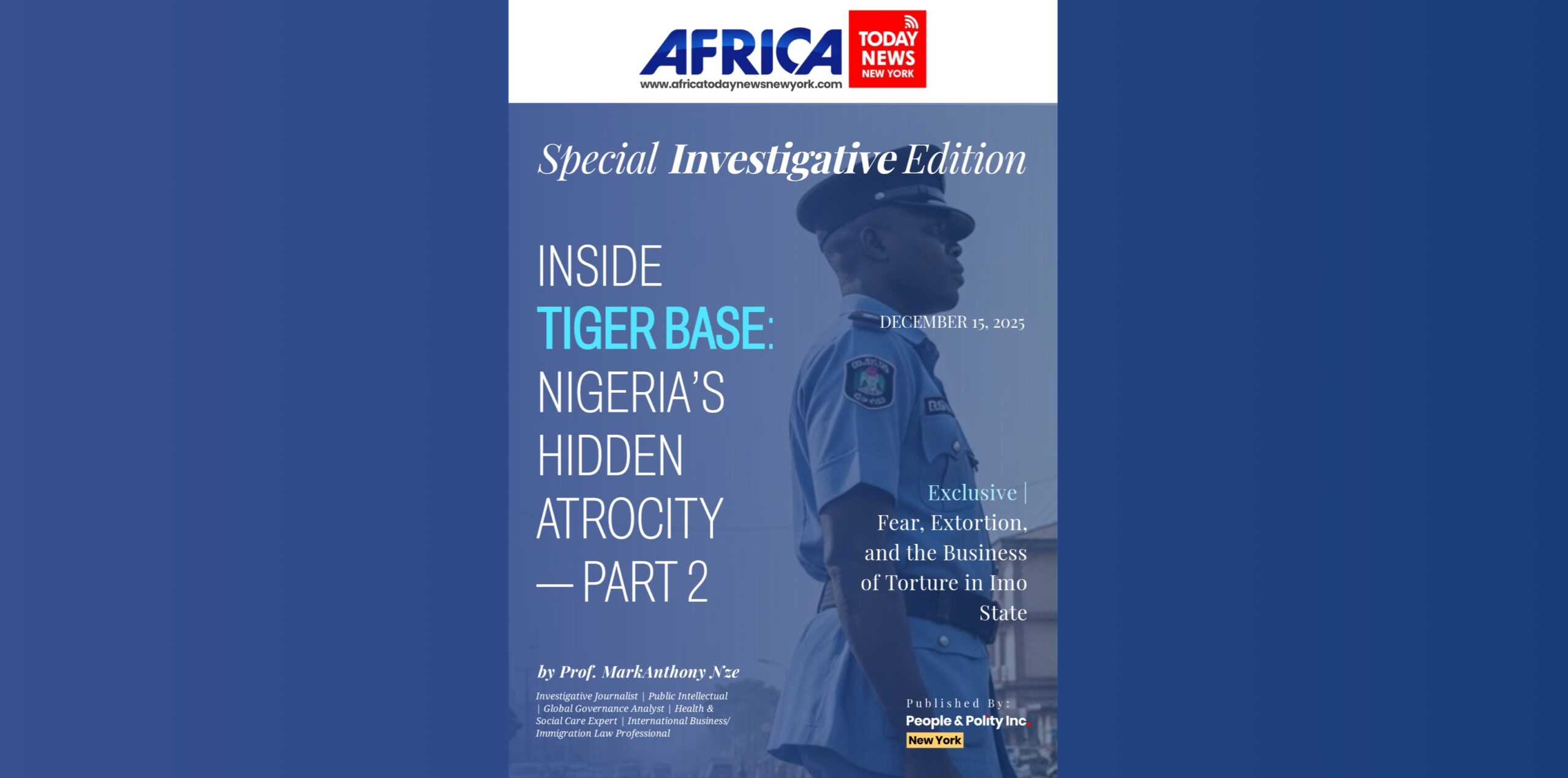
Inside the economy of extortion where the price of life is calculated in naira and silence, and the state’s own police have turned justice into commerce.
By Prof. MarkAnthony Nze
In the dark corridors of Tiger Base, freedom is not earned — it is bought. Every conversation, every plea, every scream eventually narrows to one phrase: “Call your people.” That command is not mercy; it is the beginning of negotiation. What follows is not a legal process but a financial one. The gate may carry the emblem of law, but inside, the law has been repurposed into business.
The Currency of Captivity
Former detainees describe a hierarchy of survival built entirely on money. Within hours of arrest, an officer arrives to take “details.” A notebook appears, not a charge sheet. Next to each name, a figure is penciled in, a ransom disguised as bail. The range runs from sixty thousand to two million naira, the price depending on how desperate or resourceful the family seems.
A woman from Awo Omamma said her husband’s amount changed three times. “They started with one million,” she said. “When I cried, they said, ‘Fine, bring eight hundred.’ The next day, they said six hundred. It was like bargaining for tomatoes.”
In this system, poverty is not protection; it is punishment. Those who cannot pay are beaten or left to rot in cells too crowded for sleep. One detainee, who spent ten days inside, described how a man beside him begged for food and water until his voice failed. “They said his people didn’t have money,” he recalled. “He stopped talking two days later.”
The Women with the Machines
Testimonies from multiple survivors converge on a single image: women in plain clothes seated near the compound gate, operating Point-of-Sale machines on plastic tables. They handle the payments, record the amounts, and relay messages to the officers inside. “When your family pays,” said a young man from Oguta, “the woman nods, and you hear your name shouted. That’s when you know you will see daylight again.”
These women, witnesses say, act with the calm precision of bank clerks. They count cash, swipe cards, issue no receipts, and send no messages afterward. Their presence gives the process a chilling normality — as though an entire bureaucracy has been built around illegality.
A System That Feeds Itself
Interviews with families across Imo State suggest that Tiger Base’s operations have become self-funding. Officers collect daily “returns” from payments made by detainees. Some money stays within the unit, while the rest moves upward. A retired police officer familiar with the command structure said, under condition of anonymity, that “everybody eats.”
“It’s not random,” he explained. “They know who to arrest and when. The ones who pay fast are marked as good targets for next time. Those who make noise are left inside until they learn sense.”
The same source described the use of intermediaries who pose as lawyers or police liaisons. “You will get a call,” he said. “‘I can help your son if you send money.’ The money always finds its way back to the base. It’s a machine that runs on fear.”
Read also: Part 1: The Gate Of No Return
The Theater of Torture
Extortion and violence are two sides of the same transaction. Beating is not only punishment; it is persuasion. “They make you scream on the phone so your people hear you,” said one former detainee. “Then they say, ‘You hear him? Bring the money now.’”
Others described a deliberate display of suffering — detainees lined up for inspection, some bleeding, some half-conscious, while officers taunt them about the cost of release. “They told one man, ‘If your family delays, you’ll go home in a sack,’” said another survivor. “He was dead the next morning.”
In this economy, pain is product and fear is leverage. The transaction is complete only when the body — alive or dead — proves payment or disobedience.
The Families Who Pay
In Nempi and surrounding towns, the community now keeps money hidden for emergencies. Mothers bury cash under beds, fathers sell tools and land. “We used to save for school fees,” said a widow whose son was arrested while returning from work. “Now we save for bail.”
The human toll is unrecorded but visible. Houses are sold, farms abandoned, children withdrawn from school to settle debts. Whole villages live on credit extended by fear. A youth leader in Oguta called it “a second taxation, and this one collected with guns.”
The Silence Clause
Everyone who leaves Tiger Base leaves with a warning. Survivors recall being told not to speak, not to post online, not to complain. “They said, ‘You are lucky. If we hear your name again, you’ll vanish properly,’” one man recounted. Many take the threat seriously. Families erase call logs, change phone numbers, and avoid journalists. The silence is part of the system; it ensures the next round of arrests goes uncontested.
Official Denial
When presented with detailed testimonies, the Imo State Police spokesperson dismissed them as “fiction.” He insisted that the Anti-Kidnapping Unit “does not engage in financial transactions” and that “no female operators or POS machines exist at Tiger Base.” Yet the descriptions gathered from detainees in different months, interviewed independently and in separate towns, are identical — the same setting, the same procedure, the same outcome.
The contradiction between official denial and lived reality reveals the essence of Tiger Base: it survives not because people believe in it, but because they are too afraid to challenge it.
The Economics of Fear
Every institution that operates outside oversight becomes its own economy. Tiger Base is not an anomaly; it is a mirror of a broader collapse where enforcement becomes enterprise. The officers’ salaries may be low, but the income from extortion is constant. It funds comfort for some and terror for many.
An economist at a university in Owerri, speaking off record, called it “a privatized form of policing.” He explained, “When the state underfunds justice, the enforcers fund themselves. The citizen becomes the raw material. The unit’s sustainability depends on perpetual crime — real or invented.”
The Human Equation
For those who pass through Tiger Base, release does not mean freedom. It means debt, trauma, and silence. A young trader who paid ₦400,000 for his brother’s release said the money was borrowed from five people. “We are still paying back,” he said. “We bought him alive, but we sold our lives to do it.”
Many former detainees cannot sleep through the night. Some move away from Imo entirely. Others stay but avoid police checkpoints and markets after dusk. “I cross the road when I see a van,” said one. “You never stop being a target once you’ve paid.”
The Ledger of the Damned
Among survivors, there is talk of a notebook — a physical ledger kept by officers where names and payments are recorded. None has been seen publicly, but too many people describe hearing their ransom amount quoted back with precision. “They said, ‘Your brother is five hundred,’” one woman recalled. “I asked how they knew. They said, ‘We have the book.’”
Whether the ledger exists or not, its shadow governs the lives of thousands. In it, every citizen is a potential entry, every payment a confirmation that the system works.
Closing Reflection
Tiger Base operates like a business because it is one. It trades in fear, pain, and survival. Its profit is measured in silence — the silence of victims who cannot afford to speak and the silence of authorities who choose not to listen.
What began as a police mission against kidnappers has become an industry of its own. Inside its walls, justice is priced, life is negotiable, and death is paperwork waiting to be filed.
Tomorrow’s part will examine the figure at the center of this machinery, the man detainees call Kill and Bury — the human face of Tiger Base’s cruelty, and the symbol of how impunity acquires a name.
Professor MarkAnthony Ujunwa Nze is an internationally acclaimed investigative journalist, public intellectual, and global governance analyst whose work shapes contemporary thinking at the intersection of health and social care management, media, law, and policy. Renowned for his incisive commentary and structural insight, he brings rigorous scholarship to questions of justice, power, and institutional integrity.
Based in New York, he serves as a full tenured professor and Academic Director at the New York Center for Advanced Research (NYCAR), where he leads high-impact research in governance innovation, strategic leadership, and geopolitical risk. He also oversees NYCAR’s free Health & Social Care professional certification programs, accessible worldwide at:
👉 https://www.newyorkresearch.org/professional-certification/
Professor Nze remains a defining voice in advancing ethical leadership and democratic accountability across global systems.