
The Record Exists: What U.S. Justice Opened, and Never Finished
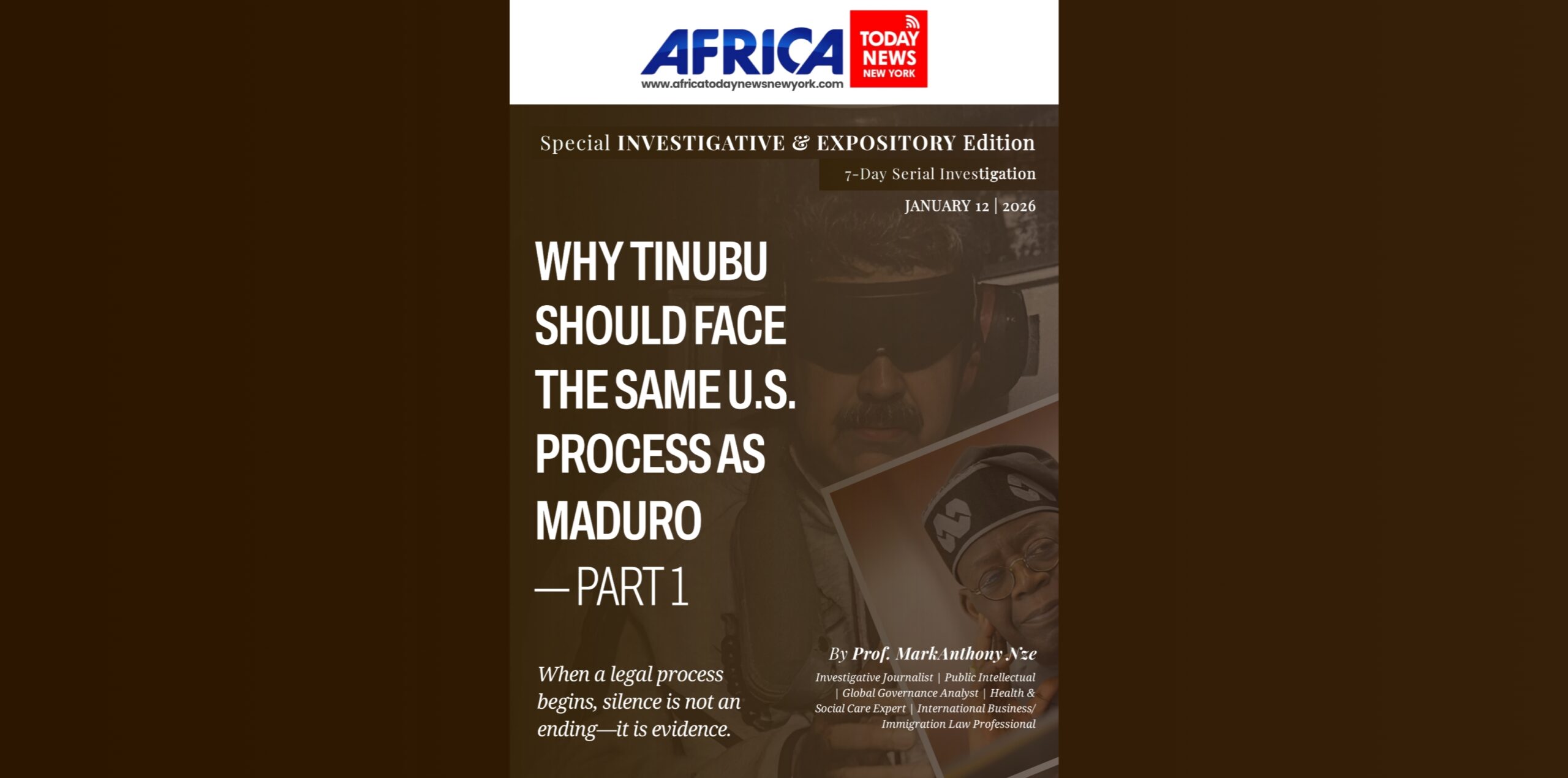
When a legal process begins, silence is not an ending—it is evidence.
The American legal system does not whisper when it acts. It leaves paper. It invokes statutes. It assigns docket numbers and submits sworn declarations under penalty of perjury. Power, in the United States, is expressed procedurally. Authority becomes real not through rumor or reputation, but through filings—complaints verified by federal agents, reviewed by prosecutors, and supervised by judges.
That is why this investigation begins with a fact that does not depend on interpretation, ideology, or political allegiance: a formal U.S. legal record exists in which federal authorities invoked civil forfeiture and federal money-laundering statutes in connection with Bola Ahmed Tinubu. That record was not produced by journalists, activists, or political rivals. It was generated by the United States government itself, in a federal court, through sworn pleadings asserting probable cause.
Once such a record exists, the debate fundamentally changes. The question is no longer whether allegations were made in the public sphere. The question becomes whether the legal process triggered by those allegations was allowed to complete itself—or was quietly arrested without explanation.
What It Means When the U.S. Asserts Probable Cause
In American law, “probable cause” is not rhetorical language. It is a constitutional threshold. It is the same standard that authorizes arrests, searches, seizures, and indictments across the federal system (U.S. Courts, 2022). When federal authorities assert probable cause in a verified complaint, they are declaring—formally and under oath—that they possess sufficient evidence to justify state action.
Civil forfeiture exists precisely for such moments. It is an early enforcement tool, designed to allow the government to seize assets believed to be connected to serious criminal conduct, including narcotics trafficking and money laundering, even when a criminal prosecution is still developing (Department of Justice [DOJ], 2023). Far from being marginal, forfeiture is often the first visible manifestation of a deeper criminal inquiry.
Crucially, probable cause does not require proof beyond a reasonable doubt. It does not establish guilt. But it does establish legitimacy of suspicion. And once asserted, it imposes procedural obligations on the state.
The 1993 Forfeiture Filing: Initiation, Not Closure
In 1993, federal authorities filed a civil forfeiture complaint in the Northern District of Illinois asserting that funds held in U.S. bank accounts were connected to narcotics trafficking and/or involved in financial transactions prohibited under federal money-laundering statutes. The complaint named accounts associated with Bola Tinubu and relied on statutes that form the backbone of U.S. anti-narcotics financial enforcement.
This point matters because statutes are not decorative. When prosecutors invoke them, they activate a defined legal architecture—one with expectations, escalation pathways, and endpoints. The filing did not convict Tinubu. It did not indict him. It did not pronounce criminal liability. Civil forfeiture is intentionally narrower than criminal prosecution; it targets property, not people (Carpenter et al., 2021).
But narrow does not mean inconsequential. Forfeiture is not an ending. It is a beginning.
How Forfeiture Is Supposed to End
Once initiated, a forfeiture action ordinarily moves toward resolution in one of several ways. The property may be forfeited uncontested. A claimant may challenge the seizure, forcing judicial adjudication. The government may dismiss the action, typically with a stated rationale. Or the matter may escalate into a criminal investigation, feeding into grand jury proceedings and potential indictments (DOJ, 2023).
What unites these outcomes is traceability. Even dismissal leaves fingerprints: docket entries, stipulations, court orders, or formal declinations. In the U.S. system, the process leaves a record.
In the Tinubu forfeiture matter, publicly available records do not show a clear terminal event resolving the action on the merits. There is no publicly documented judicial opinion explaining closure. No transparent declination memo. No visible bridge between forfeiture and criminal review. Instead, the trail appears to fade.
A stall is not a conclusion. It is a condition.
Read also: Why Tinubu Should Face The Same U.S. Process As Maduro—Intro
Why Unfinished Process Is Not Neutral
In law enforcement, an unfinished process is not an empty space. It has consequences.
First, it weakens deterrence. Financial-crime enforcement relies on predictability. When forfeiture is initiated but never transparently resolved, the signal sent is not about legality—it is about insulation (Office of the Inspector General, 2021).
Second, it corrodes institutional credibility. The United States promotes its anti-money-laundering regime as a global standard. That claim depends on consistency, not rhetoric (Transparency International, 2022).
Third, silence invites politicization. Where institutions refuse to explain, narratives fill the vacuum. Journalism’s role is not to speculate, but to force explanation—to insist that law account for its own behavior.
A Modern Court Reopens an Old Silence
Decades later, this unresolved history re-entered the legal system through a Freedom of Information Act (FOIA) lawsuit. When asked to confirm whether investigative records relating to Tinubu existed, federal agencies—including the FBI and DEA—responded with Glomar responses, refusing to confirm or deny (Electronic Privacy Information Center, 2023).
Glomar responses are extraordinary. Courts treat them cautiously because they represent one of the most extreme forms of administrative secrecy. In 2025, a U.S. district judge rejected the government’s attempt to maintain that silence, ordering the agencies to lift their Glomar responses.
The ruling did not determine what the records contain. It did something more fundamental: it affirmed that the inquiry itself is legitimate—that the existence and handling of these records is a live legal question, not a settled historical footnote (Pozen, 2019).
That judicial intervention matters. It places this issue firmly in the present.
Comparison as Method, Not Accusation
To understand why this matters, comparison is unavoidable—not as accusation, but as a method.
When the United States decides to pursue a foreign political figure aggressively for narcotics-related conduct, it does not rely on unresolved administrative actions. It files indictments. It unseals charges. It publishes arrest warrants. The handling of Nicolás Maduro demonstrates what full activation of the U.S. criminal process looks like: a clear procedural arc from investigation to indictment to public prosecution (DOJ, 2020).
The divergence between Maduro’s case and Tinubu’s is not a moral argument. It is a mechanical one. One produced public law. The other produced silence.
No special statute separates the two. The same money-laundering and narcotics laws apply. The difference lies not in law, but in application.
Discretion Has Boundaries
Prosecutorial discretion allows prioritization. It does not authorize disappearance.
American courts have consistently recognized that discretion must operate within visible boundaries. When decisions not to prosecute are made, they are ordinarily documented, especially where formal enforcement actions have already been taken (Shiner, 2018). Opaque abandonment—particularly in cases touching political power—raises a different question: not whether discretion was exercised, but whether exemption was granted.
That is the core tension here.
What This Part Establishes, and What It Does Not
This part does not argue criminal guilt. Courts do that. It establishes something narrower, more defensible, and more troubling: that U.S. legal process was initiated through sworn filings alleging narcotics-linked financial conduct, and that its public resolution remains unexplained.
In systems governed by law, initiation creates obligation. Silence does not erase it.
Part 2 will examine the forfeiture complaint itself as a forensic document—its language, its statutory architecture, and what it reveals about how seriously federal authorities once treated the matter. Only by understanding the law precisely can we assess whether equal process was withheld—or whether divergence can be justified under legal standards.
Because before justice can be accused of bias, it must first be understood.
Professor MarkAnthony Ujunwa Nze is an internationally acclaimed investigative journalist, public intellectual, and global governance analyst whose work shapes contemporary thinking at the intersection of health and social care management, media, law, and policy. Renowned for his incisive commentary and structural insight, he brings rigorous scholarship to questions of justice, power, and institutional integrity.
Based in New York, he serves as a full tenured professor and Academic Director at the New York Center for Advanced Research (NYCAR), where he leads high-impact research in governance innovation, strategic leadership, and geopolitical risk. He also oversees NYCAR’s free Health & Social Care professional certification programs, accessible worldwide at:
https://www.newyorkresearch.org/professional-certification/
Professor Nze remains a defining voice in advancing ethical leadership and democratic accountability across global systems.
Selected Sources (APA 7th Edition)
Carpenter, D. M., Knepper, L., Erickson, A., & McDonald, J. (2021). Policing for profit: The abuse of civil asset forfeiture (3rd ed.). Institute for Justice. https://ij.org/report/policing-for-profit-3/
Department of Justice. (2020). Justice Department announces charges against Nicolás Maduro and other Venezuelan officials. https://www.justice.gov/opa/pr/justice-department-announces-charges-against-nicolas-maduro
Department of Justice. (2023). Asset forfeiture policy manual. https://www.justice.gov/afp/asset-forfeiture-policy-manual-2023
Electronic Privacy Information Center. (2023). Glomar responses and FOIA litigation. https://epic.org/issues/open-government/glomar/
Office of the Inspector General. (2021). Audit of the Department of Justice asset forfeiture program. https://oig.justice.gov/reports/audit-department-justice-asset-forfeiture-program
Pozen, D. E. (2019). Freedom of information beyond the Freedom of Information Act. University of Pennsylvania Law Review, 165(5), 1097–1158. https://scholarship.law.upenn.edu/penn_law_review/vol165/iss5/1/
Shiner, R. A. (2018). Prosecutorial discretion and its limits. American Criminal Law Review, 55(2), 467–512.
Transparency International. (2022). Exporting corruption: Enforcement of foreign bribery laws. https://www.transparency.org/en/publications/exporting-corruption-2022
U.S. Courts. (2022). Probable cause. https://www.uscourts.gov/glossary/probable-cause