
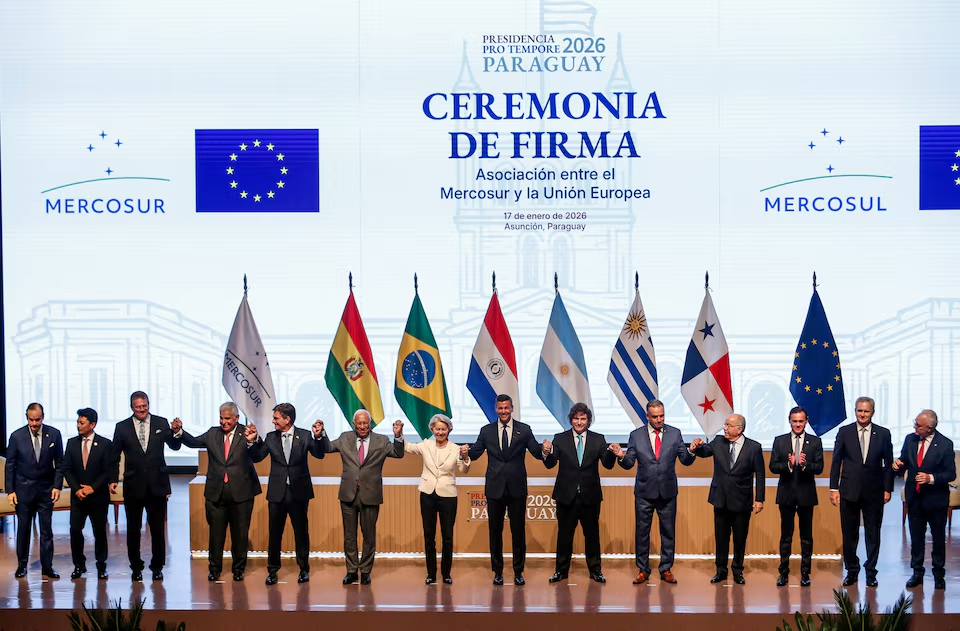
The European Union and the South American trade bloc Mercosur signed a long awaited free trade agreement on Saturday in Paraguay, setting the stage for the largest trade pact ever concluded by the EU after more than two decades of negotiations.
The deal aims to reduce tariffs and expand trade flows between the two regions, covering a combined market of roughly 700 million people. It now moves to the ratification stage, requiring approval from the European Parliament as well as the national legislatures of Mercosur members Argentina, Brazil, Paraguay, and Uruguay.
European Commission President Ursula von der Leyen and European Council President Antonio Costa attended the signing ceremony in Asuncion alongside leaders from Mercosur countries. Brazilian President Luiz Inacio Lula da Silva did not attend but was represented by his foreign minister.
The agreement comes at a moment of growing trade uncertainty, as countries face rising protectionism and geopolitical tension. Supporters say the pact strengthens economic ties between Europe and South America while reinforcing a shared commitment to open markets.
Von der Leyen, speaking after the signing, said the agreement would create the largest free trade zone in the world and send a signal about the EU’s trade priorities.
She said the deal reflected a deliberate choice to favor fair trade and long term partnerships over tariffs and isolation.
Antonio Costa echoed that message, saying the agreement would help both regions manage an increasingly unstable global environment without abandoning core values. He described the pact as a milestone for economic security on both sides of the Atlantic.
Despite broad political backing across Europe, the agreement has faced opposition from farming groups and environmental organizations. Critics warn that lower tariffs could lead to an influx of cheaper South American agricultural products, putting pressure on European farmers and increasing the risk of deforestation.
Read Also: French Farmers Continue Protest Of EU Mercosur Deal In Paris
Most EU member states approved the agreement last week, clearing the final political hurdle before the formal signing. European officials have said safeguards and sustainability commitments are built into the deal, though those assurances have not eased all concerns.
The signing also took place just hours after U.S. President Donald Trump threatened to impose higher tariffs on several European countries unless the United States is allowed to purchase Greenland, adding urgency to Europe’s efforts to strengthen alternative trade partnerships.
Trade between the EU and Mercosur reached 111 billion euros in 2024, according to official data. European exports to the region are dominated by machinery, chemicals, and transport equipment, while Mercosur exports largely consist of agricultural goods, minerals, wood pulp, and paper.
Brazil’s government said the agreement fits into President Lula’s broader strategy to expand and diversify trade relationships. In a statement, officials noted that Brazil is also pursuing trade talks with the United Arab Emirates, Canada, and Vietnam, alongside an expansion of tariff preferences with India.