
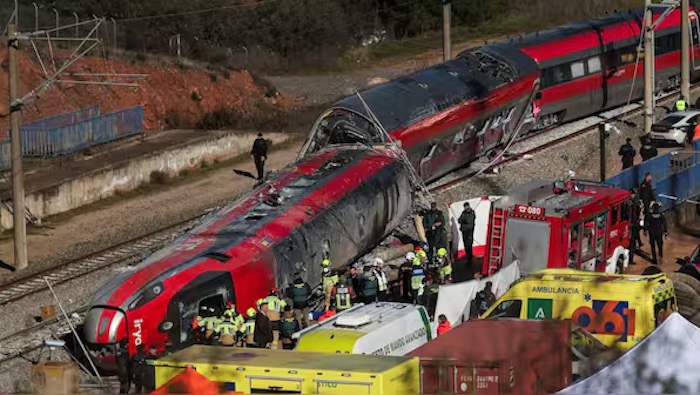
Spain began three days of national mourning after a high-speed train collision in the south of the country killed at least 40 people and injured more than 120. The crash, which happened on Sunday evening near the town of Adamuz in Córdoba province, is the deadliest rail disaster Spain has seen in more than a decade.
Prime Minister Pedro Sánchez announced the period of mourning on Monday, promising a full investigation into how two modern high-speed trains could collide on what officials described as a straight stretch of track. “This is a day of sorrow for all of Spain,” Sánchez said during a visit to the crash site. “We will get to the truth, with absolute transparency.”
The collision happened at about 7:45 p.m., around an hour after one train left Málaga heading north to Madrid. That train derailed and crossed onto the opposite track, where it struck an oncoming train traveling south from Madrid to Huelva. The force of the impact pushed several carriages into an embankment, according to Transport Minister Óscar Puente. Most of the dead and injured were in the front carriages of the second train.
Rescue workers worked through the night, cutting through twisted metal to reach trapped passengers. Emergency services treated 122 people, and 41 remain in hospital, including 12 in intensive care. Authorities said about 400 passengers and staff were on board the two trains. The death toll, officials warned, may still rise as identification continues.
Read Also: NYT Framing, Tinubu’s $9m, And Nigeria’s Silence—Intro
Puente described the crash as “extremely strange” and said the investigation could take at least a month. Early findings, according to a source briefed on the inquiry, point to a faulty rail joint that may have widened under pressure as trains passed over it. However, Spanish newspaper El País reported that it is still unclear whether the fault caused the crash or resulted from it.
The trains involved were Freccia 1000 models, capable of reaching speeds of up to 400 kilometers per hour. Though high-speed rail is generally considered one of the safest forms of transport in Spain, the crash has shaken public confidence and raised questions about infrastructure maintenance and safety oversight.
Across the country, flags have been lowered and public events canceled. Churches and town halls have opened their doors for vigils. As families wait for news of loved ones, Spain enters days of quiet reflection—grieving the lives lost and searching for answers about how such a tragedy could happen on tracks meant to carry people safely home.