
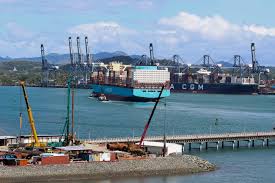
Denmark-based shipping giant Maersk is set to temporarily manage two key ports linked to the Panama Canal following a landmark court decision that struck down existing contracts awarded to a Hong Kong company.
Panama’s Maritime Authority confirmed on Friday that APM Terminals, a Maersk subsidiary, would assume interim control of the Balboa and Cristobal ports, which sit at opposite ends of the canal. The announcement came a day after Panama’s Supreme Court ruled that long standing port concessions held by CK Hutchison were unconstitutional.
The judges found that the agreements showed what they described as an excessive imbalance in favour of the Hong Kong headquartered firm. CK Hutchison, through its subsidiary Panama Ports Company, had operated the ports since 1997 under a concession that was renewed in 2021 for another 25 years.
The ruling has drawn international attention, partly because it follows repeated statements by US President Donald Trump, who has alleged that China exerts undue influence over canal related infrastructure and has hinted at Washington reclaiming control of the waterway.
Read also: Panama Canal Port Contracts Ruled Unconstitutional
Panama’s government has consistently rejected claims of foreign dominance over the canal, stressing that it has been under full Panamanian authority since 1999, after the United States formally handed it over. The canal remains a vital artery for global commerce, handling roughly five percent of worldwide trade and about 40 percent of US container traffic.
Reaction to the court decision has been swift. The United States welcomed the move, while China issued a sharp response. Foreign Ministry spokesman Guo Jiakun said Beijing would take all necessary steps to defend the lawful rights of Chinese companies operating abroad.
Panama Ports Company criticised the ruling, arguing that it undermines legal certainty and threatens the livelihoods of thousands of local workers who depend on port operations.
Built between 1904 and 1914 at enormous human cost, the 82 kilometre canal transformed global shipping by linking the Pacific and Atlantic oceans, eliminating the need for ships to sail around the Americas.