
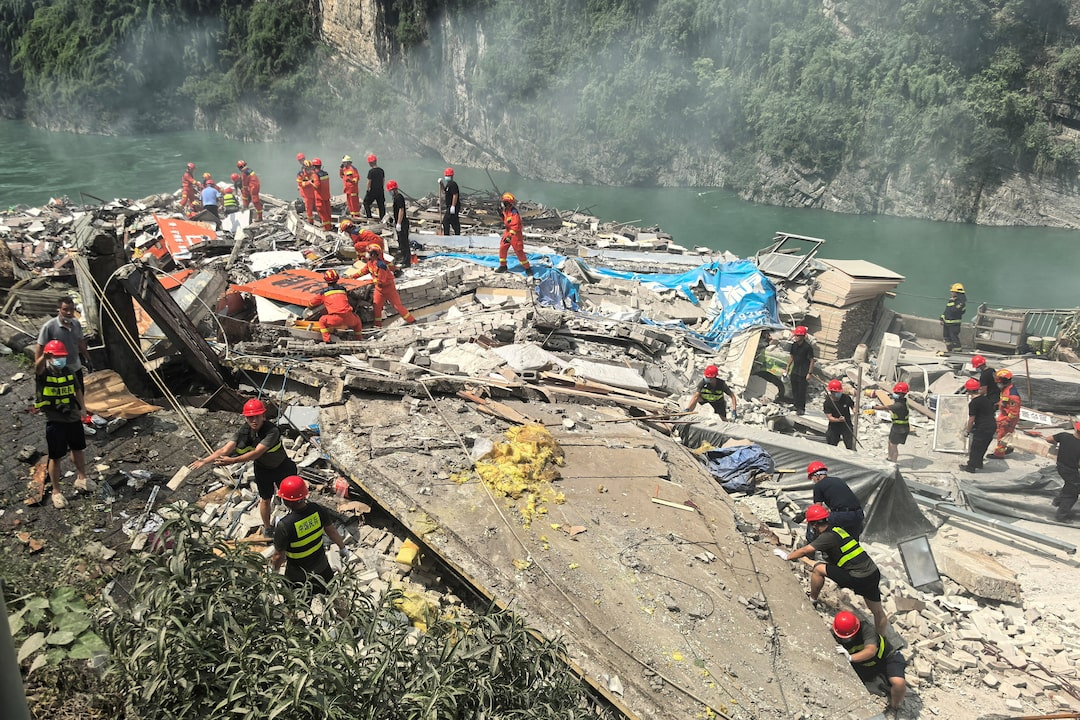
A landslide tore through a hillside in southwestern China’s Chongqing municipality Friday morning, burying homes and trapping an undetermined number of people during an evacuation that was already underway when the ground gave way.
A community worker in the Hanjia subdistrict of Pengshui Miao and Tujia Autonomous County spotted rocks falling sporadically around 8 a.m. local time and issued an emergency warning, according to state broadcaster CCTV. Authorities began evacuating more than 60 residents, but a larger slide struck about an hour later, at 9:08 a.m., crashing through several residential buildings along the Wujiang river and burying some residents who were still in the process of leaving.
Nine people had been pulled from the rubble and taken to the hospital by Friday afternoon, none in life-threatening condition, China’s official Xinhua news agency reported. The exact number still trapped had not been confirmed, and state media gave no estimate of how long the search was likely to take. Nearby residents beyond the immediate area were relocated safely, according to state media.
China’s Ministry of Emergency Management activated a level-two emergency response, one notch below the highest tier in the country’s four-level disaster classification system, and dispatched a 100-member rescue team along with senior disaster-response officials sent from Beijing. Separately, 206 firefighters and 49 vehicles from the national fire and rescue force were sent to assist. Authorities said they had allocated 8,000 pieces of relief material, including tents, folding beds, blankets and emergency kits, to support both the rescue effort and the resettlement of displaced residents.
Read also: Cameroon Hit By Deadly Landslide, Leaving 23 Dead
Rescue crews were racing against incoming thunderstorms forecast for the area, which could complicate efforts to reach anyone still buried, according to reporting from the scene. The Pengshui landslide is one of several disasters that heavy rainfall and extreme weather have caused across China in recent weeks. Landslides are a recurring hazard in rural, mountainous parts of the country during the summer rainy season, when saturated hillsides can give way with little warning, and Chinese authorities maintain a four-tier, color-coded warning system, running from blue to yellow to orange to red, that local weather and geological agencies use to signal escalating risk to residents in vulnerable areas.
Pengshui Miao and Tujia Autonomous County sits in the southeastern part of Chongqing municipality, along the Wujiang river, a major tributary of the Yangtze, bordering the neighboring provinces of Hubei and Guizhou. The county is home to a largely rural population that includes significant Miao and Tujia ethnic minority communities. Aerial footage aired by CCTV showed rock and debris falling onto a cluster of riverside residential buildings as people fled with a thick plume of dust rising behind them. A separate dashcam video, verified by Reuters, showed a section of hillside collapsing onto homes and businesses below, sending debris across a road and forcing passing vehicles, including a motorcycle, to stop as the roadway filled with rock and dust. The footage captured the moment the slope gave way, with the hillside crumbling in a matter of seconds and burying the structures at its base before drivers had time to react.
It was not immediately clear what triggered the landslide, and authorities had not said by Friday afternoon whether recent rainfall in the region played a role. Geological experts often point to a combination of steep slope angles, loosened soil and prolonged rainfall as common contributing factors in landslides of this kind in southwestern China, though officials in Pengshui had not yet released any formal findings on the specific cause.
Chongqing’s steep, terraced terrain along the Yangtze and its tributaries, including the Wujiang, has produced deadly slope failures before. A 2009 landslide in the municipality dropped roughly 12 million cubic meters of rock and earth onto homes and an iron ore operation, leaving dozens of people missing and cutting power and communications across the area. That disaster, like Friday’s, struck with little advance warning and complicated rescue efforts for days afterward.
Friday’s search and rescue effort in Pengshui was continuing as of Friday afternoon, with officials saying the final number of people affected would not be known until crews could fully clear the site. The Ministry of Emergency Management said it would provide updates as search teams worked through the debris and forecast thunderstorms moved into the area.