
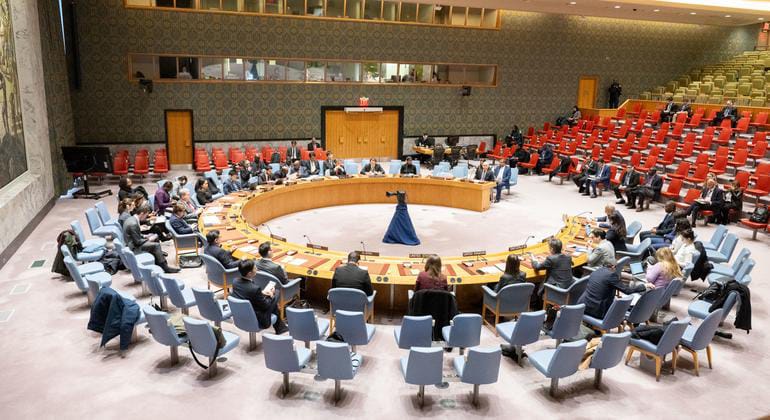
The United Nations Security Council will convene on 4 February for a high-level briefing on the evolving global threat posed by the Islamic State group, following the release of the Secretary-General’s latest assessment. The session will be chaired by the United Kingdom and feature briefings from senior UN counter-terrorism officials, reflecting growing concern within the Council about the group’s renewed momentum across multiple regions.
According to the Secretary-General’s report, the threat environment linked to ISIS has worsened since August 2025, shifting from a largely contained danger to a more adaptive, networked challenge. While the group no longer controls territory on the scale it once did, the report stresses that its operational reach has become broader, more flexible, and harder to predict. ISIS continues to take advantage of armed conflict, political uncertainty, and fragile state institutions, conditions that allow it to embed itself within local grievances while maintaining transnational ambitions.
Africa is identified as the epicentre of current ISIS activity. Affiliates operating in parts of West Africa and the Sahel have expanded their footprint, staging attacks that have killed civilians, disrupted livelihoods, and forced thousands from their homes. The report links this expansion to porous borders, overstretched security forces, and persistent governance gaps, warning that violence in these regions risks becoming further entrenched without coordinated regional and international responses.
Read also: Political Parties Abolished Under Burkina Faso Military Rule
In Afghanistan, the group’s affiliate ISIS-K remains a major concern. The report highlights its sustained capacity to plan and execute complex attacks, not only against local targets but also with potential regional and international implications. A January attack in Kabul, which killed six Afghan civilians and one Chinese national, is cited as evidence of the group’s continued lethality and intent to project relevance beyond Afghanistan’s borders.
The assessment also points to lingering risks in Syria and Iraq, where ISIS cells continue to exploit security vacuums. Particular attention is drawn to the humanitarian crisis in detention camps in northeastern Syria, where tens of thousands of people, including women and children linked to ISIS fighters, are held in precarious conditions. The report warns that prolonged neglect of these camps could fuel radicalisation and future instability.
Read also: Libyan Attorneys Investigates The Murder Of Gaddafi’s Son
Adding to these concerns is ISIS’s increasing reliance on new technologies. The group is making greater use of digital platforms for recruitment, propaganda, and financing, while experimenting with tools such as drones to enhance surveillance and attack capabilities.
During the Security Council meeting, members are expected to strongly denounce ISIS and emphasise the need for deeper intelligence sharing, coordinated counter-terrorism strategies, and sustained investment in addressing the political and humanitarian drivers that allow extremist groups to regenerate.