
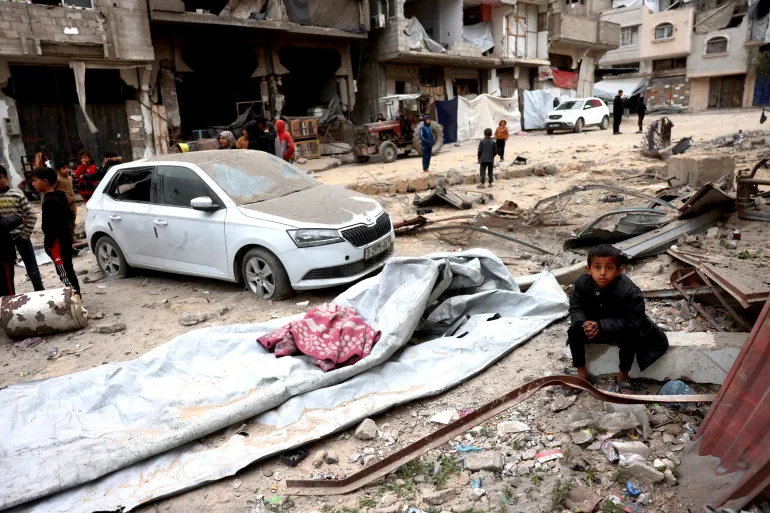
Two Palestinians were killed by Israeli fire in the northern Gaza Strip on Friday, emergency medical services said, as Israeli military operations continued across multiple parts of the enclave despite a U.S.-brokered ceasefire agreement that took effect in early October.
According to Gaza’s emergency services, the victims were killed in separate incidents in Jabalia and Beit Lahiya, two densely populated areas that have repeatedly come under Israeli attack during the war. Their bodies were transferred to al-Shifa Medical Complex in Gaza City, where hospital officials said medical teams were already overwhelmed by ongoing casualties from recent strikes.
The latest deaths show the fragility of the ceasefire arrangement, which was intended to halt large-scale hostilities but has been accompanied by near-daily incidents involving Israeli military fire, airstrikes, and ground activity, according to Palestinian health authorities and international observers.
The ceasefire, brokered by the United States with support from regional mediators, was designed to pause fighting, allow humanitarian access, and facilitate limited movement in and out of Gaza. However, since its implementation in early October, Palestinian officials say Israeli military actions have continued across the territory, raising questions about the agreement’s durability and enforcement.
Read Also: Gaza Border Reopening Long Awaited By Stranded Palestinians
Gaza’s Ministry of Health said that at least 574 Palestinians have been killed and more than 1,500 wounded since the ceasefire began. Reuters and the Associated Press have reported that Israel has acknowledged conducting what it describes as “defensive” or “targeted” operations during the truce, often citing security threats to its forces.
Israel has maintained that it reserves the right to act against perceived threats, even during the ceasefire period.
In southern Gaza, residents reported an Israeli strike on a residential building in Khan Younis, one of the largest cities in the enclave. The Israeli military said the attack was carried out after its soldiers came under fire near what it refers to as the “yellow line”—a demarcation area established by Israeli forces during the first phase of the ceasefire, effectively creating a buffer zone inside Gaza.
Local resident Saleh Abu Hatab, whose family owned the targeted building, told Al Jazeera that residents were given limited time to evacuate before the strike.
Read Also: Tel Aviv Hostage Clock Turned Off After Last Captive Recovered
“Within half an hour, the house was evacuated. It was cleared out, and then it was bombed,” Abu Hatab said, adding that the building was located across from a school that was sheltering displaced families.
Elsewhere in central Gaza, witnesses said Israeli tanks and engineering vehicles advanced east of Deir el-Balah, where they were seen bulldozing land and conducting clearing operations. Reuters has previously reported similar Israeli ground activity in areas Israel considers security-sensitive, even during periods of reduced hostilities.
The latest incidents followed a particularly deadly day earlier in the week. On Wednesday, Israeli attacks killed at least 23 Palestinians, according to Gaza health officials, making it one of the deadliest days since the ceasefire began.
Amid the ongoing violence, a small number of Palestinians have been able to return to Gaza through the Rafah crossing with Egypt. On Thursday, 21 Palestinians who had been stranded in Egypt were reunited with their families in southern Gaza, according to Palestinian officials.
The returnees traveled from the Egyptian city of El Arish, a journey that took many hours due to Israeli security restrictions and procedural delays at the crossing. Witnesses said those who arrived appeared visibly exhausted after prolonged travel and months of uncertainty.
Diplomatic efforts to stabilize the ceasefire continue, with the United States, Egypt, and Qatar working to prevent a full resumption of hostilities. U.S. officials have urged Israel to exercise restraint and expand humanitarian access, while also emphasizing Israel’s right to self-defense.