
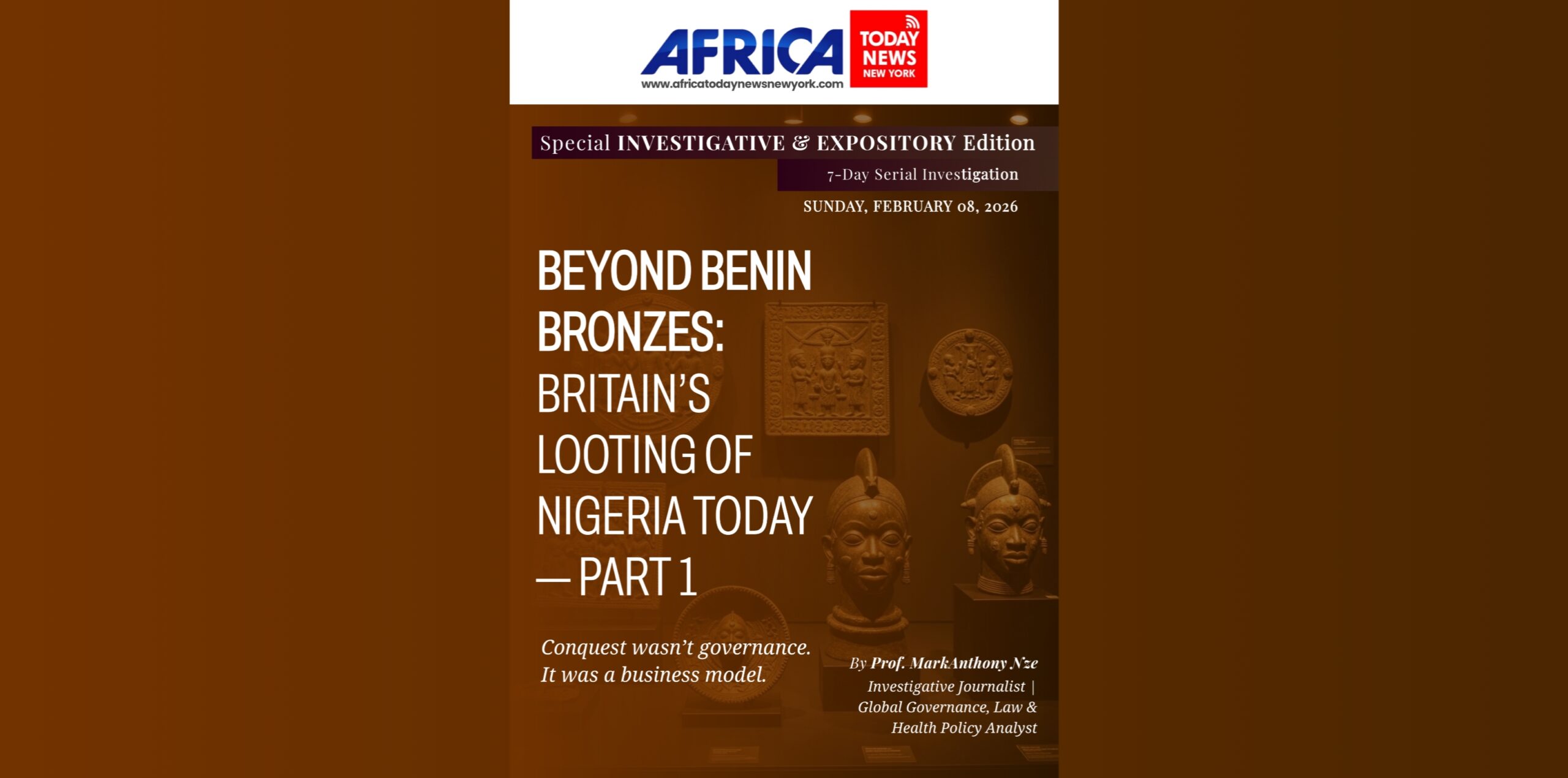
Conquest wasn’t governance. It was a business model.
By Prof. MarkAnthony Nze
Invasion for Profit
If you want to understand Britain’s extraction from Nigeria, don’t begin with the museum label or the diplomatic communique. Begin where any forensic investigator begins: with means, motive, and opportunity—and with the first thing that makes everything else possible. Force.
The Benin Bronzes compel that starting point because they are not allegory; they are evidence. The public record of returns and custody disputes today reminds us that the original seizure still has living consequences (Reuters, 2025; Associated Press, 2025). But the deeper mistake is to treat Benin as an isolated incident—an unfortunate episode of excess, later corrected by enlightened restitution. That reading is emotionally convenient and intellectually false. It shrinks a system into a scandal, and it allows the architecture of extraction to stay intact, unexamined, and—most importantly—repeatable.

This part argues a harder thesis: invasion in Nigeria was not a breakdown of policy. It was policy. Conquest was the opening move in an economic project designed to convert sovereignty into revenue, governance into logistics, and culture into portable property. Britain’s methods changed with time, but the central logic—secure control, standardized rules, externalized costs, export value—proved durable enough to outlive colonial administration itself.
You can hear the modern echo in how the relationship is narrated today. Officially, it is “trade,” “partnership,” and large headline figures. Publicly—especially in sharper, diaspora-facing commentary—it is often described as extraction that learned new vocabulary: the same outcomes achieved by quieter means (e.g., Africa Today News, New York, 2020a; Africa Today News, New York, 2024b). This report does not treat either register as scripture. It treats them as competing narratives that must be tested against the anatomy of extraction.
Read also: Beyond Benin Bronzes: Britain’s Looting Of Nigeria Today—Intro
1) Violence as an economic instrument, not a historical accident
In polite histories, conquest is often framed as a clash of values. In forensic terms, it is a market-opening device: a way to remove competing authority so resources can move under imposed rules. The essential mechanism is straightforward:
● Sovereignty is weakened or displaced.
● Rules are rewritten to make extraction “legal.”
● Institutions are shaped to normalize outward flow.
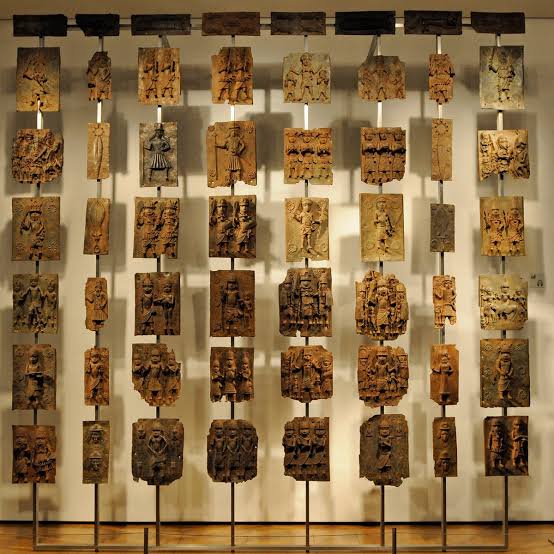
That is why cultural theft matters beyond cultural loss. Looted objects are not just stolen; they are converted—into museum capital, prestige capital, and in many cases literal financial capital through sale, exchange, or reputational value. Legal scholar-analysts of the Benin Bronzes have repeatedly underlined that the problem is not simply possession; it is that possession is often sustained by legal and institutional rationalisations that make the original violence feel remote, even irrelevant (Shyllon, 2019; Stahn, 2022). In other words: what began as coercion becomes routine, and routine becomes legitimacy.
This is exactly the pivot that makes empire durable. The violence is brief; the paperwork is forever.
And the paperwork does not only apply to art. It applies to trade routes, tariffs, labor systems, property regimes, and the pricing rules that decide who benefits from the movement of goods. Once the governing framework is captured, extraction can operate without spectacle. It can even present itself as “development.”
2) The first theft: decision rights
A courtroom-trained mind will recognise the core injury here as the removal of decision rights—the authority to determine how value is produced, priced, and retained. Before any commodity is exported, before any artefact is catalogued abroad, the critical move is the conversion of Nigerians from primary decision-makers into subjects negotiating inside someone else’s structure.
That is why the Benin case is so revealing. Even the restitution era demonstrates that the struggle is not only about objects; it is about who has authority to define custody, narrative, and legitimacy. Recent scholarship and analysis of restitution debates show that returns can become “game-changing” moments precisely because they expose the political and legal scaffolding that has long sustained possession (Stahn, 2022). And when objects return, governance disputes can erupt over who “speaks” for the heritage—an issue that is not peripheral to restitution, but central to it (Obiora, 2025; Reuters, 2025).
Translate that into economics and the parallel becomes hard to ignore: the enduring question is not only “what value left Nigeria?” but “who controlled the terms under which it left—and who controls the terms today?”
The more blunt public framing—accusing Britain of continued extraction—should be understood as a reaction to that continuity of constrained agency, not as mere rhetorical heat ( Africa Today News, New York, 2020d).
Read further: Jesus And Muhammad Are Sacred—So Why Not Fela?
3) Conquest becomes “normal economics” through institutional design
Empires are not sustained by soldiers alone. They are sustained by systems that make the extractive direction of value feel like common sense. Colonial rule, at its most effective, does not constantly shout. It quietly recalibrates the environment so that outward flow is the path of least resistance.
Modern scholarship on the Benin Bronzes has helped articulate how this works in cultural property: institutions can turn a violent taking into a curated “collection,” and then defend that collection with procedural logic (Shyllon, 2019; Pugh, 2025). The same institutional move exists in economics: what begins as imposed extraction is later defended as the market’s neutral output.
This is where the investigative journalist must do what public diplomacy rarely does: take apart the machine.
● Who sets standards?
● Who controls transport and insurance?
● Who writes the contracts?
● Where is the dispute forum located?
● Where do profits land—and where are they taxed?
These are not technicalities. They are the levers of power. If you control the levers, you do not need to control the flagpole.
4) “Support” can coexist with extraction—and that coexistence is itself a clue
A sophisticated form of domination does not look like domination. It looks like assistance. It looks like a partnership. It looks like a relationship where one side can point to aid commitments, health programs, scholarships, and shared initiatives.
And it may genuinely contain those things.
But a forensic analysis asks a different question: What is the net direction of value, capacity, and leverage? An arrangement can deliver real benefits while still producing structural depletion—especially when it pulls talent outward or locks a country into low-margin roles.
That tension is visible in the current discourse. On the one hand, UK-linked support is publicly praised in health-related commitments ( Africa Today News, New York, 2024). On the other, mobility incentives can pull Nigerian human capital outward, with officials themselves acknowledging the pressure and controversy around brain drain (e.g., Africa Today News, New York, 2022).
This coexistence is not hypocrisy; it is political economy. Aid can stabilise a relationship’s legitimacy while structural terms continue to advantage the stronger party.
In a mediation room, this is the moment you name the pattern plainly: goodwill gestures do not cancel structural imbalance. They can coexist with it, and sometimes help it endure.
5) The “bronzes lesson” is not only moral; it is operational
The Benin Bronzes teach a practical lesson about how extraction survives time:
1. Take (through force or overwhelming leverage).
2. Normalise (through institutions and narratives).
3. Legalise (through procedures and precedent).
4. Defend (through technicalities and delay).
Restitution debates show that once a taking is institutionalised, correcting it becomes difficult—even when the moral case is overwhelming (Stahn, 2022). They also show that possession is not merely physical; it is interpretive. Whoever holds the object often shapes the story (Pugh, 2025). And in some contexts, the legal scaffolding sustaining possession becomes part of the harm, not a neutral referee (Shyllon, 2019).
Now look at economic extraction through that same sequence, and the continuity becomes sharper:
● Control is taken (through colonial restructuring; later through unequal bargaining positions).
● Outflows are normalised (as “trade,” “returns,” “investment,” “services”).
● Arrangements are legalised (through contracts, treaties, corporate form).
● Challenges are slowed (through complexity, dispute forums, expertise asymmetry).
This is why the fixation on museums alone is inadequate. Cultural restitution is a mirror that reflects the larger machinery of extraction; it does not substitute for dismantling that machinery.
6) What invasion-for-profit looks like after empire
No one is sending gunboats in 2026, and yet the logic of extraction can persist through modern channels. One of the most policy-relevant is illicit financial flows and related leakage, because it shows how value can exit a country systematically, often through mechanisms that mimic legitimate commerce.
Empirical work linking illicit flows to revenue outcomes in Nigeria’s oil and gas sector underscores how damaging leakage can be to public finance (Umar & Mohammed, 2020). More recent analyses also examine the growth effects of illicit flows and the constraints they impose on emerging economies like Nigeria (Omosuyi & Afolabi, 2024). These studies do not claim a single foreign villain; they demonstrate that the loss is structural—and that once flows exit, the developmental damage is real: less fiscal space, weaker investment capacity, higher vulnerability to shocks.
So, when a relationship is narrated primarily through headline trade totals, the investigative question is not whether trade exists, but whether the trade architecture—plus the financial ecosystem around it—increases Nigeria’s capacity or reproduces low-margin dependency.
That is why the public emphasis on “£7bn trade relations” matters less than what it might conceal: services capture, profit repatriation, legal structuring, and the silent migration of gains ( Africa Today News, New York, 2024e). A country can “trade” heavily and still lose—if it supplies raw value cheaply and buys back processed value expensively, or if its highest-margin segments are controlled abroad.
7) The educational takeaway: don’t argue about motives—trace outcomes and mechanisms
A serious investigation does not need mind-reading. It needs traceability.
● If a system consistently transfers value outward, it is extractive—regardless of how politely it is described.
● If legal and institutional structures make challenge slow and costly, the extraction is self-protecting.
● If “help” and “partnership” coexist with measurable depletion of revenue and talent, the relationship is unbalanced—even if individual programs do good.
This is where the best legal thinking and the best journalism converge: both insist on evidence chains. The journalist follows money and power; the attorney follows authority and consequence. Both end up in the same place: structure.
That is why Part 1 is not a history lecture. It is an opening argument. It establishes that Britain’s entry into Nigerian space was not neutral contact; it was a method of converting Nigerian sovereignty into British gain. The method evolved—away from overt violence and toward systems that routinise outflow—but the original advantage created by conquest did not simply dissolve when flags changed.
So, yes: conquest happened. And yes: it ended, formally. But the arrangement conquest produced—an economic relationship shaped by asymmetric rule-setting and outward flow—has proved stubborn.
Or, put more bluntly: invasion for profit did not disappear. It matured.
The chapters ahead will show how that maturity works—how “indirect rule” becomes a fiscal tool, how commodity dependency is engineered, and how postcolonial “partnership” can preserve the same extractive outcomes under softer language. But Part I makes the foundational point that must not be negotiated away:
The extraction story begins with force because force created the first unequal terms. And unequal terms, once embedded in institutions, can keep paying dividends long after anyone stops calling them empire.
Professor MarkAnthony Ujunwa Nze is an internationally acclaimed investigative journalist, public intellectual, and global governance analyst whose work shapes contemporary thinking at the intersection of health and social care management, media, law, and policy. Renowned for his incisive commentary and structural insight, he brings rigorous scholarship to questions of justice, power, and institutional integrity.
Based in New York, he serves as a full tenured professor and Academic Director at the New York Center for Advanced Research (NYCAR), where he leads high-impact research in governance innovation, strategic leadership, and geopolitical risk. He also oversees NYCAR’s free Health & Social Care professional certification programs, accessible worldwide at:
https://www.newyorkresearch.org/professional-certification/
Professor Nze remains a defining voice in advancing ethical leadership and democratic accountability across global systems.
Selected Sources (APA 7th Edition)
Africa Today News, New York. (2020, August 24). How the British government has been stealing from Nigeria. https://africatodaynewsnewyork.com/2020/08/24/how-the-british-government-has-been-stealing-from-nigeria/
Africa Today News, New York. (2022, November 21). Real reason Nigerian visa applications are soaring – UK envoy. https://africatodaynewsnewyork.com/2022/11/21/real-reason-nigerian-visa-applications-are-soaring-uk-envoy/
Africa Today News, New York. (2024, April 26). Nigeria’s fight against malaria gets £1bn support from UK. https://africatodaynewsnewyork.com/2024/04/26/nigerias-fight-against-malaria-gets-1bn-support-from-uk/
Africa Today News, New York. (2024, May 6). Nigeria, UK trade relations currently worth £7bn – Envoy. https://africatodaynewsnewyork.com/2024/05/06/nigeria-uk-trade-relations-currently-worth-7bn-envoy/
Africa Today News, New York. (2026, February 7). Beyond Benin Bronzes: Britain’s looting of Nigeria today—Intro. https://africatodaynewsnewyork.com/2026/02/07/beyond-benin-bronzes-britains-looting-of-nigeria-today-intro/
Obiora, L. A. (2025). Traditional institutions and cultural heritage law: The case of Benin Bronzes. The Journal of African History.
Omosuyi, O., & Afolabi, J. A. (2024). Assessing the growth effect of illicit financial flows in an emerging economy: The case of Nigeria. International Journal of Business and Emerging Markets, 16(2), 155–169.
Pugh, C. (2025). Echoes of history: Legacies of the Benin Bronzes and restitution within the Black Atlantic. The Journal of African History.
Reuters. (2025, February 26). Nigeria’s museum agrees with royal ruler on custody of Benin Bronzes.
Shyllon, F. (2019). Benin Bronzes: Something grave happened and imperial rule of law is sustaining it! Art, Antiquity and Law, 24(3).
Stahn, C. (2022). Beyond “to return or not to return” – The Benin Bronzes as a game changer? Santander Art and Culture Law Review, 8(2), 49–88.
Umar, B., & Mohammed, Z. (2020). The effects of illicit financial flows on oil and gas revenue generation in Nigeria. Journal of Money Laundering Control, 24(1), 177–186.