
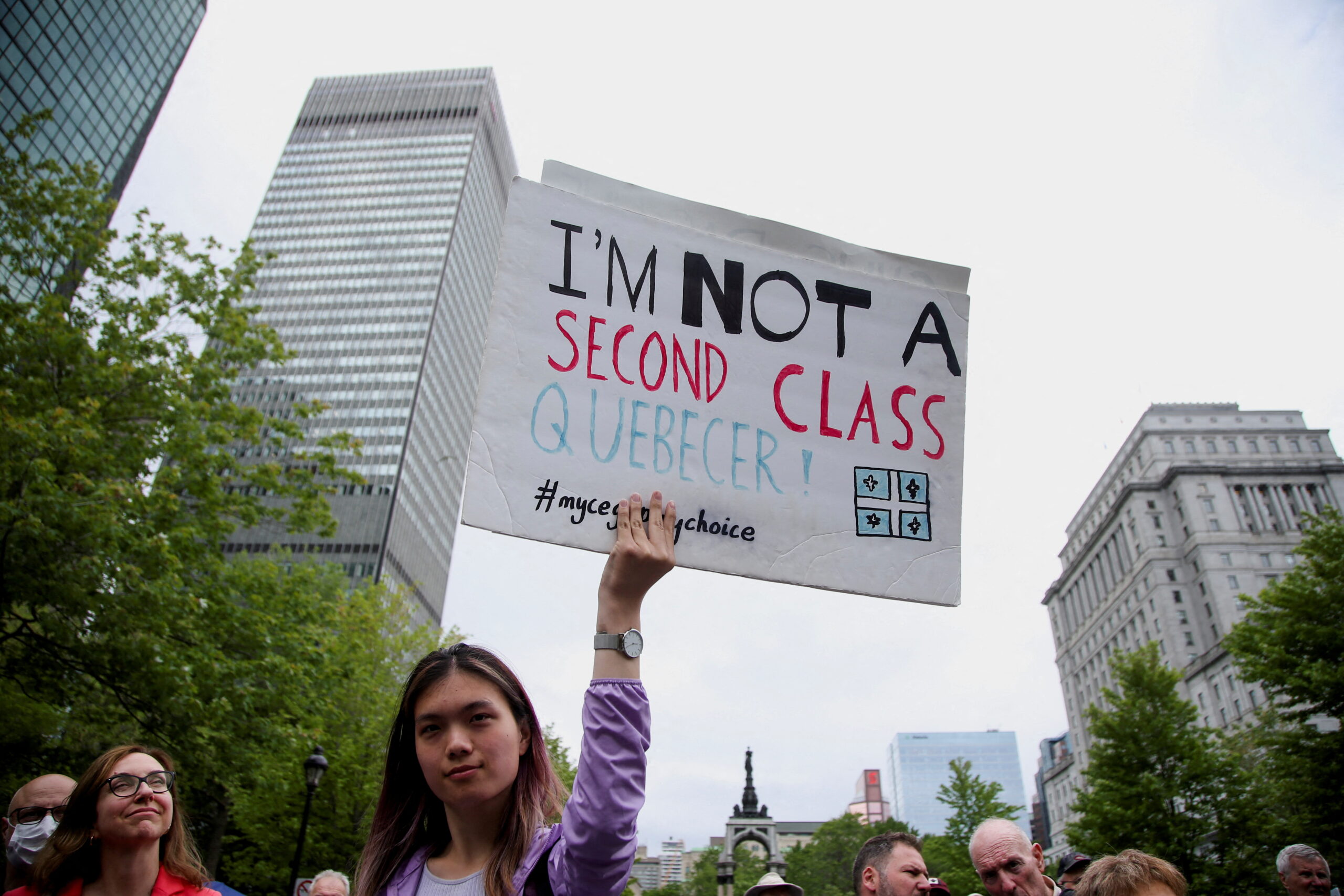
Hundreds of protesters took to the streets across Quebec, rallying in at least seven cities to denounce the provincial government’s decision to abolish a long-standing immigration pathway that many temporary workers and international graduates had relied on to build their lives in the province. The Quebec immigration protests centered on the Coalition Avenir Québec (CAQ) government’s cancellation of the Programme de l’expérience québécoise (PEQ), a move critics say has left thousands of newcomers in legal and personal limbo.
Demonstrations were held in major centers including Montreal and Quebec City, as well as Gatineau and other municipalities, drawing immigrants, students, labor advocates, unions, and opposition politicians. Protesters accused the government of breaking promises made during overseas recruitment campaigns and called the policy shift abrupt, destabilizing, and inhumane.
The PEQ, scrapped in November, had been one of the most popular routes to permanent residency in Quebec. It allowed temporary foreign workers and graduates who met French-language and employment criteria to apply for a Quebec Selection Certificate, a key step toward Canadian permanent residence. Its sudden cancellation has forced some participants to return to their countries of origin, while others face expiring permits and uncertain futures.
Among those protesting in Montreal was Mariia Kolosova, who moved to Quebec from Ukraine in 2023 with the explicit goal of settling permanently through the PEQ. She said she spent years studying French and deliberately chose work in the tourism sector to match the program’s eligibility rules.
Kolosova was still trying to accumulate the required work experience when the PEQ was first suspended and then formally abolished.
Read Also: Quebec Woman Who Sent Poison To Trump Jailed For 22 Years
“The reason I came to Quebec, one of the reasons, was because my chances were quite high,” she told reporters at the Montreal rally. “Ukrainians, many of us, we don’t have a place to go back to. It’s not that easy to change your life from scratch again.”
Her story reflects a broader concern voiced repeatedly during the Quebec immigration protests: that people made long-term decisions based on clear government criteria that were later withdrawn without transition measures. Protesters argue that while governments have the right to adjust immigration policy, doing so retroactively has real human costs.
Aram Musco, who moved to Montreal from France to pursue his studies, said he also planned to stay in the province after graduation. That plan is now in doubt.
“The main thing is it’s quite hard to anticipate the next steps,” Musco said. “With the PSTQ, what’s quite difficult to manage and understand is that the criteria can evolve.”
Quebec’s Immigration Minister Jean-François Roberge has defended the decision, saying the PEQ no longer aligned with the province’s economic and regional labor needs. The program has been replaced by the Programme de sélection des travailleurs qualifiés (PSTQ), a skilled workers system that uses a more complex points-based model.
Under the PSTQ, higher priority is given to applicants who work in sectors facing acute labor shortages, such as health care and education, and to those living outside the Montreal region. The CAQ government has argued that this approach better supports regional development and protects the French language, long a central concern in Quebec immigration policy.
Read Also: Quebec Police Investigate Seniors’ Home After 31 Deaths
However, critics say the PSTQ’s evolving criteria make it difficult for applicants already in Quebec to plan their futures. Unlike the PEQ, which had relatively clear and predictable requirements, the new system allows the government to adjust scoring priorities more frequently.
According to reporting by outlets such as Reuters and the Canadian Press, Quebec has repeatedly tightened immigration thresholds in recent years as it seeks to balance economic needs with concerns about housing shortages, public services, and linguistic integration. The PEQ’s cancellation fits into that broader trend, but opponents argue the lack of grandfathering provisions is unprecedented.
Florent Pigeyre, an advisor for French citizens living abroad, said he is helping coordinate a potential lawsuit against the Quebec government on behalf of affected immigrants in Montreal. He said he has been contacted by numerous families facing separation because of expiring permits.
“I see a lot of immigrants contact me because the families are breaking apart, because they have to separate and go back to their country of origin,” Pigeyre said. “It was not the plan. It’s not what had been sold to them from the Quebec government.”
Pigeyre added that many newcomers were actively recruited overseas by Quebec employers and government-linked initiatives. They were told the PEQ would provide a realistic path to permanence, encouraging them to leave established lives behind. With the program gone, he said, that promise has effectively been broken.
The Quebec immigration protests come at a time when Canada as a whole remains heavily reliant on immigration to sustain economic growth and offset an aging population. According to Statistics Canada and analysis cited by the BBC, immigrants account for nearly all recent labor force growth nationwide, particularly in sectors facing chronic worker shortages.