
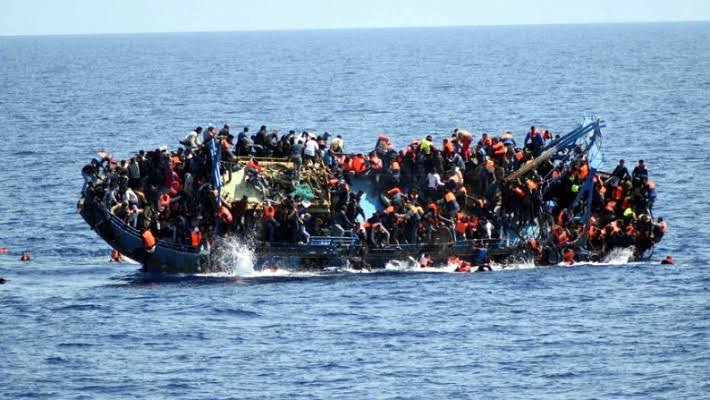
A rubber‑inflatable vessel carrying 55 people sank off the northwest coast of Libya, leaving 53 migrants, including two infants, dead or missing, the United Nations’ International Organization for Migration (IOM) said on Monday.
Only two Nigerian women were recovered alive by Libyan search and rescue personnel, according to the agency’s statement, underscoring the persistent dangers confronting people attempting the perilous central Mediterranean crossing to Europe.
The boat, loaded with men, women and children from several African countries, set out from Al‑Zawiya, a coastal city about 44 kilometres west of Tripoli, shortly before 11 p.m. local time on Feb. 5, survivors told IOM staff. Roughly six hours into the voyage, water began flooding the craft, causing it to overturn north of Zuwara, a fishing town near Libya’s border with Tunisia.
Libyan maritime authorities found and pulled the two survivors from the sea and transported them ashore, where IOM teams provided emergency medical treatment, the agency said. One woman reported that her husband had perished in the wreck, while the other said both her babies died in the incident.
Read Also: Libyan Army Leader Dies In Turkish Aircraft Crash
IOM’s Missing Migrants Project, which compiles data on deaths and disappearances along migration routes worldwide, lists this latest tragedy among a growing tally of fatalities in the central Mediterranean corridor, long considered one of the most lethal migration pathways in the world. The agency said that at least 484 people have been reported dead or missing on this route so far in 2026, with 375 deaths or disappearances recorded in January alone amid severe winter weather that hampered visibility and rescue efforts.
The deaths in early 2026 follow a broader pattern documented in 2025, when over 1,300 migrants and refugees were reported lost at sea while attempting to cross from North Africa to Europe, IOM data show. These figures are widely regarded as undercounts because many vessels never send distress calls and go unreported by the smugglers who operate them.
Libya has been a principal departure point for irregular sea migration in the Mediterranean for more than a decade. The country’s strategic location and its long, accessible coastline make it a staging ground for human trafficking and smuggling networks that transport migrants to Europe. The collapse of central authority after the 2011 uprising that toppled and killed long‑time leader Muammar Gaddafi created an environment in which armed groups and smuggling rings have flourished, exploiting porous borders and a fractured security apparatus.
Conditions for migrants inside Libya are widely documented by United Nations agencies, non‑governmental organisations and human rights monitors as dire. Many people awaiting passage are held in detention centres under the control of militias or state‑aligned forces, where abuses such as torture, extortion, forced labour and arbitrary detention have been repeatedly reported. Some rights advocates and UN investigators have described abuses in these facilities as amounting to crimes against humanity.
Read Also: Libyan Attorneys Investigates The Murder Of Gaddafi’s Son
Human traffickers and smuggling networks typically operate by recruiting or coercing migrants into overcrowded and unseaworthy vessels, often departing under cover of darkness to avoid detection by coastal patrols. These journeys can take place in storms or rough seas, with minimal life‑saving equipment on board. Once at sea, many of the small boats capsize or founder while still far from European shores.
IOM officials emphasise that the organisation does not participate directly in maritime search and rescue operations but documents incidents and assists survivors upon return to shore with medical and humanitarian support. The agency has repeatedly urged enhanced international cooperation to combat smuggling networks and to expand safe, legal avenues for migration that could reduce the need for hazardous sea travel.
European governments and regional bodies have grappled with how to manage irregular migration across the Mediterranean. Countries such as Italy, Spain, Norway and Sierra Leone have publicly called on Libyan authorities to close detention centres where widespread abuses have been alleged, and to improve conditions for intercepted migrants. Rights groups have also pressed for stronger oversight of Libyan coastguard operations, which are funded in part through European Union support intended to curb irregular departures.
Despite these calls and periodic pledges of cooperation, the number of people attempting the crossing continues to rise, driven by conflict, poverty and instability in sub‑Saharan Africa, the Sahel and parts of the Middle East. Analysts and migration experts say that without significant improvements in legal migration options, border processing mechanisms and coordinated rescue operations, fatalities in the central Mediterranean are likely to persist.
The next scheduled release of comprehensive IOM data on migrant movements and mortality is expected later this month, providing further insights into the fallout from this incident and broader migration trends in early 2026.