
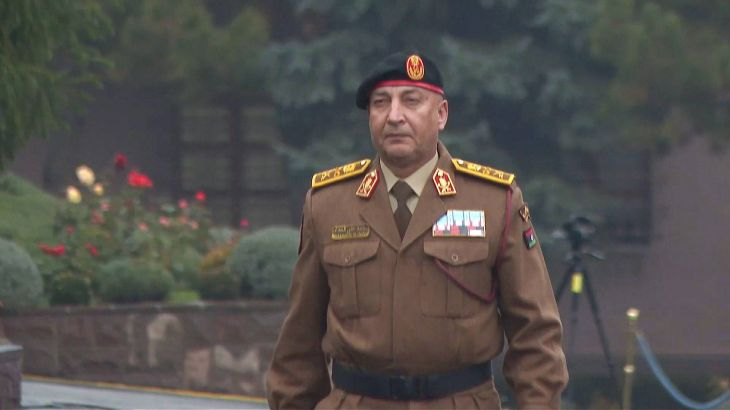
Libya’s top military commander, Mohammed Ali Ahmed al Haddad, has died after the private jet carrying him and other senior officials crashed near Ankara, Turkish authorities confirmed. The aircraft went down shortly after departing from Turkey’s capital on Tuesday, killing everyone on board.
Al Haddad, who served as chief of staff of the Libyan army, was travelling with a high level military delegation following defence talks with Turkish officials. Also killed in the crash were four senior Libyan officers and three crew members. Turkish investigators say early findings rule out sabotage, pointing instead to a technical malfunction.
On Wednesday, Turkish Interior Minister Ali Yerlikaya announced that the jet’s black box had been recovered and that formal analysis had begun. He said the aircraft lost contact with air traffic control roughly 40 minutes after takeoff from Ankara’s Esenboga Airport, while en route to Tripoli. Wreckage was later found in the rural Haymana district, south of the capital.
Libyan Prime Minister Abdul Hamid Dbeibah confirmed the deaths, describing the incident as a devastating national loss. In a statement, he praised the victims for their service, discipline and commitment to Libya, adding that they died while carrying out their official duties. The UN recognised Government of National Unity declared three days of national mourning, ordered flags flown at half mast and suspended official events.
Read also: Libya National Museum Reopening Marks Cultural Revival
Turkish officials said the Dassault Falcon 50 aircraft had reported an electrical problem mid flight and requested an emergency landing. Preparations were underway for its return to Esenboga when the plane vanished from radar. Footage broadcast by local media showed a flash in the night sky, believed to be the moment of impact.
Al Haddad was widely regarded as a unifying figure in Libya’s fractured security landscape. Appointed in 2020, he played a key role in UN backed efforts to bridge divisions between rival factions after years of conflict following the 2011 uprising that toppled Muammar Gaddafi. Known for resisting pressure from powerful armed groups, he consistently pushed for reconciliation and institutional unity.
Condolences poured in from across Libya, including from eastern factions led by Khalifa Haftar, reflecting the respect al Haddad commanded nationwide. Libya has announced it will send an investigative team to Ankara to work alongside Turkish authorities as inquiries continue.
The fatal crash came just days after Turkiye extended the mandate of its military deployment in Libya, underscoring the close political and defense ties between Ankara and Tripoli.