
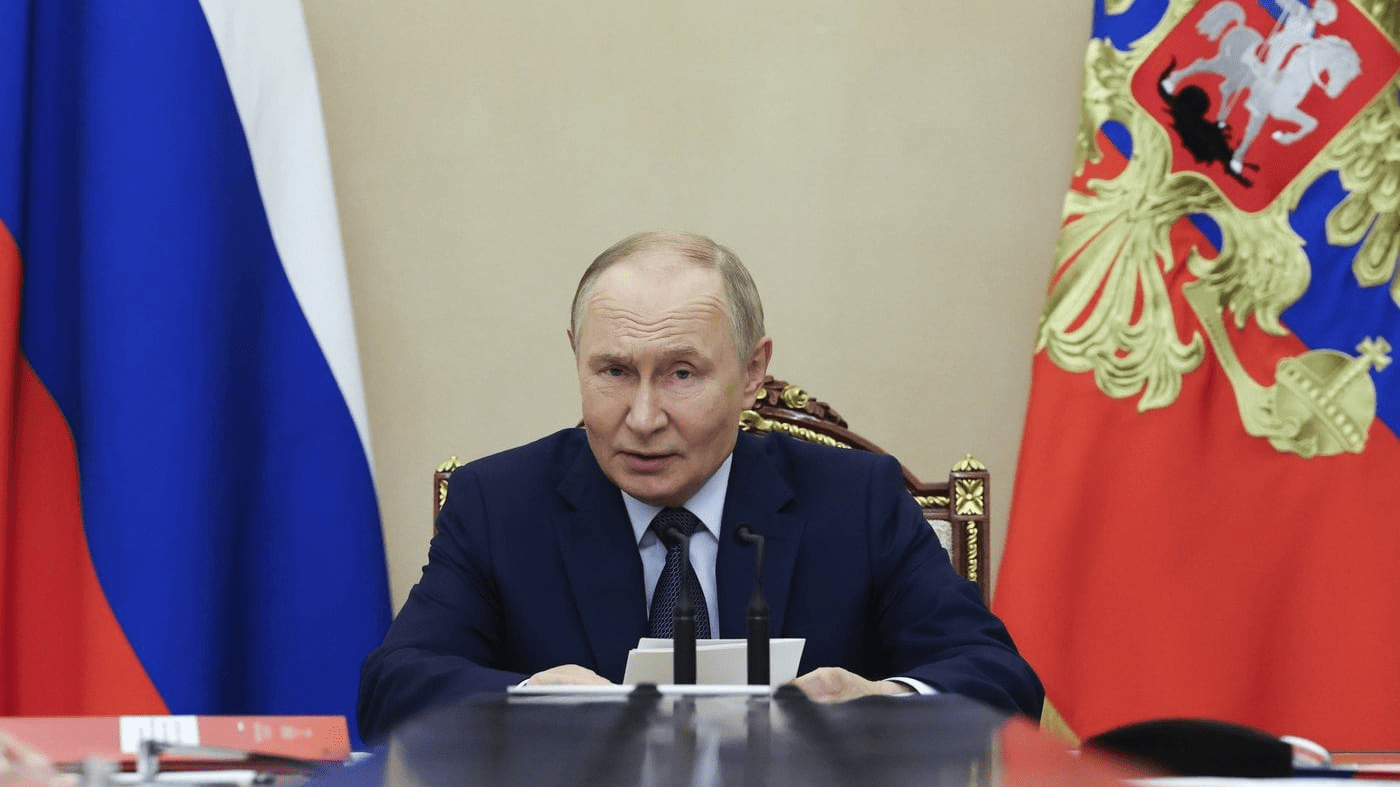
Russia said it would continue observing limits on strategic nuclear weapons previously set by a bilateral arms control treaty with the United States, provided Washington does the same, after the agreement expired earlier this month without a replacement.
Foreign Minister Sergey Lavrov told Russia’s parliament on Wednesday that Moscow would adhere to a moratorium announced by President Vladimir Putin on exceeding the treaty’s ceilings. “We proceed from the fact that this moratorium, which was announced by our president, remains in effect, but only while the United States does not exceed the outlined limits,” Lavrov said.
The treaty, known as New START, had been the last remaining accord constraining the strategic arsenals of the world’s two largest nuclear powers.
Its expiration left the United States and Russia without legally binding caps on deployed strategic warheads and delivery systems for the first time since the early 1970s, raising concern among arms control analysts about a potential new weapons competition.
Lavrov said Moscow believed Washington was also likely to remain within the established limits. “We have reason to believe that the United States is in no hurry to abandon these limits and that they will be observed for the foreseeable future,” he said, without providing details.
U.S. President Donald Trump has declined a proposal from Putin to voluntarily extend adherence to the treaty’s restrictions for another year. The White House has said it prefers negotiating a broader replacement agreement and has called for a “new, improved and modernised” framework rather than prolonging the existing one.
Russian officials have likewise indicated they are open to a new arrangement but have linked progress to wider geopolitical issues and the scope of participation. Washington has pressed for China to be included in future negotiations, citing growth in Beijing’s nuclear capabilities.
Read also: Ukraine’s Zelenskiy To Unveil Election Blueprint Feb 24
According to the Stockholm International Peace Research Institute, China has expanded its arsenal by roughly 100 additional nuclear warheads annually since 2023. China is estimated to possess about 600 warheads, compared with roughly 4,000 each held by the United States and Russia. Beijing has declined to join trilateral talks, arguing its stockpile remains significantly smaller.
A Chinese Foreign Ministry spokesperson said after the treaty expired that China would not participate in bilateral U.S. Russian arms reduction negotiations.
Moscow has said that if China were included, the nuclear forces of U.S. allies such as the United Kingdom and France should also be considered. Independent estimates put their arsenals at roughly 290 and 225 warheads respectively.
New START was signed in Prague in 2010 by then U.S. President Barack Obama and Russian President Dmitry Medvedev and entered into force in 2011. It limited each country to 1,550 deployed strategic nuclear warheads and 700 deployed delivery systems, including intercontinental ballistic missiles, submarine launched ballistic missiles and heavy bombers.
Read also: U.S. To Deploy 200 Troops To Train Nigeria’s Military
The treaty also established verification measures, including data exchanges and on site inspections. Those inspections were suspended during the COVID 19 pandemic and never fully resumed as relations deteriorated. In 2023 Russia rejected further inspection activities as tensions rose with Washington over the war in Ukraine.
Although inspection procedures halted, Moscow previously said it continued to observe the numerical ceilings established by the treaty. U.S. officials have similarly said they intended to act consistently with its limits while diplomatic options were explored.
Arms control agreements between Washington and Moscow date back to the Cold War, when successive treaties sought to limit strategic weapons and establish transparency measures. Analysts have warned that the absence of inspection mechanisms reduces visibility into the other side’s arsenal and could complicate strategic planning. No new negotiations have been formally announced. Both governments have indicated interest in a replacement framework but have not set a timetable for talks. For now, adherence to the previous limits depends on voluntary compliance by each side rather than legally binding obligations.