
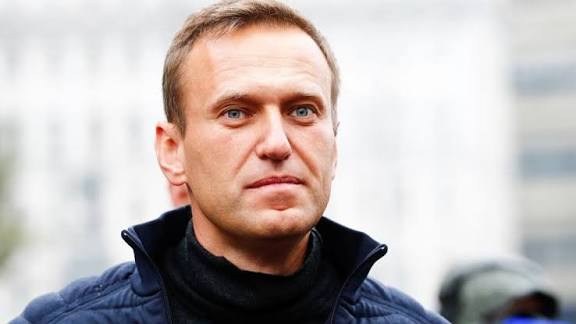
LONDON— Five European nations on Saturday attributed the 2024 death of Russian opposition leader Alexei Navalny to poisoning with a toxin derived from South American poison dart frogs, saying their analysis conclusively detected the substance in samples from his body.
In a joint statement, Britain, France, Germany, Sweden, and the Netherlands said the compound, epibatidine, was identified through testing conducted over the past two years.
The statement added that the toxin is not naturally found in Russia. “Russia claimed that Navalny died of natural causes.
But given the toxicity of epibatidine and reported symptoms, poisoning was highly likely the cause of his death,” the statement said.
Navalny, a prominent Kremlin critic, died while serving a sentence in an Arctic penal colony after being convicted on extremism-related charges he denied.
His death was announced in February 2024, shortly before the opening of the Munich Security Conference.
The timing prompted the conference to adjust its schedule, allowing Navalny’s widow, Yulia Navalnaya, to address delegates and call for accountability.
“I was certain from the first day that my husband had been poisoned, but now there is proof … I am grateful to the European states for the meticulous work they carried out over two years and for uncovering the truth,” Navalnaya wrote on social media while attending the Munich conference on Saturday.
The European statement said Russia had the means, motive, and opportunity to administer the poison while Navalny was imprisoned.
The allies called for Moscow to be held accountable under international conventions, including the Chemical Weapons Convention and, in this case, the Biological and Toxin Weapons Convention, citing “repeated violations” by Russian authorities.
Britain’s foreign ministry described the findings as evidence of “an alarming pattern of behaviour” by Russian officials.
Read Also: Beyond Benin Bronzes: Britain’s Looting Of Nigeria Today—Part 7
The United Kingdom previously conducted a public inquiry into the 2018 Novichok poisoning of former Russian double agent Sergei Skripal and his daughter in Salisbury, concluding that Russian President Vladimir Putin must have authorized the attack.
Foreign Minister Yvette Cooper told reporters that UK scientists collaborated with European partners to examine Navalny’s death.
She did not provide details about how the samples were obtained or which laboratories carried out the analyses. The Russian embassy in London did not respond immediately to requests for comment.
Navalny, 47 at the time of his death, was a central figure in Russia’s opposition movement and had survived a previous poisoning in 2020 with a Novichok nerve agent, an attack widely attributed to Russian state operatives.
After recovering in Germany, he returned to Russia in early 2021 and was promptly arrested.
Authorities later convicted him of extremism and embezzlement-related offenses, charges his supporters and Western governments dismissed as politically motivated.
Memorial gatherings and protests followed Navalny’s death across Europe, with demonstrators calling for justice in cities including London, Berlin, Vilnius, and Rome.
The latest findings by the five European nations, announced almost exactly two years after his death, reinforced concerns among Western governments about the treatment of political dissidents in Russia.
The joint statement underscored that the identified toxin, epibatidine, is extremely potent. While widely known as a naturally occurring compound in certain species of poison dart frogs in South America, it has no precedent in Russia, the statement noted. “Given the toxicity of epibatidine and the symptoms reported prior to Navalny’s death, the evidence supports the conclusion that he was deliberately poisoned,” the statement said.
Read Also: Tuchel Signs New England Contract To 2028 Euros
British officials emphasized continuity between Navalny’s case and prior attacks against Kremlin critics, suggesting that the incident fits a broader pattern of targeting opponents with chemical or toxic substances.
Analysts say such findings could complicate diplomatic relations with Moscow and increase pressure on international bodies to enforce compliance with conventions regulating chemical and biological agents.
The European allies indicated that the investigation was the result of coordinated forensic and scientific work conducted over a two-year period.
Details on the chain of custody for the biological samples, testing methods, or the laboratories involved have not been publicly disclosed.
Russian authorities have consistently denied involvement in Navalny’s death.
Kremlin officials have characterized accusations from Western countries as politically motivated and have disputed prior investigations into attacks on Russian dissidents abroad.
Navalny’s death remains a focal point in ongoing debates about political repression in Russia and the international response to state-sponsored use of toxins and chemical agents.
Saturday’s announcement marks the second anniversary of his death and is likely to draw renewed scrutiny from European governments and human rights organizations.
Officials from the five European countries said they would continue to press for accountability and transparency regarding the circumstances of Navalny’s death, though no legal action against Russia has been publicly confirmed.