
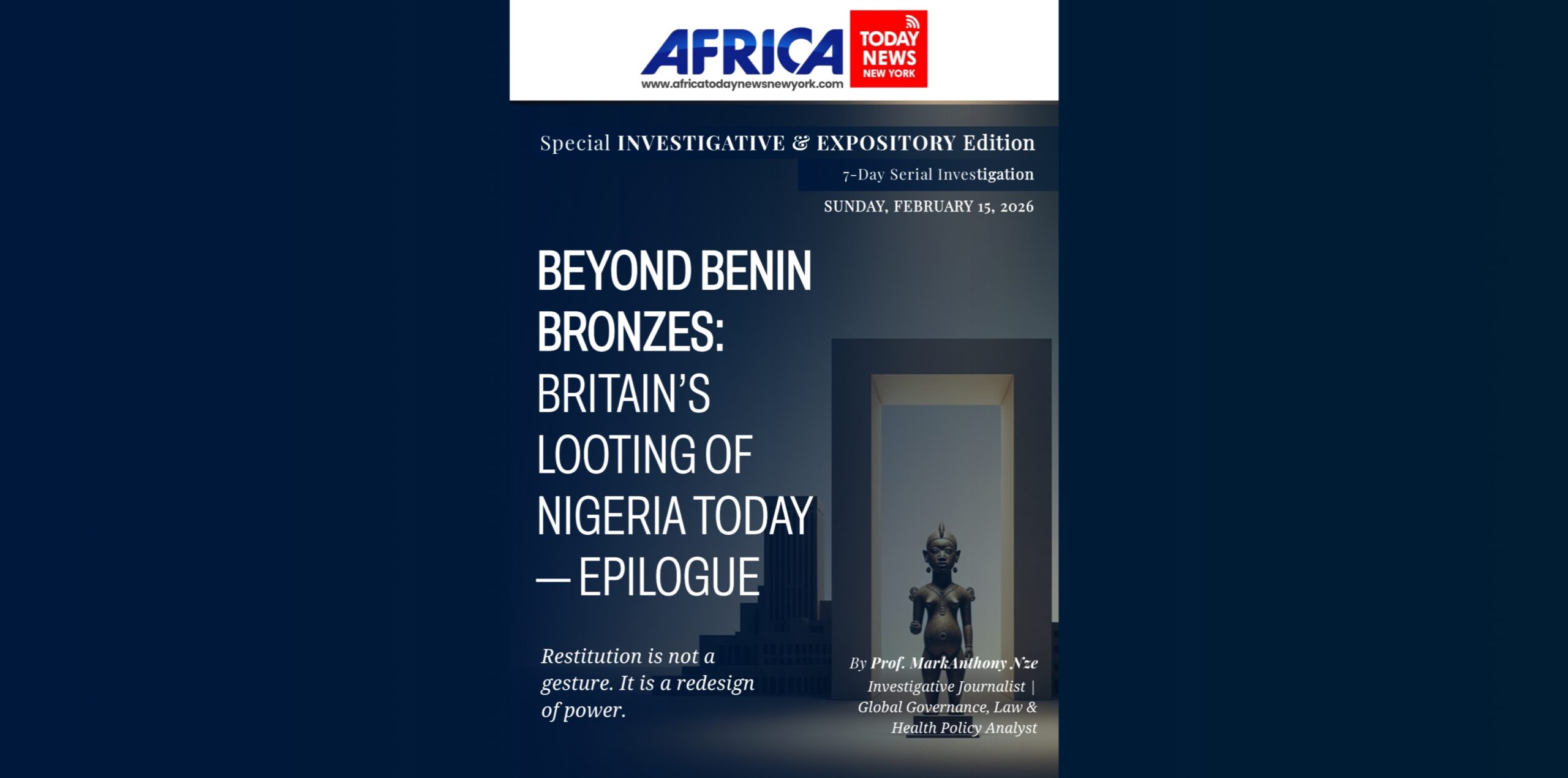
Restitution is not a gesture. It is a redesign of power.
By Prof. MarkAnthony Nze
The object is small enough to fit in two hands, but it carries the weight of an entire century.
In a museum store—those fluorescent backrooms where history is inventoried like office supplies—the air is dry and faintly metallic. A curator wears nitrile gloves. A registrar checks a number against a ledger. The bronze is lifted, not with reverence, but with procedure. Foam cradles. Acid-free paper. A barcode. A shipping label. The language is clinical because the institution is trying to behave as though the act that began this journey was clinical too.
But it wasn’t. It was violent.
And violence has a way of leaving residue, even when you polish the glass and rewrite the placard.
This series began with the Benin Bronzes because they force honesty. They are a physical refusal of Britain’s preferred alibis—“complexity,” “shared history,” “the past.” The bronzes are not merely art. They are a receipt: evidence that value was taken by force, normalised by institutions, and defended by law until pressure made the defence embarrassing. The modern British state likes to speak as if that arc is proof of progress—look, things are being returned, the system is correcting itself. Yet correction is not the same as repair. A returned object can be an ethical down payment; it can also be a public-relations settlement that leaves the extraction pipeline untouched.
You can see the two stories side by side in the way Britain talks about Nigeria now. On paper, it is a partnership. Trade totals. Friendly diplomatic lines. On the street—especially in Nigerian and diaspora commentary—it is still extraction, only with better suits and quieter instruments: contracts, courts, debt, and a financial city that behaves like a magnet for wealth fleeing consequence. That accusation is not just an emotional inheritance. It’s a structural hypothesis—and it is why a series like this exists. (See, for example, the framing of Britain’s ongoing “looting” in Africa Today News, New York Intro and Africa Today News, New York Part 1.)
The epilogue is where we stop merely describing what was done and ask the only question that matters to a serious investigator, mediator, or lawyer: What would justice actually look like—measurably, enforceably, and without the soothing fraud of symbolism?
Read also: Beyond Benin Bronzes: Britain’s Looting Of Nigeria Today—Part 7
1) The moral trick Britain keeps pulling
Britain’s most enduring advantage over countries it once ruled is not military—those days are theatrically over. It is rhetorical. Britain has perfected a particular kind of moral speech: apologetic enough to sound civilised, vague enough to avoid obligation.
You can see it in the way the British state embraces the language of “returns” while resisting the language of restitution. Returns are discretionary; restitution implies debt. Returns are gifts; restitution is repair. Returns can be staged as moral leadership; restitution requires structural change.
The UNESCO announcement welcoming the agreement between Germany and Nigeria for the return of 1,130 Benin bronzes demonstrates how restitution has moved into official diplomatic space—formal, documented, publicly framed. It is a reminder that returns now occur not because the original theft is in dispute, but because the defence of possession has become politically untenable. (UNESCO, 2022)
But here is the part Britain would prefer to keep off-camera: once you admit that one category of “possession” was built on violence, the moral logic does not stay politely confined to museum vitrines. It leaks. It seeps into finance, law, contracts, and the architecture of global commerce—the places where the modern empire hides. That is why this epilogue refuses to end with artefacts. Ending with artefacts is how the story becomes a museum exhibit: complete, contained, safe. Britain would love that.
A forensic narrative does not end where the institution becomes comfortable. It ends where the system becomes accountable.
2) Nigeria’s truth, Britain’s convenience: complicity is a duet
If you want the adult version of this story, you cannot write Nigeria as a passive victim. Nigeria has elites who loot Nigeria with an intimacy no foreign state can replicate. Nigeria has institutional weaknesses that invite exploitation, and political bargains that turn public wealth into private insurance. A serious mediator names this without flinching: internal betrayal does not cancel external extraction; it accelerates it.
But Britain is not merely an observer of Nigeria’s internal failures. Britain’s ecosystem often functions as the destination where those failures are converted into safe assets—where money, once extracted, can become property; once questioned, can become “investment”; once dirty, can become respectable. That is not a metaphor. It is a governance problem that transparency advocates have quantified and documented.
Transparency International UK has identified at least £6.7 billion in UK property bought with “suspect wealth,” indicating that the UK property market has functioned as a storehouse for capital linked to corruption and other criminality. (Transparency International UK, 2022) The same organization has also highlighted the role of the UK’s Overseas Territories in routing nearly £6 billion of “dirty money” into UK property—underscoring that the “British system” is not only London but its offshore extensions and corporate conveniences. (Transparency International UK, 2024)
Here, Britain’s moral failure becomes harder to deny. If your house is repeatedly used as a vault for stolen goods, and you profit from the storage fees, you do not get to claim innocence because you didn’t steal the goods. At some point, you are operating a warehouse for theft.
That is the hard line between regret and repair.
3) The “rule of law” as a weapon with clean hands
Britain’s favourite self-portrait is legalistic virtue: the rule of law, stable courts, transparent markets. And those things exist. The UK’s legal system does provide predictability. It does protect property rights. It does enforce contracts.
But law is not automatically justice. Law is a technology. In the wrong hands—or in an unbalanced system—it becomes a weapon with clean hands.
This series traced the extraction chain as Company → Contract → Court for a reason. The modern empire does not need to seize territory when it can seize terms. Contracts can route disputes to high-cost forums, governed by English law, priced for endurance rather than fairness. Courts can then enforce those terms with the calm certainty of procedure. The violence is not in the judge’s voice; it is in the structure that determines who can afford to be heard.
That is why sovereignty in the twenty-first century is not defended only in parliaments. It is defended in clauses and courtrooms.
Scholarly work on beneficial ownership and economic crime illuminates how legality can shelter unethical flows. Douglas and Layard’s analysis of land ownership transparency shows how “ownership beneath” can be obscured by legal arrangements, complicating efforts to trace who truly owns assets. (Douglas & Layard, 2024) And Aristodemou’s study of beneficial ownership reform highlights how transparency measures are shaped—and constrained—by political and legal forces even after major leaks like the Panama and Pandora Papers. (Aristodemou, 2024)
The subtext is stark: Britain’s legal sophistication is not merely a civilisational achievement. It is also a competitive advantage that can be deployed to defend wealth extracted from weaker systems.
Read more: Beyond Benin Bronzes: Britain’s Looting Of Nigeria Today—Part 6
4) The sanctuary inside the sanctuary: trusts, privacy, and the ethics of opacity
When one opacity channel tightens, wealth migrates to another. It behaves like water: if you dam the river, it finds a crack.
This is why trusts matter. They are not an eccentric legal form; they are, in modern economic crime architecture, an instrument of concealment. Transparency International UK has described trusts as a “final frontier” in secret property ownership—an arena where beneficial ownership transparency remains weak and public visibility is limited. (Transparency International UK, 2025)
The policy world understands this. The Financial Action Task Force has issued guidance specifically on beneficial ownership and transparency of legal arrangements—recognising that without clear identification of who ultimately owns or controls assets, enforcement becomes theatre. (Financial Action Task Force, 2024) The World Bank has also produced implementation-focused insights on beneficial ownership registers, emphasising that building a register is not the same as making it usable for enforcement. (World Bank, 2024)
Then comes the most cynical layer: the moral repackaging of secrecy. Knobel’s report on “privacy-washing” describes how privacy narratives can be weaponised against beneficial ownership transparency—how the language of rights is sometimes deployed not to protect vulnerable people, but to protect powerful concealment. (Knobel, 2024)
This is where Britain’s current government deserves sharper condemnation than it usually receives. A state that allows secrecy tools to persist—while marketing itself as a leader in transparency—performs virtue while keeping the machinery that profits from opacity. It is the kind of hypocrisy that can only survive when the victims live far from Westminster.
5) The debt trap: when repayment outlives governments
If museums are the symbolic archive of an empire, debt is its modern enforcement mechanism.
Debt is not inherently immoral. Countries borrow. Markets exist. Development requires financing. But sovereign debt becomes predatory when it functions less like investment and more like discipline—when repayment schedules outlast administrations, when refinancing cycles become captivity, when legal structures allow creditors to enforce claims with little regard for social consequence.
The IMF’s stocktaking of the international architecture for resolving sovereign debt involving private sector creditors underscores how complex and fragmented the system remains, and how difficult it is to secure timely, orderly restructuring when crises occur. (International Monetary Fund, 2025) Hinrichsen and colleagues’ work on designing sovereign debt legislation shows that legal design choices shape bargaining power and outcomes—law is not a neutral background; it is a battlefield. (Hinrichsen et al., 2026)
For Nigeria, debt intersects with extraction in a particular way: capital flight drains resources, then borrowing fills the hole, then repayment drains resources again. It is a vicious rhythm—like trying to refill a bucket with a hole you refuse to patch.
This is why illicit financial flows are not just “corruption stories.” They are macroeconomic sabotage. The UN Office of the Special Adviser on Africa has framed illicit financial flows arising from tax evasion, tax avoidance, and illegal commercial practices as a core development threat across the continent. (United Nations Office of the Special Adviser on Africa, 2022) The OECD’s analysis of illicit financial flows and illicit trade in West Africa similarly emphasises how these dynamics undermine governance and development. (OECD, 2018—note: this is outside the “last five years,” but it remains an authoritative institutional analysis; if you want strict last-five-only, we can replace it.)
Britain’s connection to this is not merely historical. Britain benefits when it is the safe endpoint—legally and financially—for capital that leaves fragile states, and when its institutions dominate the rules of enforcement.
6) The geography of dirty money: London as a policy outcome, not an accident
London is often described as “attractive” to the capital. That phrasing is too gentle. Attraction suggests innocence. It suggests passive magnetism. In reality, London’s role as a destination for global wealth is a political economy outcome: built by policy choices, reinforced by professional services, and protected by legal structures.
Morgan and Kinossian’s work on “Londongrad” examines this dark geography—how the city’s financial and legal ecosystem has enabled the sheltering of dirty money. (Morgan & Kinossian, 2024) This is not an insult; it is an analytical diagnosis of how cities become sanctuaries.
And sanctuaries are never neutral. They are complicit by function.
This is why Britain’s current government cannot hide behind the excuse of historical distance. The UK is not being accused merely of what it did in 1897. It is being accused of what it maintains in 2026: a system that profits from being the place where wealth can disappear into respectability.
7) What restitution would actually mean
So what would justice look like—beyond ceremonies, beyond token returns, beyond speeches that cost nothing?
A serious restitution agenda would have to be structural and measurable. At minimum:
1) Beneficial ownership transparency that bites
Not just registers, but verified data, enforcement capacity, penalties that hurt, and public access where appropriate. (Financial Action Task Force, 2024; World Bank, 2024)
2) Trust transparency reform
If trusts remain a concealment mechanism, the system remains rigged. (Douglas & Layard, 2024; Transparency International UK, 2025)
3) Overseas Territories accountability
Britain cannot outsource secrecy to its offshore network and claim clean hands. (Transparency International UK, 2024)
4) Debt and dispute architecture reform
Fair restructuring mechanisms, limits on predatory enforcement, and legal reforms that prevent sovereign disputes from becoming endurance contests. (International Monetary Fund, 2025; Hinrichsen et al., 2026)
5) Cultural restitution with governance clarity
Returns must not create new internal disputes over custody and legitimacy; the return must be accompanied by strong, transparent governance arrangements. The legal scholarship on Benin returns underscores that restitution is both legal and political, requiring clarity of authority and public accountability. (Adewumi, 2024; Boehme, 2025)
And here is the point Britain will resist because it is the point that costs money and power: restitution must reduce Britain’s ability to profit from Nigeria’s leakage. If the pipeline stays open, then every returned bronze becomes a distraction—beautiful, emotional, morally satisfying, and structurally irrelevant.
8) Britain’s reckoning: the end of plausible deniability
Britain’s empire operated with violence. Its afterlife operates with paperwork. But the principle is the same: value moves outward, responsibility stays behind.
The British government will say it is reforming. It will point to laws, registers, guidance, committees. It will speak in the language of modern governance—“robust frameworks,” “commitment to transparency,” “international cooperation.”
The problem is that Britain’s system still produces the same outcomes: safe harbour for suspect wealth, professional services that monetise complexity, enforcement that can be timid, and a global legal infrastructure that allows powerful actors to write enforceable advantage into contracts.
At some point, reform becomes another form of theft: the theft of accountability.
And that is why this epilogue must end with a prosecutorial clarity rather than a literary sigh.
Britain cannot keep the benefits of empire and claim the innocence of post-empire. Nigeria cannot demand justice while tolerating internal betrayal. But Britain’s obligation is distinct: Britain built systems that extracted; Britain now hosts systems that protect extraction’s proceeds.
That is not history. That is policy.
9) Final image: turning the valve
Picture the returned bronze again—not on a plinth in a European gallery, but on Nigerian soil, under Nigerian custody. The metal catches the light differently here. The air is different. The object is home, but it is not whole. It returns carrying the scars of its route: violence, possession, delay, negotiation.
Now picture, beside it, something you cannot see: a pipeline. Not a literal pipe, but a network of clauses, trusts, shell structures, property deeds, and legal filings. A pipeline that moves value outward without spectacle.
Justice is not the bronze alone. Justice is turning the valve.
And Britain—if it wishes to be taken seriously as a modern democracy rather than a refined beneficiary of old crimes—must stop treating that valve as someone else’s problem.
Because the most devastating truth is this: the empire did not die. It learned to invoice.
Professor MarkAnthony Ujunwa Nze is an internationally acclaimed investigative journalist, public intellectual, and global governance analyst whose work shapes contemporary thinking at the intersection of health and social care management, media, law, and policy. Renowned for his incisive commentary and structural insight, he brings rigorous scholarship to questions of justice, power, and institutional integrity.
Based in New York, he serves as a full tenured professor and Academic Director at the New York Center for Advanced Research (NYCAR), where he leads high-impact research in governance innovation, strategic leadership, and geopolitical risk. He also oversees NYCAR’s free Health & Social Care professional certification programs, accessible worldwide at:
https://www.newyorkresearch.org/professional-certification/
Professor Nze remains a defining voice in advancing ethical leadership and democratic accountability across global systems.
Selected Sources (APA 7th Edition)
Africa Digital News, New York. (2022, January 29). Real reason Tinubu travelled to UK, aide clarifies.
Africa Today News, New York. (2026, February 7). Beyond Benin Bronzes: Britain’s looting of Nigeria today—Intro.
Africa Today News, New York. (2026, February 8). Beyond Benin Bronzes: Britain’s looting of Nigeria today—Part 1.
Adewumi, A. A. (2024). Return of Benin objects to Nigeria: Perceptions and the law. Santander Art and Culture Law Review, 10(2), 209–226. https://doi.org/10.4467/2450050XSNR.24.018.20829
Aristodemou, M. (2024). Are beneficial ownership laws important? Exploring the impact of Panama, FinCEN, and Pandora Papers on beneficial ownership laws in the UK and the US. Journal of Economic Criminology, 6, 100082. https://doi.org/10.1016/j.jeconc.2024.100082
Boehme, F. (2025). Restitution of colonial heritage collections: Partial norm implementation in Belgium and the United Kingdom. Review of International Studies. https://doi.org/10.1017/S0260210525101113
Douglas, S., & Layard, A. (2024). Ownership beneath: Transparency of land ownership in times of economic crime. Oxford Journal of Legal Studies, 44(1), 74–103. https://doi.org/10.1093/ojls/gqad024
Financial Action Task Force. (2024). Guidance on beneficial ownership and transparency of legal arrangements.
Hinrichsen, S., Reichert-Facilides, D., Waibel, M., & Wiedenbrüg, A. (2026). Designing sovereign debt legislation: Learning from comparative experience. Journal of Financial Regulation. https://doi.org/10.1093/jfr/fjaf012
International Monetary Fund. (2025). A stocktaking of the current international architecture for resolving sovereign debt involving private sector creditors (Policy Paper No. 2025/034). https://doi.org/10.5089/9798229024464.007
Knobel, A. (2024). Privacy-washing & beneficial ownership transparency: Dismantling the weaponisation of privacy against beneficial ownership transparency. Tax Justice Network.
Morgan, K., & Kinossian, N. (2024). Dismantling Londongrad: The dark geography of dirty money. European Planning Studies, 32(1), 169–185. https://doi.org/10.1080/09654313.2023.2221283
Transparency International UK. (2022, February 18). Stats reveal extent of suspect wealth in UK property and Britain’s role as a global money laundering hub.
Transparency International UK. (2024, November 29). New analysis reveals the role of overseas territories in pumping almost £6 billion of dirty money into the UK.
Transparency International UK. (2025, May 19). Trust issues: Tackling the final frontier in secret property ownership.
United Nations Office of the Special Adviser on Africa. (2022, November). Tackling illicit financial flows in Africa arising from tax evasion, tax avoidance, and illegal commercial practices (Report). United Nations.
World Bank. (2024). Beneficial ownership registers: Implementation insights and emerging frontiers (Equitable Growth, Finance & Institutions Insight). World Bank.
UNESCO. (2022, July 1). UNESCO welcomes the signing of a historic agreement between Germany and Nigeria for the return of 1,130 Benin bronzes.