
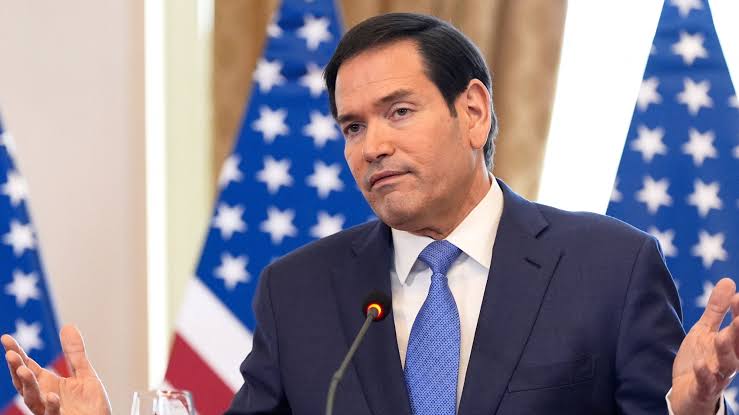
BUDAPEST — U.S. Secretary of State Marco Rubio described on Sunday a report from five European nations implicating Russia in the death of opposition leader Alexei Navalny as “troubling,” while stressing that Washington had no reason to doubt the findings.
The report, issued Saturday by Britain, France, Germany, Sweden, and the Netherlands, concluded that Navalny had been exposed to epibatidine, a potent neurotoxin naturally found in poison dart frogs native to South America.
According to the joint statement, chemical analyses of samples taken from Navalny’s body “conclusively” confirmed the presence of the substance, which is not known to occur naturally in Russia.
Rubio acknowledged awareness of the European statement and emphasized that the U.S. assessment of the case aligns with the scientific evidence presented.
“We obviously are aware of the report. It’s a troubling report. We’re aware of that case of Mr. Navalny and certainly … we don’t have any reason to question it,” he said.
The Russian government, which has repeatedly denied involvement in Navalny’s death, dismissed the findings as a “Western propaganda hoax,” according to Russia’s state news agency TASS.
Read Also: EU Sanctions On Iran Expand As Bloc Moves To List IRGC
Moscow has maintained that Navalny’s death in a remote Arctic penal colony in February 2024 followed legal proceedings in which he was convicted on charges of extremism and other offenses he consistently denied.
Rubio clarified that the United States did not participate in the joint European statement because it was an initiative undertaken independently by the five countries. “Those countries came to that conclusion.
They coordinated that. We chose — doesn’t mean we disagree with the outcome. It just wasn’t our endeavour. Sometimes countries go out and do their thing based on the intelligence they’ve gathered,” he said.
The U.S. secretary of state stressed that Washington was not challenging the findings. “We’re not disputing or getting into a fight with these countries over it. But it was their report, and they put that out there,” Rubio added.
Navalny, a long-time critic of President Vladimir Putin, was imprisoned in a penal colony in the Russian Arctic following his conviction on charges that included extremism, fraud, and violations of parole.
He consistently rejected the accusations. His death in February 2024 drew international attention, prompting repeated calls from Western governments for accountability and independent investigations.
European authorities said the identification of epibatidine in Navalny’s samples marks a rare and specific form of poisoning.
Experts noted that the toxin’s natural sources are limited to South American poison dart frogs, making accidental exposure highly unlikely. The joint statement described the chemical evidence as “conclusive,” reflecting extensive laboratory testing coordinated among the five countries.
Analysts say the findings could increase tensions between Russia and Western states, which have repeatedly condemned Moscow over alleged human rights abuses and targeted attacks on political opponents.
Read Also: India EU Trade Deal Creates Massive Free Trade Zone
While the United States refrained from issuing a formal statement, Rubio’s remarks indicate tacit acceptance of the European report’s conclusions, emphasizing the distinction between independent national initiatives and broader diplomatic coordination.
The Navalny case has remained a focal point in international discussions about political repression and the safety of dissenting voices in Russia.
Human rights organizations have repeatedly called for transparency regarding the circumstances of his detention, treatment, and death. The Arctic penal colony where he was held, officials have said, is known for its remote location, harsh conditions, and limited oversight, complicating independent verification of events.
Navalny’s death prompted immediate reactions from European capitals. Britain, France, Germany, Sweden, and the Netherlands issued statements highlighting the toxicology results and reaffirming their commitment to investigating the case.
Their joint release underscored the rarity of epibatidine exposure outside South America and the improbability of natural contamination in Russia, framing the findings as consistent with deliberate administration of a poison.
Rubio’s comments, delivered during a diplomatic visit in Central Europe, reinforced the United States’ long-standing position of concern regarding the treatment of political opponents in Russia while maintaining a careful diplomatic stance.
By choosing not to formally join the European statement, Washington signaled both respect for allied initiatives and adherence to its own intelligence and procedural protocols.
The Navalny case remains a subject of ongoing scrutiny. U.S. and European officials have said they will continue monitoring developments, reviewing available evidence, and coordinating on matters of intelligence and legal accountability.
No additional investigations have been publicly announced by Russia, which continues to reject external scrutiny.
The next anticipated step involves continued international dialogue on chemical weapons and toxicology investigations, as well as potential diplomatic or legal measures based on the European report.
Officials in Brussels and Washington have emphasized that further verification and procedural follow-up will determine any coordinated response among Western nations.