
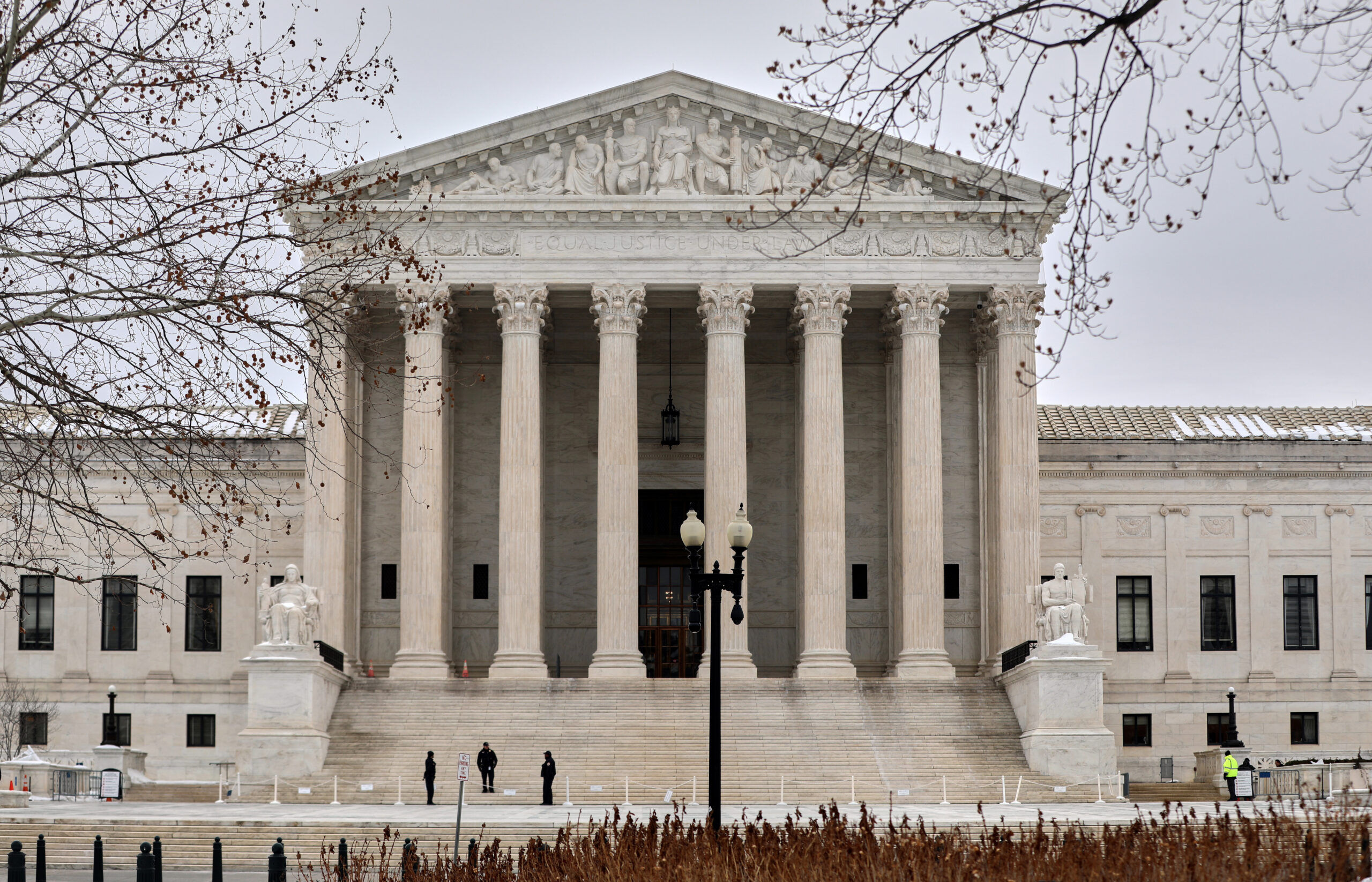
The United States Supreme Court struck down most of President Donald Trump’s sweeping global tariff programme on Friday, ruling six to three that he had exceeded his constitutional authority in imposing the levies, a landmark decision that landed on the same day the White House confirmed Trump would travel to Beijing from March 31 to April 2 to meet Chinese President Xi Jinping in talks whose central subject, trade policy, has just been fundamentally disrupted by the court’s ruling.
The justices held that Trump’s aggressive approach to tariffs imposed under the International Emergency Economic Powers Act, a 1977 statute that allows a president to regulate economic transactions during a declared national emergency, was not permitted under that law. “IEEPA does not authorize the President to impose tariffs,” Chief Justice John Roberts wrote for the majority.
The ruling invalidates many, but not all of Trump’s tariffs. Duties imposed under different statutory authorities, including those on steel and aluminium, remain in place.
The decision was the first major piece of Trump’s second-term agenda to come squarely before the court, which he helped shape with three conservative appointments during his first term. The majority opinion included Roberts alongside Justices Neil Gorsuch and Amy Coney Barrett all Republican appointees, as well as the three liberal justices: Sonia Sotomayor, Elena Kagan, and Ketanji Brown Jackson. Justices Clarence Thomas, Samuel Alito, and Brett Kavanaugh dissented.
The Treasury has collected more than $133 billion from the import taxes imposed under the emergency powers law. The economic impact of the full tariff programme has been estimated at approximately $3 trillion over the next decade by the Congressional Budget Office. The court’s ruling was silent on whether those payments must be refunded, a question that Kavanaugh, writing in dissent, warned could be a significant and complicated legal process. Penn-Wharton Budget Model estimated the total sum potentially subject to refund at $175 billion. Stocks rose sharply on news of the ruling. Trump, who was informed of the decision during a meeting with governors, called it a “disgrace,” according to a person familiar with his reaction.
The ruling arrived at a moment of acute diplomatic sensitivity. The White House, separately, confirmed Friday that Trump would travel to China from March 31 to April 2, his first visit to Beijing since returning to office and his first in-person meeting with Xi since the two leaders met at the Asia-Pacific Economic Cooperation summit in Busan, South Korea, on October 30 last year. At that meeting, the two leaders reached a partial trade standdown: the United States agreed to reduce fentanyl-related tariffs on Chinese goods from 20 per cent to 10 per cent, while China agreed to pause sweeping export controls on rare earth minerals for one year and resume purchases of American soybeans, which Beijing had boycotted for much of 2025. Trump rated that meeting “a 12 on a scale of zero to 10.”
The planned April meeting was set to focus on whether to extend the truce negotiated in October, as well as tensions surrounding Taiwan. Both of those discussions now proceed against a dramatically altered legal backdrop.
Read Also: Scott Bessent Warns On Trump Emergency Tariff Powers
Many of the tariffs that formed the leverage in the October negotiation and the anticipated Beijing talks have now been struck down by the court. The administration said it was reviewing the ruling and did not immediately indicate whether it would seek a legislative pathway to reimpose the levies. Senior officials have previously stated they expected to preserve the tariff framework under alternative statutory authorities.
China formally confirmed last week that it was in communication with Washington about the visit. Foreign Ministry spokesman Lin Jian said Xi had repeated his invitation during a phone call with Trump and that “the two sides are in communication on this,” stressing the importance of direct head-of-state engagement. Beijing’s stated position entering the talks had been to push for certainty and predictability in the bilateral relationship, a goal Chinese analysts described as the country’s primary strategic objective in managing Trump’s second term.
Analysts at the Atlantic Council noted after the October summit that China had already demonstrated significant leverage over the negotiations through its rare earths export controls and the soybean embargo, which successfully forced Washington to lower tariffs.
“China is getting the better of the US in these recent truce negotiations,” Piper Sandler analysts told clients after Busan. Whether the Supreme Court ruling strengthens or weakens the United States’ hand in April depends substantially on what, if any, tariff authority the executive can demonstrate it retains going into the meeting.
Taiwan is the other major variable. The October summit largely sidestepped the issue, but Xi raised it directly in a subsequent phone call with Trump in February, following Washington’s announcement in December of an $11.1 billion arms sale to Taipei, the largest in U.S. history. Taiwan expects further such sales. Washington is legally bound under the Taiwan Relations Act to provide the island with the means to defend itself, a commitment that China has consistently opposed. Whether the subject can again be deferred at the Beijing summit, or whether Xi will demand a substantive discussion of it, remains among the most consequential open questions heading into late March.
The Supreme Court’s ruling upheld two previous lower court decisions, including that of the U.S. Court of International Trade, that had also found Trump lacked authority under IEEPA to impose the global tariffs. Trump had previewed his displeasure with the expected outcome repeatedly in recent weeks. “Without tariffs, this country would be in such trouble right now,” he said Thursday in Georgia. “I’ve been waiting forever.”
Read Also: House Passes Measure To Overturn Trump’s Canada Tariffs
The White House had no formal comment on the ruling by late Friday afternoon beyond Trump’s reported private reaction. The administration was expected to outline its legal and legislative strategy in the coming days. Congressional Republicans were divided on the decision, with some signalling interest in passing legislation that would grant the president explicit statutory tariff authority, a route Kavanaugh suggested in his dissent might preserve much of the policy in practice, even if the IEEPA basis had been invalidated.
The Beijing visit dates, March 31 to April 2, were confirmed by a White House official speaking on condition of anonymity. A formal presidential announcement had not been made as of Friday evening.