
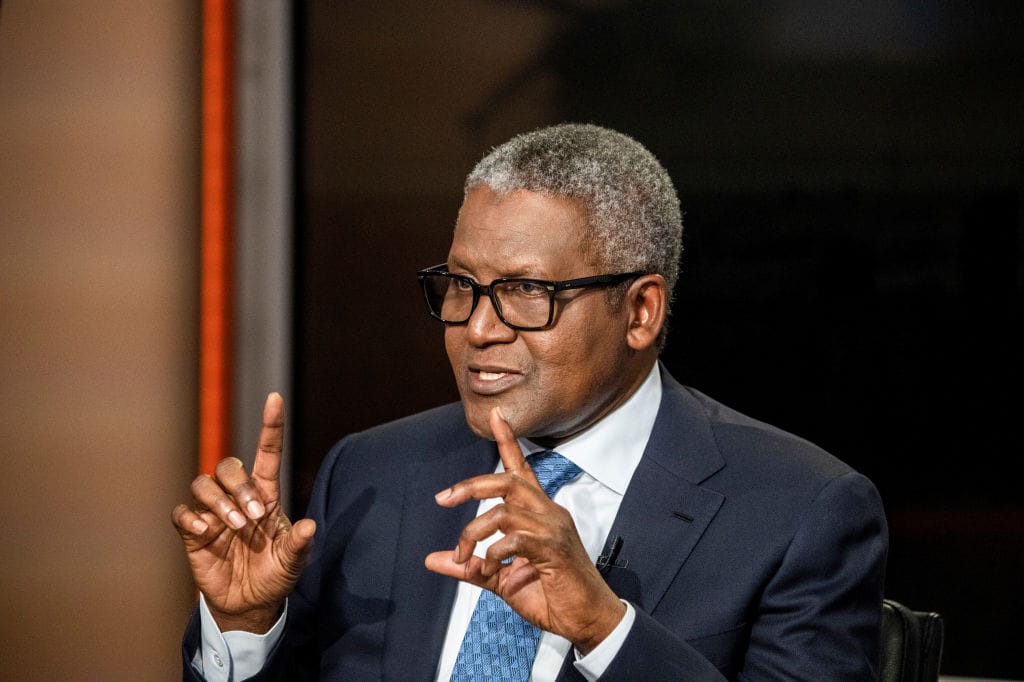
Nigeria faces a shortage of up to 50 million jobs by the end of the decade, a deficit that has prompted one of Africa’s wealthiest industrialists to accelerate plans for investments in steel manufacturing, power generation and port infrastructure as private capital races to fill gaps left by sluggish government action.
Aliko Dangote, whose conglomerate already dominates cement, fertilizer and petrochemical production across multiple African markets, told The New York Times he views large-scale industrial projects as essential to absorbing the country’s expanding youth population. His group currently employs roughly 30,000 workers at its newly operational petroleum refinery, about 80 percent of them Nigerian, and expects total employment to reach 65,000 as expansion accelerates.
The refinery, which began commercial operations in recent months, now produces around 650,000 barrels daily.
Dangote said output should double within three years as additional units come online, a timeline that would make the facility one of the largest single-site refineries globally and reshape Nigeria’s position in regional fuel markets.
But refining represents only one component of a broader push to deepen manufacturing capacity across the continent. Dangote said his next targets include steel production, expanded electricity access and port development—three sectors he described as critical to supporting the kind of heavy industry that has eluded much of sub-Saharan Africa.
“We have to industrialise Africa,” he said, pointing to infrastructure deficits that have constrained growth for decades.
Industry observers noted that steel would position the group in a sector vital to construction, housing and industrial machinery, while investments in power and ports could address bottlenecks that have long frustrated businesses operating in Nigeria. Unreliable electricity and congested ports rank among the most frequently cited obstacles to economic activity in the country.
Dangote cited India’s Tata Group as a reference point, describing the conglomerate’s presence across automobiles, steel, technology and other industries as proof that diversified manufacturing can transform emerging economies.
He said African industrial players need to adopt similar ambitions if the continent is to compete globally.
The Dangote Group has built cement plants in more than a dozen African countries and operates facilities producing sugar, salt and agricultural products. The addition of a refinery has given the conglomerate a foothold in energy, and the planned expansion into steel and power would extend its reach into sectors where state-owned enterprises have historically dominated but often underperformed.
Read also: Forbes: US Wealthiest Aren’t The Most Charitable
Dangote also announced intentions to list shares in the refinery on the Nigerian stock exchange, a move designed to broaden local ownership of the asset and provide liquidity for investors. He did not specify a timeline or the percentage of shares to be offered.
Despite progress, he acknowledged persistent challenges. Infrastructure gaps and crude supply issues have complicated efforts to secure consistent feedstock for the refinery, he said. Logistics inefficiencies and bureaucratic delays continue to slow operations across multiple projects.
Dangote has previously criticized bottlenecks in Nigeria’s oil value chain, arguing that production disruptions and opaque procurement processes undermine the country’s ability to capitalize on its natural resources. He has called for reforms to streamline crude allocation and improve coordination between producers and refiners.
His comments reflect frustrations shared by other private sector actors who have attempted to navigate Nigeria’s complex regulatory environment. The refinery faced years of delays before commencing operations, with financing, permitting and infrastructure hurdles all contributing to the extended timeline.
Dangote said his group would persist in sectors that reduce import dependence and keep economic value within Africa. “Nobody dared to do it, so we did it,” he said, referring to the decision to build the refinery despite widespread skepticism about its feasibility.
The industrialist’s wealth, estimated in the tens of billions of dollars, derives largely from his cement operations, which have benefited from Nigeria’s construction boom and infrastructure projects across West Africa. He has reinvested profits into ventures aimed at addressing supply gaps in critical goods, betting that local production can displace imports and generate sustained returns.
Read more: Africa Can Solve Global Challenges, Former UN Chief Claims
Steel production, if pursued, would mark a significant escalation. Nigeria once operated a state steel company that collapsed amid mismanagement and underinvestment, leaving the country reliant on imports for most of its steel needs. Reviving domestic production would require substantial capital and coordination with mining operations to secure iron ore and other raw materials.
Electricity generation presents a different set of challenges. Nigeria’s power grid remains unreliable despite partial privatization, with frequent outages disrupting businesses and households. Independent power producers have struggled to achieve profitability due to difficulties collecting payments from distribution companies and regulatory uncertainty.
Port development could prove more straightforward, given the group’s experience managing logistics networks for its existing operations. Nigeria’s main ports in Lagos and Port Harcourt face chronic congestion, and additional facilities would ease pressure on those hubs while creating new trade corridors.
The expansion plans position Dangote as central to Nigeria’s economic trajectory at a time when government capacity to drive industrialization remains constrained by fiscal pressures and political instability. His ability to mobilize capital and execute complex projects has made him a rare example of private sector leadership in a landscape dominated by state actors and foreign multinationals.