
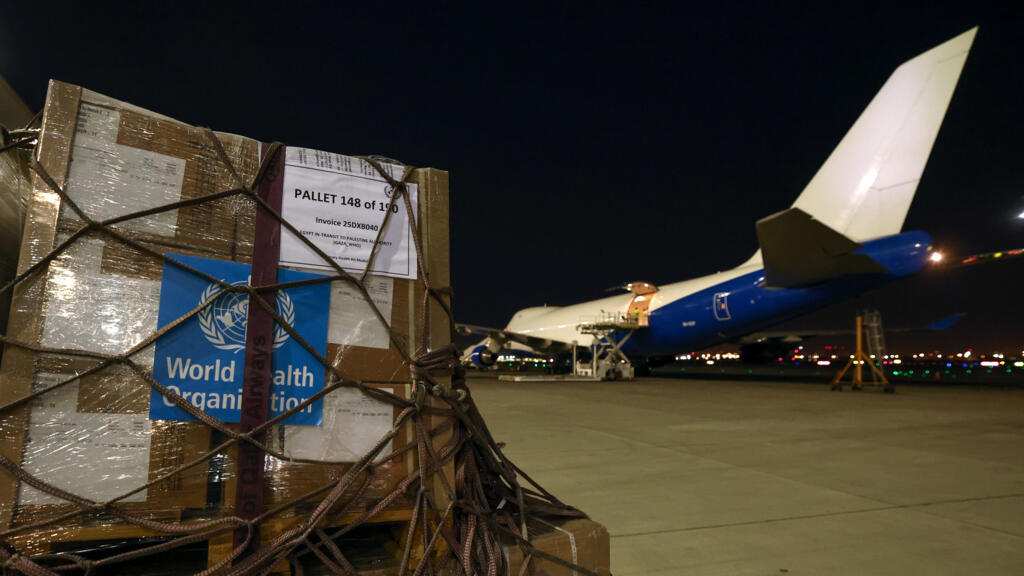
Urgent medical supplies worth $26 million sit trapped in or bound for Dubai as fighting across the Middle East has shut down the World Health Organization’s main distribution center for global health emergencies, cutting off aid to dozens of countries battling disease outbreaks and humanitarian crises.
More than 50 emergency requests from 25 nations cannot be fulfilled, WHO Eastern Mediterranean regional director Hanan Balkhy said Thursday. Among the stranded cargo: $6 million in medicines for Gaza and $1.6 million in polio laboratory supplies needed in Afghanistan and Pakistan, where the disease remains endemic.
The Dubai hub processed over 500 emergency orders for 75 countries last year. Its closure due to airspace restrictions and insecurity around the Strait of Hormuz has severed what Balkhy called “an extremely important lifeline for the humanitarian response.”
Eighteen million dollars worth of health supplies already at the facility cannot be accessed. Another $8 million in shipments cannot reach it.
The disruption follows US-Israeli attacks on Iran that began Saturday and have since drawn in neighboring countries, forcing airlines to cancel flights and governments to restrict movement through key transit routes.
WHO Director-General Tedros Ghebreyesus said the conflict’s impact “goes beyond the immediately affected countries,” warning that the suspension demonstrates how regional violence can cripple global emergency response systems.
The organization is negotiating with UAE authorities on whether operations can resume and exploring alternate routes through hubs in Nairobi, Dakar and Brindisi. If fighting continues, Balkhy said discussions may turn to land routes through Saudi Arabia, though she expressed hope that would not be necessary.
The polio supplies held up in Dubai were destined for Afghanistan and Pakistan, the only two countries where the virus still circulates naturally. Delays in delivering laboratory equipment and vaccines could undermine efforts to eradicate the disease, which paralyzes children and has no cure.
Gaza’s health system, already devastated by months of Israeli bombardment, depends on external supplies to treat patients and maintain basic services. The $6 million in medicines stuck in Dubai represents critical stocks that cannot be replaced quickly through other channels.
Read also: Trump Insists On Hand-Picking Iran’s Next Leadership
WHO is coordinating health responses across 16 countries affected by the fighting, supporting health ministries to sustain essential services while strengthening disease surveillance and preparing for mass casualties and displacement, Balkhy said.
Iran has not requested WHO assistance, she noted, saying its health system is withstanding current pressures. But the organization is scaling readiness for chemical, biological, radiological and nuclear risks as strikes have hit areas near sensitive facilities.
Tedros warned that any damage to nuclear sites could carry serious public health consequences. He did not specify which facilities face the greatest danger, but Iran operates nuclear reactors and enrichment plants that international monitors have flagged as vulnerable to attack.
Healthcare itself has come under fire. WHO verified 13 attacks on medical facilities in Iran that killed four people and injured 25. An attack in Lebanon killed three paramedics and wounded six others. The tally covers less than a week of fighting.
“Under international humanitarian law, health care must be protected and not attacked,” Tedros said.
The attacks reflect a pattern seen in previous Middle East conflicts, where ambulances, hospitals and medical personnel have been targeted despite protections under the Geneva Conventions. Whether those norms will hold as fighting intensifies remains uncertain.
Dubai’s role as a logistics hub made it ideal for WHO operations. Its location between Europe, Africa and Asia allowed rapid deployment of supplies in multiple directions. Its airports handle massive cargo volumes, and its free zones simplified customs procedures for emergency shipments.
That same geography now makes it vulnerable. The Strait of Hormuz, which Dubai sits near, has been threatened by Iran as fighting continues. Missiles and drones have crossed Emirati airspace, and governments have restricted flights as a precaution.
Whether the hub can reopen depends on security conditions improving and airspace reopening. Balkhy gave no timeline for when that might happen but said WHO was monitoring the situation closely.
Redirecting supplies through Nairobi, Dakar or Brindisi would add time and cost to deliveries. Those hubs lack Dubai’s capacity and infrastructure, and rerouting would strain systems already stretched by simultaneous emergencies in multiple regions.
Land routes through Saudi Arabia would be slower still and would require coordination with multiple governments to ensure safe passage. Such arrangements take weeks to negotiate and implement, leaving countries waiting for supplies with no clear delivery date.
The 25 countries affected by the disruption span continents. Some face conflict, others natural disasters or disease outbreaks. All depend on WHO’s logistics network to receive equipment and medicines they cannot produce or procure locally.
Read also: Mexican Court Orders Army To Release Missing Students Files
For Afghanistan and Pakistan, polio eradication efforts run on tight schedules. Vaccination campaigns target children at specific ages, and laboratory supplies must arrive on time to test samples and track the virus. Delays can allow transmission to continue unchecked.
Gaza’s medical needs are acute. Hospitals operate with shortages of anesthetics, antibiotics and surgical supplies. The $6 million in medicines represents weeks or months of treatment for patients who have nowhere else to turn.