
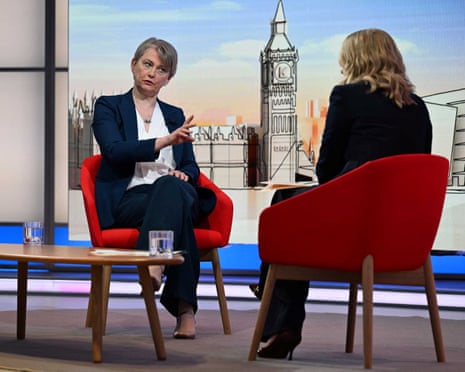
Foreign secretary Cooper has supported her prime minister, Keir Starmer, in dealing with the developing crisis between Iran and the UK following criticism from US President Donald Trump over the UK’s response to the crisis and the value of the UK’s military intervention in the region.
Speaking during an interview with television channels broadcast on Sunday, Foreign Secretary Cooper announced that the UK would act in its own best interest and not follow the policies set by the US government.
Her announcement comes at a time when President Trump posted on social media criticizing the UK’s contribution to the crisis, including the possibility of sending the aircraft carrier HMS Prince of Wales to the Middle East.
In his post, President Trump wrote: “We don’t need people that join wars after we’ve already won!”
British officials have confirmed that the HMS Prince of Wales, one of the Royal Navy’s two aircraft carriers, has been put on high alert.
However, Cooper was not willing to comment on whether the ship would be sent to the Gulf or surrounding areas.
Read Also: Starmer And Trump Speak After Days Of Public Acrimony
“It’s up to the U.S. president to decide what he thinks is in the U.S. national interest, and that’s for him to do,” said Cooper during the interview. “But it’s our job as the UK government to decide what’s in the UK national interest, and that doesn’t mean agreeing with other countries or outsourcing our foreign policy to other countries.”
The British government had not taken part in the initial air strikes conducted by the United States and Israel against Iranian forces during the early stages of the conflict.
However, the British government had given permission to US forces to use their bases to conduct defensive operations against Iranian attacks, including those used to intercept Iranian missiles and drones.
British fighter jets have also been deployed to the region, with Royal Air Force pilots assisting with intercepting aerial attacks targeting allied countries.
Defence officials announced that the UK had already deployed aircraft and additional personnel to the region prior to the most recent escalation.
Cooper announced that an additional 400 military personnel were deployed to the region with the fighter jets as part of the preparatory measures.
Additional Typhoon fighter jets and Wildcat helicopters were deployed to the region since the conflict escalated.
Britain’s role in the conflict has also sparked a political debate, with the government attracting criticism from political opponents.
Conservative Shadow Home Secretary Chris Philp claimed the government had not predicted the conflict and had left key naval forces in the wrong positions.
Philp said that the government could have deployed the ships closer to the eastern Mediterranean or the Gulf. “The problem is, those ships as we speak, are nowhere near Cyprus.
They’re nowhere near the Gulf. They’re tied up at the docks in Portsmouth because Keir Starmer and the Labour government showed no foresight whatsoever.”
Read Also: US Casualties From Iran War Arrive Home, Trump Presides
One of the ships that will be deployed to the eastern Mediterranean to bolster security at the RAF Akrotiri base in Cyprus is the air defense destroyer HMS Dragon. Currently, the ship is in Portsmouth.
However, the ship will be deployed to the eastern Mediterranean to bolster security at the RAF Akrotiri base in Cyprus. The base has been a key base for both the UK and its allies.
There has been limited disruption at the base.
During the week, a small drone hit the runway at the RAF Akrotiri base.
However, the Ministry of Defense said that the incident resulted in “minimal damage” to the runway.
The British military presence in Cyprus is also in focus because it plays a key role in surveillance and defense in the region.
On another front, the crew of HMS Prince of Wales has been instructed to prepare to set sail within five days if the government decides to dispatch the carrier strike force to the region.
The diplomatic repercussions of Trump’s attack have also coincided with a broader debate in Britain over how closely it should work with U.S. military interventions.
Former Prime Minister Tony Blair, who took Britain into the Iraq War in 2003 in conjunction with U.S. forces, argued in a private gathering on Friday that the UK should have supported the initial strikes against Iran.
In his speech to the attendees, Blair reportedly claimed the United States remained an “indispensable cornerstone” of British security and that governments across the alliance should “show up” for the alliance regardless of the leadership in the United States.
Iran also issued a warning regarding any extension of Britain’s involvement. Seyed Ali Mousavi, who serves as the Iranian ambassador to London, warned that the UK should be “very careful” about becoming more involved in the conflict.
Jenrick claimed that delays by the government in making this decision damaged the relationship between the US and the UK.