
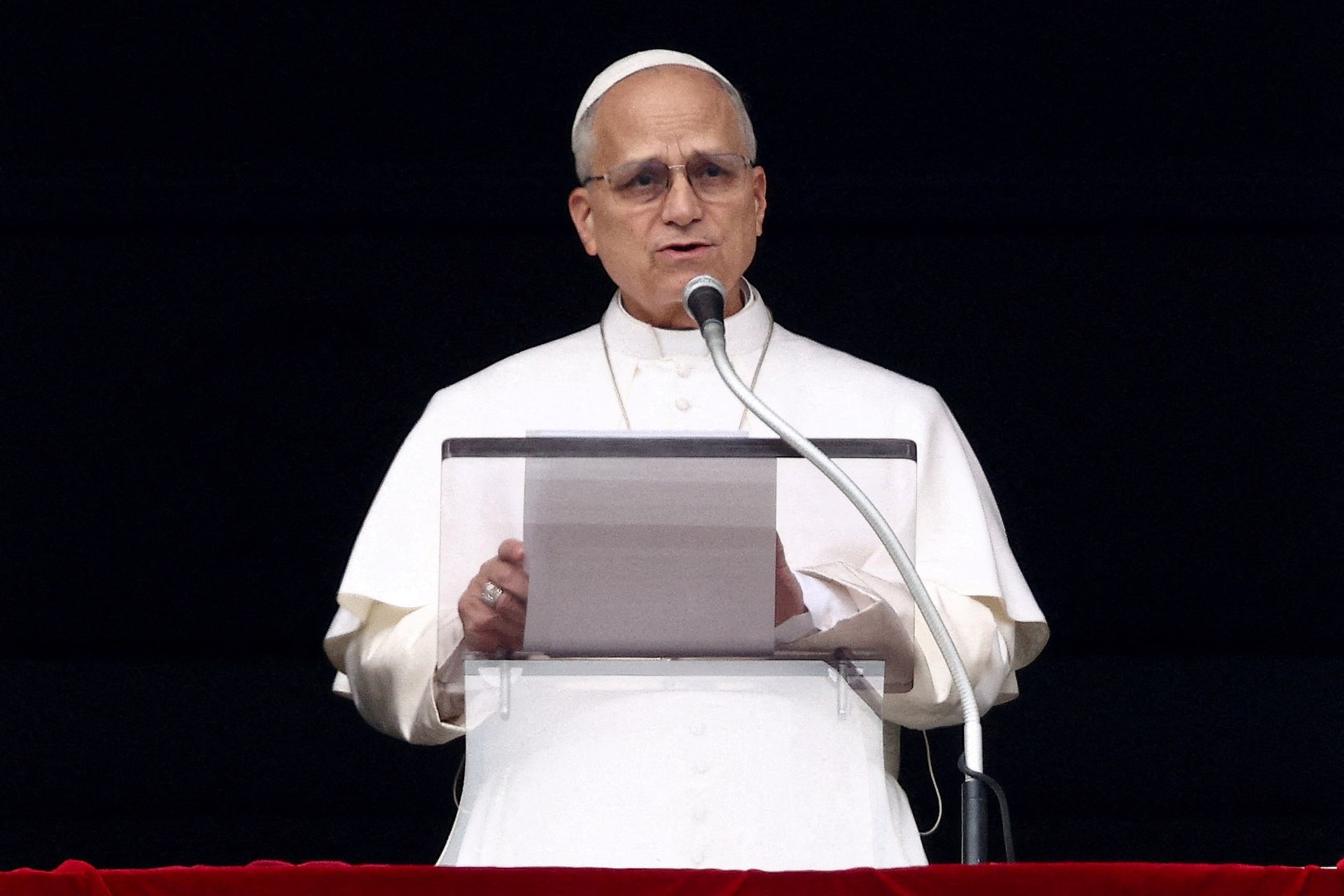
Pope Leo XIV delivered his second public intervention on the Iran war in a week on Sunday, telling thousands of the faithful gathered in St. Peter’s Square for the Angelus prayer that deeply troubling news continued to arrive from Iran and across the Middle East, that the conflict was generating a widening climate of hatred and fear, and that the Holy See was increasingly worried the war would spread to neighbouring countries.
He named Lebanon specifically as a country that could “once again sink into instability” if the fighting continued to escalate.
“Alongside the episodes of violence and devastation and the widespread climate of hatred and fear, there is also growing concern that the conflict could spread and that other countries in the region, including dear Lebanon, could once again sink into instability,” the Pope said, speaking from the window of the Apostolic Palace overlooking St. Peter’s Square. “Let us raise our humble prayer to the Lord that the roar of bombs may cease, that weapons may fall silent, and that space may be opened for dialogue in which the voices of peoples can be heard.”
The address was Leo’s most explicitly geopolitical since his election, and came as Lebanon’s death toll from Israeli strikes on Hezbollah positions climbed past 300, a figure that lent concrete urgency to his warning about the country’s fragility.
Lebanon was drawn into the conflict on March 2 when Hezbollah began firing rockets and drones into northern Israel, prompting Israeli airstrikes on Beirut’s southern suburbs and a threat from Israel’s Defence Minister that the country would pay a “very heavy price” if it failed to rein in the Iran-aligned militia. An Israeli strike on an apartment in the Ramada hotel building in the heart of Beirut on Saturday — the first to reach the Lebanese capital’s centre since hostilities resumed — gave Leo’s words an immediacy the crowd in St. Peter’s Square could not have missed.
The Angelus address was the Pope’s fourth public statement on the conflict in nine days. It came two days after the Vatican’s most senior diplomat, Cardinal Secretary of State Pietro Parolin, delivered the Holy See’s most direct legal critique of the war on Wednesday, telling journalists that the US-Israeli strikes undermined international law and that nations did not possess the right to launch preventive wars — language whose precision was understood in diplomatic circles as a deliberate Vatican legal position rather than a pastoral expression of sorrow.
Read Also: US Casualties From Iran War Arrive Home, Trump Presides
The combination of Parolin’s Wednesday statement and Leo’s Sunday Angelus has established the Vatican as the most consistent institutional voice in the world calling for a ceasefire grounded in international legal norms rather than military outcomes.
Leo, born Robert Francis Prevost in Chicago in 1955, occupies a particular position in the conflict’s diplomatic landscape as the first American pope in the history of the Roman Catholic Church.
His condemnations of a war launched by an American president carry a weight that no previous papal statement on US military action has carried — a fact not lost on senior Vatican officials, who are understood to be carefully calibrating the legal and moral language of each intervention to maximise its persuasive effect on a global Catholic population of 1.4 billion that includes significant communities in Iran, Lebanon, Iraq, Israel, the UAE, and the United States itself.
The Church’s position that preventive war lacks legal or moral justification is consistent with Catholic just war doctrine as articulated in the Catechism, which requires that war be a last resort, that it be declared by a legitimate authority, and that its expected benefits proportionately outweigh its harms — conditions Vatican officials have signalled they do not believe were met by Operation Epic Fury.
Read Also: Israeli Leader Commits To Toppling Iran, Prolonging War
The Angelus prayer on Sunday drew one of the largest crowds in St. Peter’s Square since Leo’s election, with pilgrims from dozens of countries present. Several carried Lebanese and Iranian flags, and a group of Lebanese Catholics held a banner reading “Stop the War — Lebanon Cannot Fall Again.” Leo did not refer to any party by name, consistent with the Vatican’s longstanding practice of addressing armed conflicts in humanitarian rather than partisan terms. He made no reference to Hezbollah’s entry into the war, to Iran’s missile strikes on Gulf cities, or to the question of Iranian nuclear weapons — the stated justification for the US-Israeli campaign — framing his intervention entirely around the suffering of civilians and the imperative of dialogue.
No formal Vatican diplomatic initiative had been announced as of Sunday afternoon. The Holy See maintains formal diplomatic relations with Iran, Israel, and Lebanon, and senior Vatican officials have indicated through back channels that the Pope would be willing to serve as a mediator or to host ceasefire talks, though no government had formally accepted such an offer.