
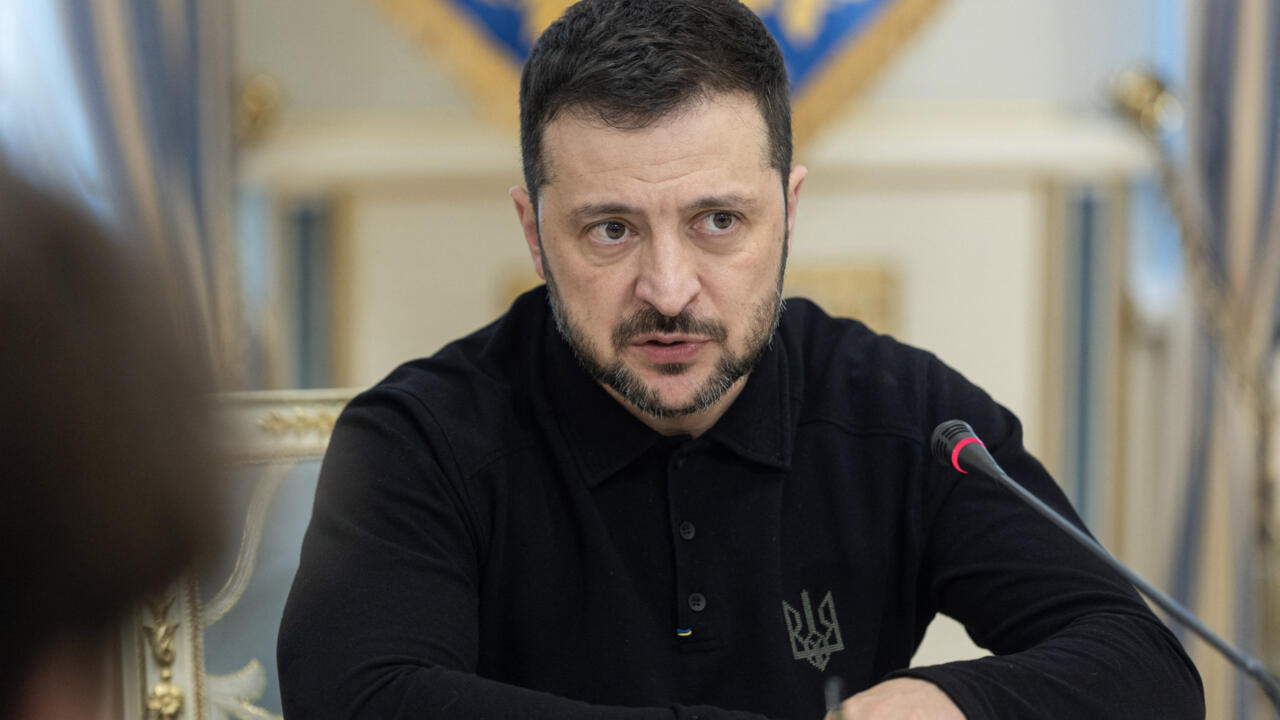
Ukrainian President Volodymyr Zelensky confronted his country’s accelerating geopolitical marginalisation in Paris on Friday, telling a joint news conference with French President Emmanuel Macron that the United States Treasury’s decision to issue a 30-day waiver on Russian oil sanctions was counterproductive, potentially providing Moscow with $10 billion in additional war revenue, as ceasefire negotiations between Kyiv and Russia remained on hold due to the Iran conflict and a proposed 90 billion euro European loan for Ukraine had yet to be agreed.
“This easing alone by the United States could provide Russia with about $10 billion for the war. This certainly does not help peace,” Zelensky said at the Élysée Palace. He was direct about the consequences of the waiver for Ukraine’s battlefield situation. “I believe that lifting sanctions will, in any case, lead to a strengthening of Russia’s position. It spends the money from energy sales on weapons, and all of this is then used against us. Therefore, ultimately lifting sanctions only so that more drones will later be flying at you is, in my opinion, not the right decision,” he said.
The US Treasury issued a license on Thursday authorising the delivery and sale of Russian crude oil and petroleum products already loaded on vessels at sea, a measure designed to free stranded cargoes and relieve supply pressure caused by Iran’s closure of the Strait of Hormuz. The 30-day waiver does not lift the underlying sanctions architecture imposed on Russia following its February 2022 invasion of Ukraine, but it creates a temporary carve-out that allows seaborne Russian oil already in transit to reach buyers without the threat of secondary sanctions on the vessels or counterparties involved. Russia’s economic envoy Kirill Dmitriev said from Moscow that the waiver was an acknowledgement of the obvious and described further easing as “increasingly inevitable,” adding that the global energy market “cannot remain stable” without Russian supply.
The Allied response to Washington’s decision was unusually sharp. German Chancellor Friedrich Merz said that six of the G7’s seven members had told Trump clearly during a video summit on Wednesday that easing Russian oil sanctions “would not send the right signal,” only to learn the following morning that Washington had proceeded regardless. “Again, we believe this is wrong,” Merz said. Germany’s Economy Minister Katherina Reiche said she was “concerned that we are further filling Putin’s war chest.” The United Kingdom’s energy department minister Michael Shanks said London would not loosen its own Russia sanctions at all, describing the moment as “critical” in the context of Russia’s ongoing aggression.
Macron, standing beside Zelensky, characterised the US waiver as “limited” and “taken on an exceptional basis” and emphasised that it did not broadly or permanently roll back the sanctions framework the US itself had established. “It does not broadly or permanently roll back the sanctions that they themselves decided to apply,” he said.
Macron used the news conference to reaffirm France’s support for Ukraine in the strongest terms he had employed since the Iran war began.
“Nothing will deter us” from helping Ukraine, he said, praising Kyiv’s “remarkable tenacity and courage” in the face of Russia’s invasion. He reiterated that there was no legitimate basis for lifting Russian sanctions and that if Moscow calculated it could exploit the Iran crisis to ease the pressure on its economy and military, it was mistaken. Without elaborating further, he said Western weapons support to Ukraine would be stepped up.
Read Also: Russia Kills Seven in Kharkiv, Ukraine Residential Block
The Paris visit came one day after Zelensky had travelled to Romania, where he deepened defence ties and agreed to launch joint drone production with Bucharest, a partnership that is part of a broader Ukrainian strategy to diversify its weapons manufacturing base across allied European nations.
The Romanian arrangement and the Paris discussions are both driven by the same concern: that the Iran war has not only diverted global attention from Ukraine but is actively degrading the resources available to support Kyiv’s defence, particularly in the critical area of air defence.
Zelensky’s most striking analytical claim in Paris concerned the comparative scale of air defence expenditure in the two conflict theatres. He said Gulf states had consumed more PAC-3 air defence interceptors in a few days of Iranian attacks than Ukraine had received from the United States across the entire four years since Russia’s full-scale invasion. He did not provide a source for the figure. The claim, if broadly accurate, illustrates the material consequence of the Iran war’s diversion of Western and US-allied defence industrial output — and the structural difficulty Ukraine faces in obtaining adequate interceptor stocks when competing for finite production capacity against sovereign governments that are themselves under active aerial bombardment.
Ukraine has meanwhile repositioned itself as a potential technology supplier to the Middle East, offering drone interception expertise built up over four years of operational experience countering Russian unmanned systems. Zelensky said Ukraine had received requests for drone combat assistance from six countries, had already deployed expert teams to three of them, and had received separate requests from the United States and Jordan. He said the offer was not limited to the supply of interceptors but extended to the deployment of Ukraine’s integrated approach to counter-drone warfare, encompassing radar integration, air defence coordination, and the full operational system built during the conflict with Russia.
Read Also: Ukraine Strikes Russian Missile Plant With Storm Shadows
“There must be proper, systematic work with radars and with the entire air defense system. Ukraine is ready to share this experience for the sake of the security of those partners who are helping us,” he said. Kyiv is offering the technology in exchange for weapons it cannot manufacture domestically, principally high-end air defence missiles and advanced munitions.
Ukraine is separately awaiting White House approval for an agreement on producing battle-tested drones jointly with an American partner, Zelensky said on Thursday. The arrangement has been under discussion for several weeks but has not received formal sign-off from the Trump administration. The White House has not publicly commented on the proposal.
US-mediated talks between Kyiv and Moscow, which were approaching a substantive stage before the Iran war erupted, have been placed on hold. Zelensky said they could potentially resume next week, though he offered no confirmation and no indication that the US had committed to a specific timetable. The ceasefire talks have been paused since February 28, when Operation Epic Fury began. The core obstacle — Washington’s proposal that Ukraine formally cede Russian-occupied portions of the Donetsk and Luhansk regions — has not been resolved and is unlikely to be addressed until the Trump administration’s immediate focus on the Iran conflict has eased.
The 90 billion euro EU loan for Ukraine, which would provide Kyiv with funding to purchase weapons and sustain government operations, has not yet received agreement from all EU member states. Ukraine hopes it will be in place by mid-April.