
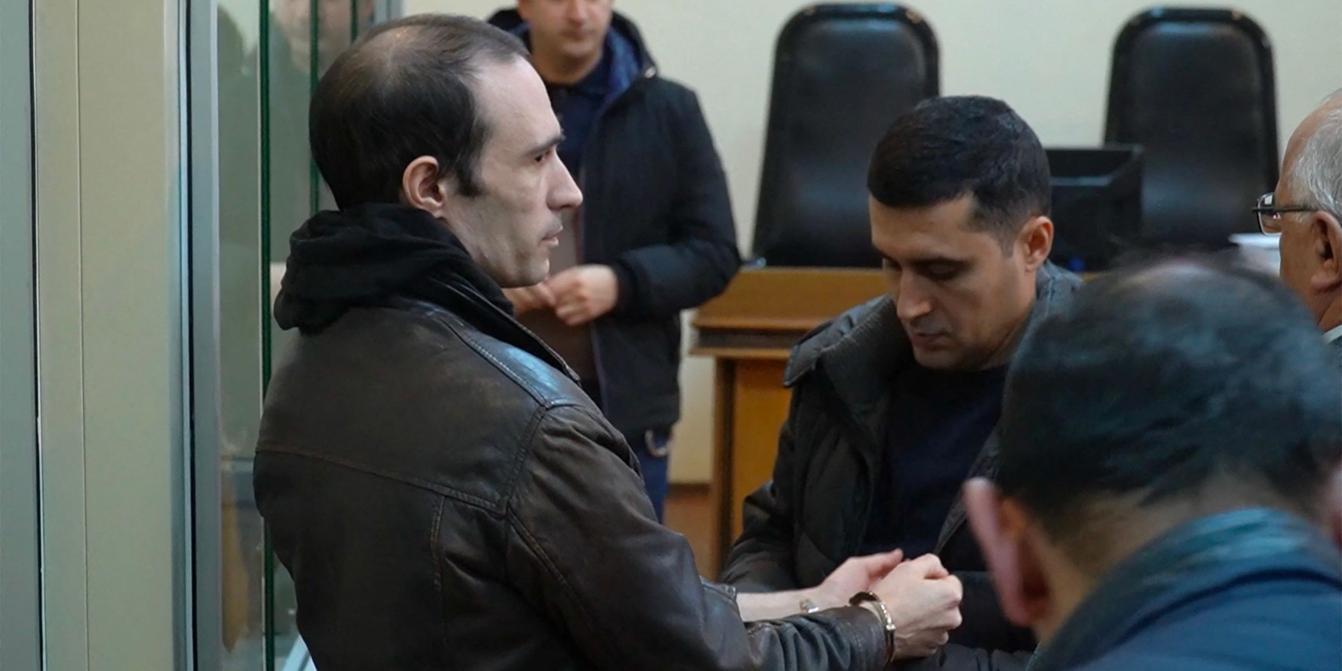
A Baku court sentenced Martin Ryan, a dual French-British citizen who had been running a food importing business in Azerbaijan, to ten years in prison on Monday after convicting him of espionage on behalf of France’s external intelligence service, the DGSE, in a case that produced the expulsion of two French embassy officials, strained bilateral relations between Paris and Baku for over two years, and drew directly on the political tensions generated by France’s alignment with Armenia in the Nagorno-Karabakh conflicts.
The verdict was delivered at the Baku Court for Grave Crimes by Judge Elmin Rustamov. Ryan was convicted under Article 276 of Azerbaijan’s Criminal Code, which covers espionage. His co-defendant, Azerbaijani national Azad Mammadli, was simultaneously convicted of high treason under Article 274 and sentenced to twelve years in a strict-regime penal institution. Both men will serve their terms in strict-regime facilities. Ryan is to be deported from Azerbaijan upon completing his sentence.
Ryan denied spying in his final statement to the court. “I consider myself guilty only in that I should not have established contacts with some embassy employees, or that I should have shared information about them with the appropriate authorities,” he said. “I did not spy. I am not a spy, and during the court case I tried to prove this.” He pleaded partially guilty to some charges while contesting the characterization that he had acted as a knowing agent of French intelligence. His lawyer has not announced whether Ryan intends to appeal.
According to the indictment filed by Azerbaijan’s State Security Service, Ryan was recruited into covert cooperation by officers of the DGSE who were operating under diplomatic cover at the French embassy in Baku. The scope of the alleged intelligence-gathering operation as described in court documents was extensive, encompassing information on weapons and ammunition produced in Azerbaijan, the staffing of the Azerbaijani armed forces during the 44-day Patriotic War of 2020, current and former military personnel who could be developed as intelligence sources, individuals studying abroad in French-language programs, the monitoring of Azerbaijan’s bilateral relationships with the United Kingdom, Algeria, Turkey, Pakistan, Iran, China, Somalia, and Central Asian states, military cooperation plans, and covert money transfers. Two DGSE officers operating from the French embassy were declared persona non grata and expelled from Baku as the investigation developed.
The prosecution alleged that Ryan recruited Mammadli and arranged meetings between him and French intelligence officers, who tasked Mammadli with recruiting additional Azerbaijani and Russian contacts at a Moscow university where he was studying. Prosecutors also alleged that Ryan, through Mammadli, organized relationships with employees of French bank Societe Generale operating in Azerbaijan to facilitate covert financial transfers. Mammadli denied guilt at the start of the trial.
Ryan had been in Baku since approximately 2020, operating as general director of Merkorama LLC, a small company specializing in the import of French food products and raw materials into the Azerbaijani market. The company had fewer than ten employees, the majority of them Azerbaijani nationals. He had been engaged to an Azerbaijani woman at the time of his arrest on December 4, 2023. His father told AFP in January 2025 that “no incriminating evidence has been presented” against his son and expressed confidence in French consular support, while describing the family as “tired but optimistic.” France’s Foreign Ministry described Ryan’s detention as “arbitrary” and called for his immediate release throughout the two-year pretrial and trial period.
Read Also: Iraq Attack Claims French Soldier’s Life, Wounds Several
France has argued throughout the proceedings that Ryan was caught in the crossfire of diplomatic tensions rather than engaged in active intelligence work. Paris rejected the accusations against him and insisted he had no connection to French intelligence services. French officials described the case as inseparable from the broader deterioration of France-Azerbaijan relations that followed the Second Nagorno-Karabakh War of 2020, in which France took a firmly pro-Armenian position, and the subsequent period in which Azerbaijan accused Paris of backing Armenian rearmament and France accused Azerbaijan of fomenting unrest in France’s overseas territory of New Caledonia.
Relations between the two countries showed signs of improvement in the months before the verdict, however.
At a meeting in Copenhagen in October 2025, Azerbaijani President Ilham Aliyev told President Emmanuel Macron that “past misunderstandings between the two countries have been resolved.” A French government source told AFP shortly before Monday’s verdict that Paris wanted to “carry forward a process of normalization with Azerbaijan” and that among the remaining “disagreements between our two countries is the fate of Martin Ryan.”
Read Also: France Deploys Carrier Group, Plans Hormuz Escort Mission
The Ryan conviction is the most high-profile espionage case in Azerbaijan involving a Western national in recent memory, but it is not without precedent in the region’s recent history. Azerbaijan has consistently used its State Security Service to pursue what it characterizes as foreign intelligence operations on its soil, particularly those allegedly connected to French, Armenian, or Iranian intelligence activities. The country’s 2020 military victory in the Second Nagorno-Karabakh War — which returned to Azerbaijani control territory lost in the 1990s conflict — and its subsequent consolidation of control over the former Armenian-populated enclave in September 2023 have produced a heightened domestic security posture in which foreign citizens working in Azerbaijan face significant risks of surveillance and arrest in connection with their diplomatic or business contacts.
Monday’s sentencing also sets a backdrop for any diplomatic negotiations over Ryan’s early release. Precedent exists: Azerbaijan pardoned another French citizen, Theo Hugo Clerc, who had been jailed for three years for drawing graffiti in the Baku metro, in May 2025 — a release widely interpreted as a diplomatic gesture in the context of the France-Azerbaijan normalization process. Whether a similar pardon or early release mechanism will be pursued for Ryan, whose case is considerably more politically sensitive, has not been indicated by either government. France’s foreign ministry said after the verdict that it would “continue its efforts to defend the rights and interests of Martin Ryan.”