
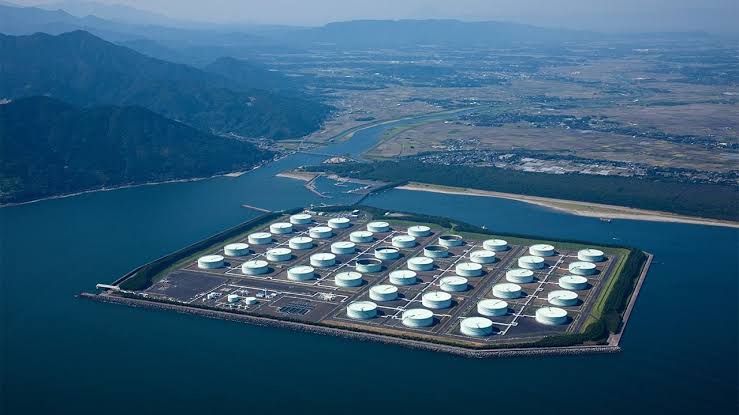
Japan began releasing its strategic oil reserves on Monday, becoming the first nation to act on an emergency agreement among developed economies to flood markets with stockpiled crude as war in the Middle East drives energy prices to punishing levels.
The move follows a March 11 decision by members of the International Energy Agency to collectively tap government-managed oil stockpiles — the largest coordinated reserve release in the agency’s history. A total of 271.7 million barrels will be made available worldwide, the IEA said, with Asian and Oceanian members moving first while countries in the Americas and Europe begin their releases at the end of the month.
Japan is among the most exposed nations to the current crisis. The country sources 95 percent of its oil imports from the Middle East, leaving it with almost no buffer against supply disruptions originating in the Gulf.
Its reserves, however, are among the world’s largest — standing at more than 400 million barrels as of December, equivalent to 254 days of domestic consumption. That deep stockpile gives Tokyo both the means and the political justification to act quickly.
A notice published Monday in Japan’s official government gazette confirmed the release had begun, stating formally that the level of oil reserves in the country “is being lowered.” Under Japanese law, the notice is not merely informational — it compels managers of oil reserve facilities to draw down their holdings to meet the newly mandated standard. Several Japanese media organisations interpreted the publication as confirmation that the process was already underway.
Government spokesman Minoru Kihara said Monday that 15 days’ worth of private-sector petroleum reserves would be released. That figure sits alongside a separate commitment from Digital Economy Minister Sanae Takaichi, who said last week the government planned to release one month’s worth of national reserves on top of the private-sector drawdown. Economy, Trade and Industry Minister Ryosei Akazawa had indicated on Friday that private stockpiles would be mobilised before the government’s own holdings — a sequencing that suggests the full scale of Japan’s contribution will unfold in stages over the coming weeks.
Read also: Trump Tells World To Guard Hormuz Strait Without US
The speed of Japan’s response reflects the severity of what the war has done to energy markets. Iranian attacks on Gulf oil facilities and the effective closure of the Strait of Hormuz have sent global crude prices surging, straining household budgets and industrial costs across oil-importing nations. For Japan, which imports virtually all of its energy needs, the price shock is not abstract — it transmits directly into electricity bills, transport costs, and the broader inflation picture that the government has been struggling to manage.
The IEA’s coordinated release is designed to send a clear signal to markets: consuming nations are not passive victims of the supply disruption. By releasing stockpiles in volume, members aim to bridge the gap between what the market needs and what it can currently access through normal channels, buying time for diplomatic or military developments to alter the underlying situation at the strait.
Whether the release will be sufficient depends on how long the disruption lasts and how completely Iranian interdiction continues to block Hormuz traffic. The 271.7 million barrels committed collectively by IEA members is a substantial figure in absolute terms, but the strait normally handles roughly 20 million barrels per day of oil and liquefied natural gas combined. A prolonged closure would exhaust even the largest coordinated reserve response within weeks, not months.
Japan’s 254-day reserve buffer — built deliberately over decades precisely for scenarios like this one — gives the country unusual depth compared with most IEA members. The United States, by contrast, has drawn down its Strategic Petroleum Reserve significantly in recent years, leaving it with less cushion than it carried into previous crises. European nations, many of which accelerated stockpiling after the disruptions caused by the war in Ukraine, enter this crisis in somewhat better shape than they did in 2022, though still dependent on the pace of any diplomatic resolution.
Read also: Beijing-Pyongyang Train Resumes After Covid Shutdown
The IEA said national implementation plans had been submitted by all member countries, with the Asia-Oceania grouping — which includes Japan, South Korea, Australia and New Zealand among others — moving to release stocks immediately. The staggered rollout, with the Americas and Europe following at month’s end, appears designed to ensure supply reaches the markets most immediately affected by the Hormuz disruption first, given their geographic proximity to the Gulf.
South Korea, which also sources the vast majority of its oil from the Middle East, is expected to move in parallel with Japan. Neither Seoul nor other Asian IEA members had released formal figures by Monday on the scale of their individual contributions.
In Tokyo, officials framed Monday’s gazette notice as the practical beginning of a process already agreed in principle. The language was measured, the mechanism bureaucratic — but the action underneath it was the largest emergency energy intervention the world has attempted, set in motion by a war whose end remains nowhere in sight.