
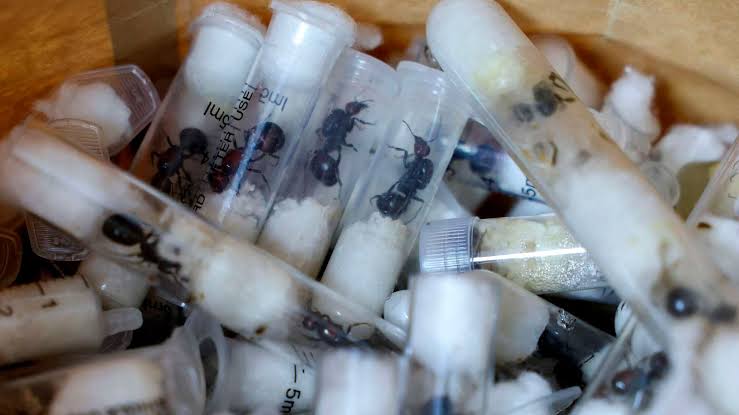
Kenyan prosecutors arraigned a local man at the Jomo Kenyatta International Airport court on Monday on charges of supplying live garden ants to an international smuggling syndicate, connecting him directly to the Chinese national arrested at the same airport last week and to a separate consignment seized in Bangkok earlier this month — widening what investigators have described as the most sophisticated domestic ant-trafficking network yet uncovered in Kenya.
Charles Mwangi was arraigned at the JKIA Law Courts after the Office of the Director of Public Prosecutions filed charges. Police had conducted a search of his residence and recovered 1,000 unpackaged live garden ants, 113 live garden ants packaged in modified syringes, and 503 empty syringes prepared for further packaging. The combination of ready-packaged ants and a large volume of prepared but unfilled syringes suggested an active operation at the moment of the search rather than a completed delivery — consistent with the prosecution’s allegation that Mwangi served as a regular supplier rather than a one-time courier.
Prosecutors linked Mwangi directly to Zhang Kequn, the Chinese national arrested at JKIA on March 11 while attempting to board a flight to China with more than 2,000 live ants concealed in test tubes and tissue paper rolls. They also linked him to a consignment of ants seized in Bangkok on March 10 that originated from the Kenyan port city of Mombasa, and said he had ties to accomplices in several Kenyan counties.
The Bangkok connection is particularly significant to the investigation’s scope. Its discovery means the trafficking network was operating through at least two separate export channels simultaneously — the air route through JKIA to China, and a maritime route through Mombasa to Thailand — suggesting a level of organizational complexity that significantly exceeds the low-volume opportunistic operations that characterized earlier Kenyan ant-smuggling cases. The March 10 Bangkok seizure and the March 11 JKIA arrest occurring within 24 hours of each other also indicates that the Kenya Wildlife Service and Kenyan customs authorities may have been working with international counterparts in a coordinated surveillance operation, though prosecutors have not confirmed that publicly.
Zhang Kequn’s court appearance is scheduled for March 17, at which the KWS is expected to present the results of its forensic examination of an iPhone and MacBook recovered from Zhang at the time of his arrest. KWS investigators have also extended their field operations beyond Nairobi to Nakuru, Naivasha, and other towns in the Rift Valley where ant harvesting is believed to be ongoing. The three individuals Zhang had identified to investigators as his suppliers — one of whom is now alleged to be Mwangi — became the focal point of the domestic investigation in the days following his detention.
Read Also: Chinese Man Held In Kenya Over 2,000-Ant Smuggling Attempt
The species at the center of the case is Messor cephalotes, the giant African harvester ant, a ground-dwelling insect endemic to East Africa that serves ecologically significant roles in seed dispersal and soil aeration. It has become a highly sought-after species in the formicarium hobby market across Europe and Asia, where collectors pay premium prices for queen ants capable of founding colonies that can be observed in elaborate glass or acrylic enclosures. A single queen Messor cephalotes can command the equivalent of several hundred US dollars in specialist online markets, and established colonies retail for considerably more. The removal of queens from wild populations is particularly ecologically damaging because queens can live fifteen to twenty years and are irreplaceable in sustaining the colony’s reproductive capacity.
Under Kenya’s Wildlife Conservation and Management Act and the broader legal framework that classifies insects as protected wildlife, the collection, sale, export, and possession of wild ants without a Kenya Wildlife Service permit is a criminal offense carrying potential imprisonment and significant fines. The penalties were applied directly in April 2025, when two Belgian nationals and a Vietnamese citizen were convicted at the same JKIA court of illegally dealing with protected species after being found with queen ants. Each was fined the equivalent of approximately $7,700. That case was described at the time as a landmark judgment — the first to treat insects as protected wildlife deserving of the same criminal sanctions as elephant ivory or rhino horn.
Read Also: Nairobi Flash Floods Claim 23 Lives In Sudden Deluge
The Mwangi arraignment, taken together with Zhang’s detention and the Bangkok and Mombasa seizures, suggests that the April 2025 conviction did not deter the trafficking network. Instead, it appears to have prompted operational refinements — the shift from syringes to specialized test tubes documented in the Zhang case, the diversification of export routes from air-only to include maritime shipping through Mombasa, and the geographic spread of collection and packaging operations across multiple Kenyan counties rather than a single location. These adaptations are consistent with how trafficking networks in other high-value wildlife categories, such as rhino horn and elephant ivory, have historically responded to enforcement pressure: by multiplying redundancy and reducing exposure at any single node of the supply chain.
The KWS and the DPP have not publicly confirmed whether additional suspects beyond Mwangi and Zhang are in custody or under active investigation. Mwangi was not immediately available for comment through any reported legal representative. No plea has been recorded, and no bail application or hearing date has been publicly confirmed beyond the reference to Monday’s arraignment. Zhang’s next court mention is confirmed for March 17 at the JKIA Law Courts.