
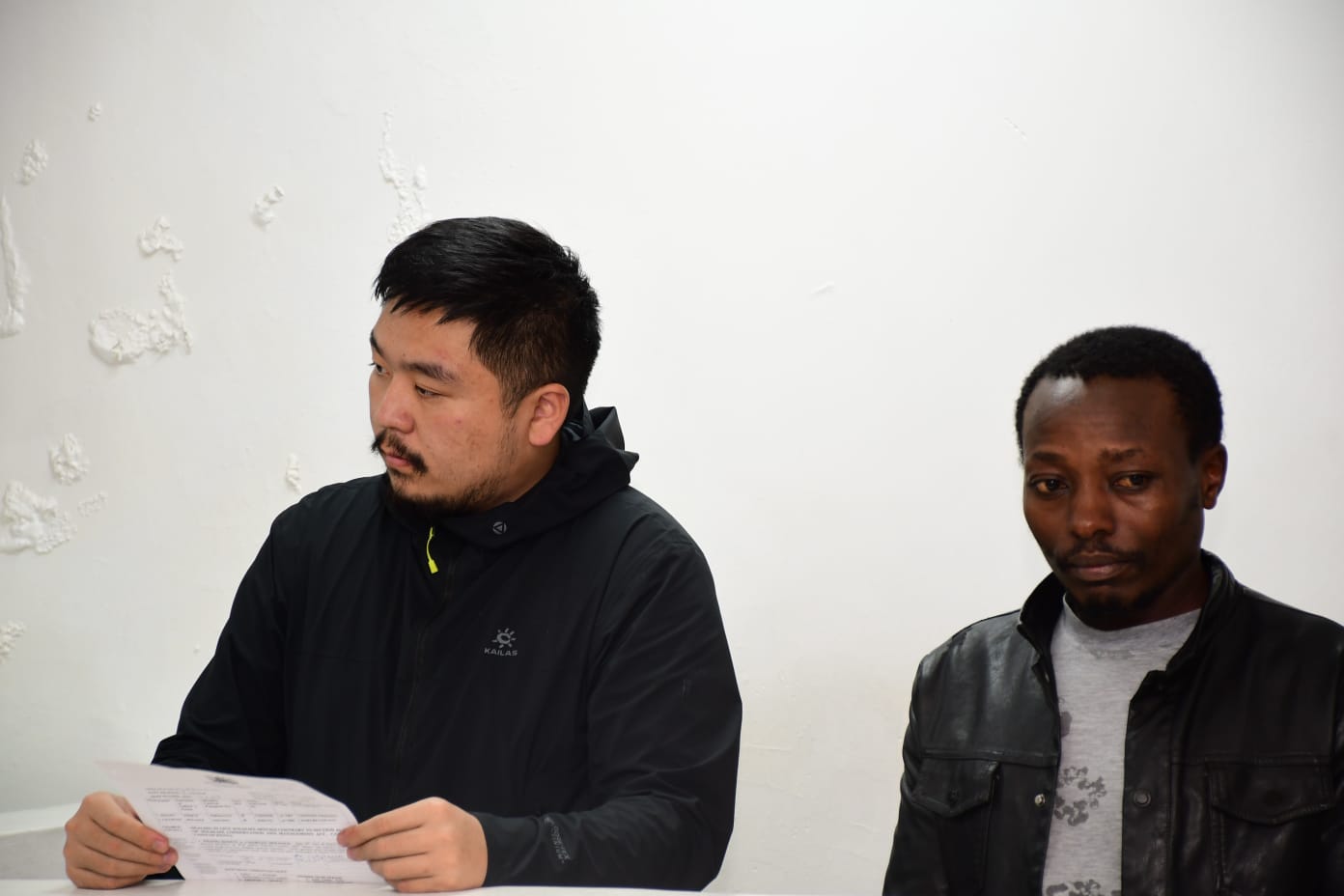
A Nairobi court charged Chinese national Zhang Kequn and Kenyan supplier Charles Mwangi with illegal wildlife transportation on Tuesday, with prosecutors presenting CCTV footage of the two men meeting at a hotel in Nakuru to exchange live ants twelve days before Zhang was arrested at JKIA — evidence that prosecutors said placed the two men in a direct operational relationship and substantiated their allegation that the pair were central nodes in an international ant-trafficking network with documented branches in Mombasa, Naivasha, Kajiado, Bangkok, and an earlier connection to two Belgian nationals who were convicted at the same court in April 2025.
Both men pleaded not guilty before Senior Principal Magistrate Irene Gichobi at the JKIA Law Courts. Prosecution lawyers John Tago and Mercy Katsivo revealed that CCTV footage from Moonlight Hotel in Nakuru showed Mwangi supplying ants to Zhang Kequn on March 5, 2026 — six days before Zhang’s arrest at JKIA on March 11. The prosecution further noted that in April 2025, Mwangi supplied ants to three individuals of Vietnamese, Belgian, and Kenyan nationality who were later arrested and charged at the JKIA Law Court. Mwangi also stands linked to the consignment seized in Bangkok on March 10, originating from Mombasa, with accomplices reportedly based in Naivasha sub-county, Mombasa, and Kajiado County.
The Nakuru hotel evidence is the most significant disclosure to emerge since Zhang’s initial arrest. It establishes that Mwangi and Zhang conducted at least one direct in-person exchange on the same week as both the Bangkok seizure and Zhang’s own JKIA arrest, compressing the timeline of the syndicate’s activity into a matter of days and demonstrating that the network was operating at high pace across multiple channels simultaneously. Zhang had been in Kenya for approximately two weeks before his arrest, during which time prosecutors allege he acquired ants from Mwangi in Nakuru, had ants shipped through Mombasa to Bangkok via a separate route, and was attempting to depart with more than 2,000 ants in test tubes and tissue paper through the JKIA departure terminal.
The court ordered Zhang and Mwangi remanded in custody. Senior Principal Magistrate Gichobi ordered Mwangi to be detained at Lang’ata Police Station for three days while investigations continue. The matter is scheduled for mention on March 19, 2026. Zhang’s case is listed for mention on March 27, when the KWS is expected to present its forensic findings from the examination of his iPhone and MacBook, both of which were seized at the time of his arrest.
The April 2025 precedent that Mwangi is alleged to have been part of provides useful context for what prosecutorial outcomes in this case might look like. Two Belgian teens were arrested in April 2025 with approximately 5,000 ants, and after being convicted were given the choice of paying a $7,700 fine or serving a year in prison.
Read Also: Kenya Arraigns Local Ant Supplier Linked To Bangkok Seizure
The KWS described that judgment as a landmark case — the first to formally treat insects as protected wildlife under the same legal framework applied to elephant ivory or rhino horn. Zhang’s case is potentially more serious given the prosecutors’ allegation that he was the ringleader of a previously broken-up trafficking ring who returned to Kenya using a different passport, and that the operational scope under his direction included both air and maritime export routes.
The Mombasa-to-Bangkok maritime corridor that Mwangi is linked to has not been previously documented in public KWS or NDCS enforcement records as a confirmed ant-trafficking route. Its emergence in these proceedings — alongside the JKIA air route to China — confirms that the syndicate was maintaining at least two parallel export channels, reducing its operational risk exposure if either was interdicted. The Bangkok seizure occurring on March 10, one day before Zhang’s JKIA arrest, means that both channels were simultaneously active in the same week, adding to the case for treating the operation as a coordinated transnational enterprise rather than a loosely associated series of individual transactions.
Read Also: Chinese Man Held In Kenya Over 2,000-Ant Smuggling Attempt
The species involved, Messor cephalotes — the giant African harvester ant — is endemic to East Africa and serves roles in seed dispersal and soil aeration that ecologists describe as disproportionately important for ecosystems in which they are present. The queen ant, the primary commodity in the trafficking trade, can live for fifteen to twenty years and is the sole reproductive individual in a colony that can number tens of thousands of workers. Removing queens from wild populations imposes a compounding ecological loss that is not visible at the level of any single seizure but cumulates over time as more and more colonies are deprived of their reproductive capacity.
The price premium in overseas formicarium markets makes the risk calculus attractive to traffickers. A single queen Messor cephalotes can command several hundred US dollars in specialist European or Asian markets, and a live colony of several hundred to several thousand individuals can sell for multiples of that. Zhang’s two thousand ants, if successfully imported into China and sold individually, could have generated returns equivalent to several hundred thousand dollars at the retail end of the market — a return that would have comfortably absorbed the cost of multiple Nairobi trips and a distribution network spanning several Kenyan counties.
KWS officials confirmed that field investigations were continuing in Nakuru, Naivasha, Mombasa, and Kajiado to locate and apprehend the additional accomplices identified in the prosecution’s court submissions. No further arrests in connection with the Mwangi or Zhang cases had been announced as of Tuesday afternoon.