
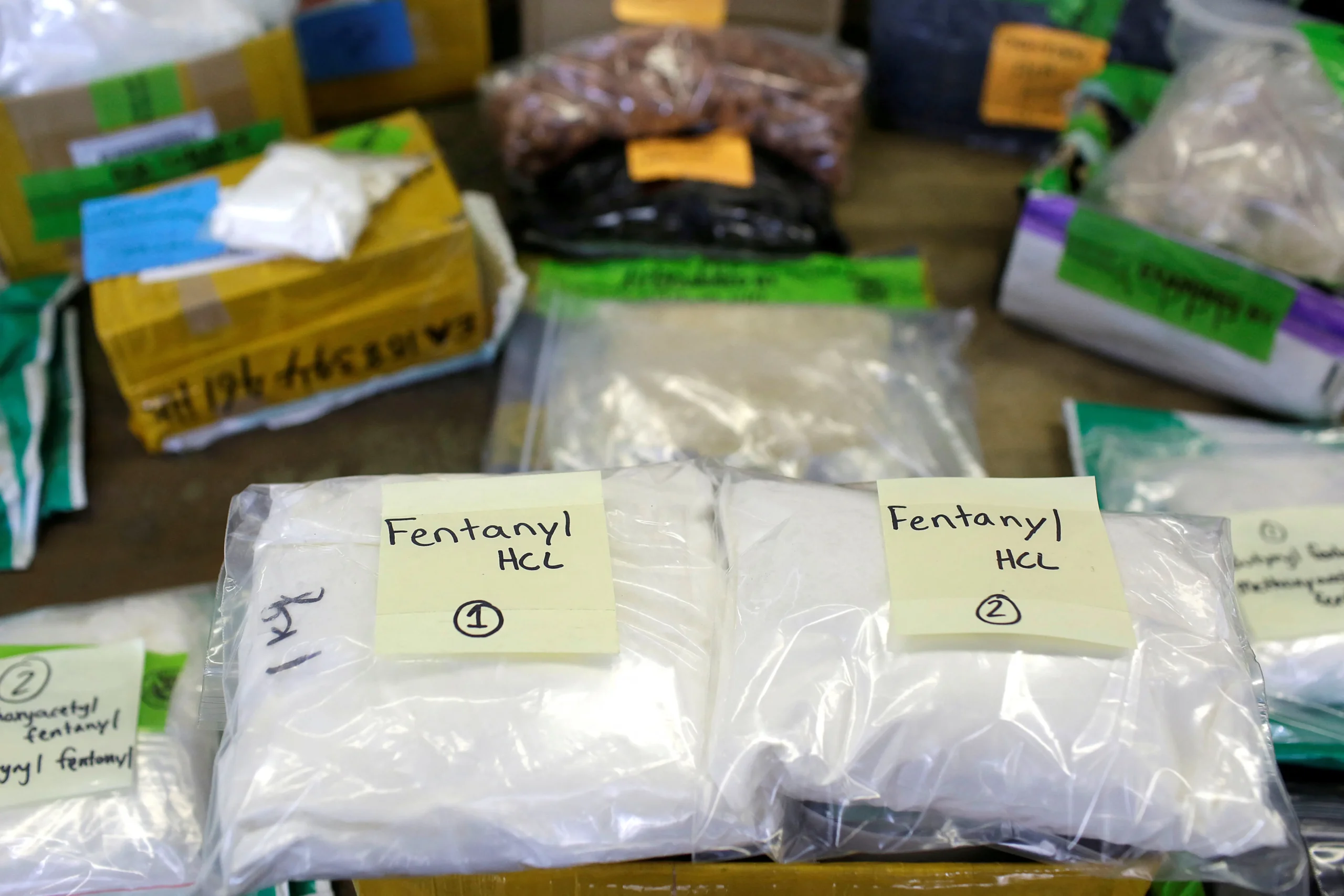
China publicly disclosed Thursday that authorities in the central province of Hubei had arrested seven people and subjected twelve others to criminal enforcement measures in a campaign targeting the production, distribution, and export of fentanyl precursor chemicals — the first time in years Beijing has publicized criminal arrests specifically linked to the illegal trade that the United States has repeatedly identified as a primary driver of its domestic overdose crisis.
The Hubei provincial anti-narcotics commission confirmed that a special operation launched in December 2025 under a directive from the Ministry of Public Security had by February investigated 22 criminal cases involving precursor chemicals for fentanyl. Seven individuals were arrested.
Twelve others were subjected to criminal compulsory measures — a category that can include formal detention, summons, or bail-like restrictions. One additional individual received administrative detention, and four companies were issued administrative penalties. Authorities also shut down more than 200 websites linked to non-compliant enterprises during the operation.
The timing and public nature of the announcement were as significant as its substance. The disclosure follows weekend trade talks between American and Chinese officials held to prepare for a summit between President Donald Trump and Chinese President Xi Jinping that had originally been scheduled for the end of March in Beijing.
Trump postponed the trip due to the ongoing U.S.-Israeli war against Iran but said he planned to travel to Asia in “about five or six weeks.” For years, Washington had demanded that Beijing move beyond regulatory warnings and website removals to actual criminal prosecutions of chemical suppliers whose products were being synthesized into fentanyl that reached American streets.
Thursday’s announcement marked the first formal indication that China had done so and chosen to say so publicly.
The operation followed a broader diplomatic exchange. In late October, China and the United States reached an agreement under which Beijing committed to concrete steps to disrupt fentanyl precursor networks in exchange for a reduction in the fentanyl-related tariff Trump had imposed on Chinese imports, a levy that had been set at 20 percent and was cut to 10 percent following a meeting between Trump and Xi in South Korea.
The public disclosure of the Hubei operation Thursday represents Bejiing’s most prominent signal yet that it is following through on that agreement, coming at a moment when the two governments are actively managing a broader relationship under strain from trade disputes, the Iran war’s economic fallout, and the postponed summit.
Among the specific cases outlined in Chinese state media coverage, one arrest in Wuhan — the provincial capital — was made possible by intelligence shared directly by the U.S. Drug Enforcement Administration.
A company operating in Wuhan was found to be selling both precursor chemicals and psychoactive stimulants. The suspect was arrested in December in a joint operation with police from Shandong province. In a separate case, two individuals were arrested on suspicion of setting up shell companies to sell controlled substances and drug precursor chemicals for export overseas.
Read Also: China Ties Taiwan Energy Offer To Reunification
The precursor chemicals at the center of the campaign are substances that are legal in commercial form but can be chemically converted into fentanyl — a synthetic opioid 50 to 100 times more potent than morphine. Fentanyl and its analogues are responsible for the majority of the more than 70,000 annual drug overdose deaths recorded in the United States in recent years, according to data from the Centers for Disease Control and Prevention. U.S. law enforcement and public health officials have identified Chinese chemical manufacturers as the primary upstream source of the precursor compounds, which typically transit through Mexico where they are processed into finished fentanyl by drug trafficking organizations before entering the American supply.
The tariff dimension of the standoff has been further complicated by a recent legal development. The U.S. Supreme Court last month struck down a 10 percent fentanyl-related tariff that Trump had imposed on China under the International Emergency Economic Powers Act, ruling that the statute did not authorize the specific tariff mechanism employed.
The Trump administration has since informed Beijing that it intends to reimpose the levy under an alternative legal framework. The precise statute the administration intends to use has not been publicly specified, and the timeline for reimposition has not been confirmed.
Chinese officials have historically contested Washington’s characterization of their role in the fentanyl crisis. Beijing has argued that it has taken extensive regulatory steps to schedule the precursor chemicals in question — adding them to controlled substance lists, mandating export documentation, and penalizing non-compliant chemical companies — and has accused successive American administrations of using the fentanyl issue as a pretext for economic pressure. Chinese officials have described Washington’s repeated demands for criminal prosecutions as “blackmail,” arguing that China’s domestic legal framework and regulatory approach are not obligated to mirror American enforcement preferences.
Read Also: Philippines Dismisses China’s Sweeping Sea Sovereignty Bid
That defensiveness, however, has existed alongside a recognition that the fentanyl issue has become inseparably entangled with the broader tariff negotiations that define the current phase of U.S.-China economic relations. Trump’s original executive action imposing a 10 percent tariff specifically on fentanyl grounds immediately upon taking office in January 2025 established a direct transactional link: Chinese action on precursors could yield tariff relief. The October deal that halved that levy demonstrated the formula could work. Thursday’s announcement, coordinated with state media to maximize visibility before the postponed Trump-Xi summit, fits that pattern — a public demonstration of compliance designed to hold the current tariff arrangement in place and prepare the ground for the rescheduled meeting.
The Hubei operation covered the full supply chain, from the synthesis and production of controlled precursors through their storage, distribution, and export — indicating the task force was not limited to street-level or retail-facing activity but extended into manufacturing facilities and export logistics chains. The commission said it had also strengthened internet monitoring infrastructure and risk-prevention systems across the province related to precursor chemical sourcing. Whether comparable operations are being conducted in other Chinese provinces — particularly those with larger concentrations of fine chemical manufacturing, such as Zhejiang and Jiangsu — has not been disclosed.
No U.S. government official commented on the Chinese announcement by the time of publication. The Trump administration’s position that Beijing must sustain and expand criminal enforcement as a condition of further tariff relief has not been formally revised or publicly restated since the Supreme Court ruling last month. The rescheduled Trump-Xi summit remains undated.