
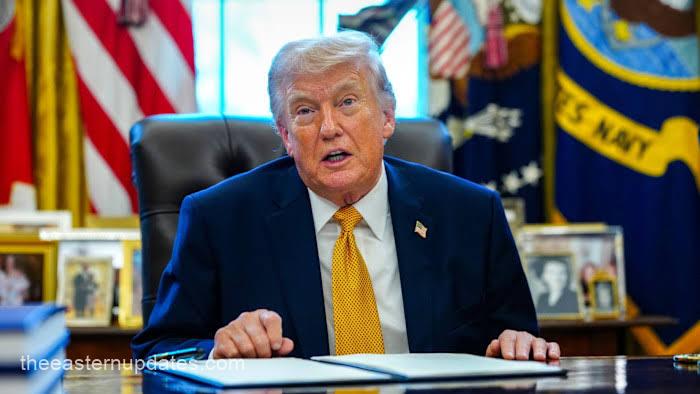
President Donald Trump threatened Saturday to replace Transportation Security Administration screeners with Immigration and Customs Enforcement agents at the nation’s airports starting Monday, escalating a five-week standoff over funding for the Department of Homeland Security that has produced hours-long security lines across the country, the resignation of hundreds of TSA officers, and a growing political crisis for an administration already managing the costs of a war in the Middle East.
“If the Radical Left Democrats don’t immediately sign an agreement to let our Country, in particular, our Airports, be FREE and SAFE again, I will move our brilliant and patriotic ICE Agents to the Airports where they will do Security like no one has ever seen before,” Trump wrote on Truth Social on Saturday morning. He followed the post hours later with a direct operational statement: “I look forward to moving ICE in on Monday, and have already told them to, ‘GET READY.’ NO MORE WAITING, NO MORE GAMES!”
The partial government shutdown reached its 36th day on Saturday, having begun when Congress missed a February 14 deadline to fund the Department of Homeland Security. Nearly 50,000 TSA employees have been working without full pay since then, with officers set to miss their second complete paycheck on March 27 if no funding deal is reached.
The effects have been severe and accelerating. As of March 17, 366 security officers had quit their positions entirely. The highest single-day callout rate recorded was 55 percent at Houston Hobby International Airport on March 14. At Atlanta’s Hartsfield-Jackson International — the world’s busiest airport — 38 percent of officers failed to report to work on Wednesday and 32 percent on Thursday.
The visible impact on travelers has been substantial. By early Saturday morning, wait times at George Bush Intercontinental Airport in Houston had stretched to 150 minutes. Hartsfield-Jackson reported two-hour lines at its main checkpoint. LaGuardia in New York and Miami International were seeing 35 to 45-minute delays. Officials warned that some smaller airports could be forced to close entirely due to staffing shortages, and that conditions are not expected to improve until the funding impasse is resolved and officers receive paychecks.
The TSA screens more than 2.5 million passengers daily, making the scale of disruption one of the most consequential domestic effects of any government shutdown in recent memory.
Trump’s threat to substitute ICE agents for TSA personnel drew immediate and pointed pushback from security and legal experts. ICE agents receive no training in airport security screening, are not certified on TSA equipment, and carry an enforcement mandate — immigration removal — that is entirely distinct from the physical security function the TSA performs. Analysts noted that substituting ICE for TSA could have serious complications, including the absence of training on screening equipment and the creation of an immigration enforcement environment inside passenger terminals. Stewart Baker, a DHS policy official under President George W. Bush, acknowledged the training gap while offering a qualified defense of the proposal’s underlying logic: using ICE agents “may be slower than using trained people, but it would be better than having nobody.”
Trump’s posts were explicit that the ICE deployment would not be limited to security screening. He wrote that ICE agents would carry out “the immediate arrest of all Illegal Immigrants who have come into our Country, with heavy emphasis on those from Somalia” — a statement that introduced an explicit immigration enforcement component into what is nominally an airport safety proposal and significantly raised Democratic opposition.
Read Also: Trump Eyes Wind-Down In Iran War But Israel Warns Of Surge
Senator Richard Blumenthal of Connecticut called it “another reckless, lawless threat to misuse ICE agents.” He added that Trump “seems to have no concept of what the limits are on ICE, and I think America would be absolutely appalled to see ICE agents roaming through airports, just as they’ve been breaking down doors at homes.”
The standoff between Republicans and Democrats over DHS funding centers on ICE itself. Democrats have demanded that any funding package include reforms to ICE’s operational practices, following the shooting deaths of two American citizens — Alex Pretti and Renee Good — in Minneapolis during immigration enforcement operations earlier this year. Their demands include requirements that ICE agents display identification badges, wear body cameras, remove masks during operations, and obtain judicial warrants before entering private property, along with a prohibition on the deportation of U.S. citizens.
The White House expressed willingness in a letter this week to codify requirements for body cameras and visible officer identification, refrain from conducting immigration operations at sensitive locations including hospitals and schools, permit oversight of DHS detention facilities, and commit to not knowingly detaining or deporting U.S. citizens absent a violation of law. Democrats have not accepted these concessions, and Senate Majority Leader John Thune said he saw “deal space” emerging but that resolution was not yet imminent.
Senate Democratic leader Chuck Schumer proposed a separate vote on Saturday in a rare weekend session to fund just the TSA independently of ICE and CBP, allowing security personnel to be paid while negotiations continued. The Senate voted down that motion, with Republicans arguing that DHS must be funded as a complete unit rather than in pieces that selectively exclude immigration enforcement agencies.
Read Also: Trump Pledges To Demolish Iran’s Premier Gas Field
House Democrats separately launched a discharge petition to fund TSA, the Coast Guard, and the Cybersecurity and Infrastructure Security Agency without providing money to ICE or Customs and Border Protection — a mechanism that would require the signatures of a majority of House members, including some Republicans, to force a floor vote.
Major U.S. carriers sent an open letter to Congress warning that the shutdown threatened what was forecast to be a record-breaking spring travel season: “Americans — who live in your districts and home states — are tired of long lines at airports, travel delays and flight cancellations caused by shutdown after shutdown,” the letter read.
TSA union representative Rebecca Wolf told TIME that officers were relying on food banks and secondary employment to make rent and utility payments.
“Many are frustrated. They’ve gone to try to get help with payments for their rents, electricity bills. It just impacts everything, and it takes a toll on your mental and your emotional health, and eventually that breaks you down physically. So officers are getting sick, they’re calling out,” she said. Pop-up food banks in South Florida had fed nearly 200 TSA workers and their families, while Pittsburgh International Airport partnered with a local food bank to support affected officers.
Tesla CEO Elon Musk offered Saturday morning to personally cover the salaries of TSA workers during the shutdown, posting on X: “I would like to offer to pay the salaries of TSA personnel during this funding impasse that is negatively affecting the lives of so many Americans.” How such an arrangement would work legally or practically was not specified. The White House did not immediately respond to questions about the offer.
Bipartisan talks involving White House border czar Tom Homan and a group of senators entered their third consecutive day on Saturday with no confirmed breakthrough. No agreement was announced before the end of the day.