
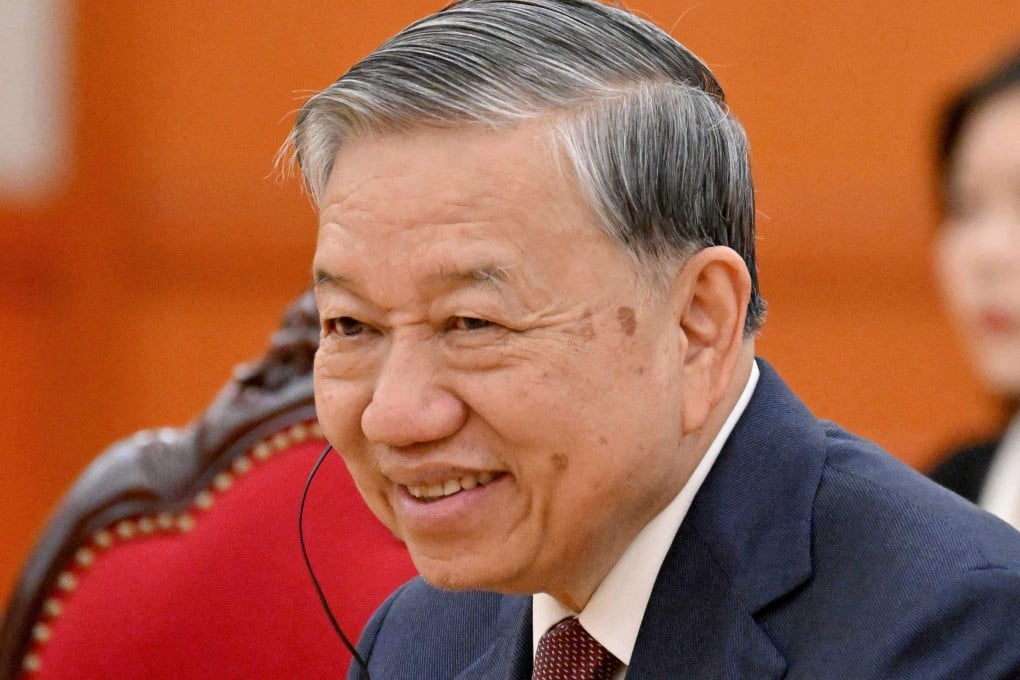
Vietnam’s Communist Party secured 482 of the 500 seats in the country’s National Assembly, according to official results released Sunday, delivering a near-total parliamentary dominance consistent with every legislative election the party has held since the founding of the Socialist Republic in 1975, and paving the way for the assembly’s opening session in April, when the newly elected legislature is expected to confirm the party’s general secretary, To Lam, as the country’s president.
Almost 93 percent of the 864 parliamentary candidates who stood in the March 15 election were Communist Party members, with independent candidates accounting for 7.5 percent of the field — down from 8.5 percent in the previous election cycle in 2021.
The party’s 482-seat haul represents 96.4 percent of the chamber and is roughly consistent with the margin it held in the outgoing 15th National Assembly. Official figures put turnout at more than 99 percent — a figure that critics and independent election observers have consistently noted is incompatible with voluntary participation in a multi-constituency system, but which authorities have described as reflecting the enthusiasm of Vietnamese citizens for the democratic process.
The results were formally confirmed at an international press conference Sunday, having first been communicated to the Communist Party’s Politburo and Secretariat — the country’s highest decision-making bodies — immediately after the March 15 polling day, before any public announcement was made. That sequencing, in which the party’s leadership hierarchy receives election outcomes before the public does, illustrates the structural relationship between the party and the state institution it nominally oversees.
The National Assembly, as a unicameral legislature, has the formal authority to enact laws and confirm state leadership appointments, but its ability to challenge or revise key party decisions on personnel and policy is effectively constrained by the character of its membership.
To Lam, who was unanimously re-elected as the party’s general secretary — Vietnam’s most powerful position — at the party’s 14th National Congress in January, receiving 180 votes from 180 Central Committee members, is widely expected to additionally assume the state presidency when the new assembly convenes.
Read Also: Vietnam’s Lam Pursues Presidency In China-Style Power Grab
If that confirmation proceeds as anticipated when the assembly holds its first session on April 6, To Lam would simultaneously hold the two highest offices in Vietnam’s political system: general secretary of the ruling party and president of the Socialist Republic.
That configuration would align Vietnam’s formal power structure with that of neighboring China, where Xi Jinping holds both the position of Communist Party general secretary and the state presidency — a concentration of authority that To Lam’s consolidation of Vietnam’s leadership over the past year has increasingly mirrored in its pace and ambition.
To Lam assumed the general secretaryship in mid-2024 following the resignation of Nguyen Phu Trong amid health concerns and moved quickly to stamp his authority on the party and state apparatus. His first months in office were characterized by sweeping institutional reforms described by analysts as shocking in their speed and severity, an anti-corruption campaign that resulted in the removal or prosecution of numerous senior officials across government and business, and a sustained public commitment to achieving annual economic growth above 10 percent through 2030 — an ambitious target that has been partly enabled by Vietnam’s position as a preferred manufacturing destination for companies diversifying supply chains away from China.
After casting his vote on March 15 in the Ba Dinh ward of Hanoi, To Lam told state television that the election aimed “to choose the most prestigious people to continue leading the country to more development.” His framing positioned the vote as a mechanism of quality selection rather than competitive choice — a characterization consistent with how the Vietnamese Fatherland Front, the state body that manages the candidate vetting and nomination process, describes the election in official materials.
The election attracted a small number of independent candidates — those not formally affiliated with the Communist Party — though their inclusion in the process has never historically produced a significant bloc within the assembly. Authorities sanctioned a number of citizens in the period immediately before and during the election for posting commentary online about candidates that officials deemed defamatory or misleading, requiring individuals to remove posts, acknowledge alleged violations, and pledge not to repeat the behavior. Several were fined under Decree 15/2020, which allows authorities to penalize the sharing of information online deemed harmful to social order.
Read Also: Vietnam Communist Party Leader To Lam Secures New Term
Vietnam approaches the new assembly term as a country navigating a complex combination of domestic economic ambition and external vulnerability. Its export-oriented manufacturing economy — built substantially on electronics, textiles, and footwear destined for North America and Europe — is sensitive to shifts in global trade patterns of the kind being driven by the U.S.-Israel war against Iran and the associated energy price shock.
The Strait of Hormuz’s effective closure has not significantly disrupted Vietnam’s primary trade routes, which run through the South China Sea, but the broader compression of global economic activity and the disruption of energy markets has introduced inflationary pressures that the party’s leadership will be required to manage as it seeks to deliver the growth commitments To Lam has publicly made.
The assembly’s inaugural session beginning April 6 will be its most consequential in the near term, not for any legislative agenda it is expected to advance but for the leadership appointments it will ratify. In addition to the presidency, the assembly will confirm a new prime minister, a new National Assembly chairperson, and other senior state figures whose names will be determined by the Politburo before the session opens. No public announcement of those nominees has been made.