
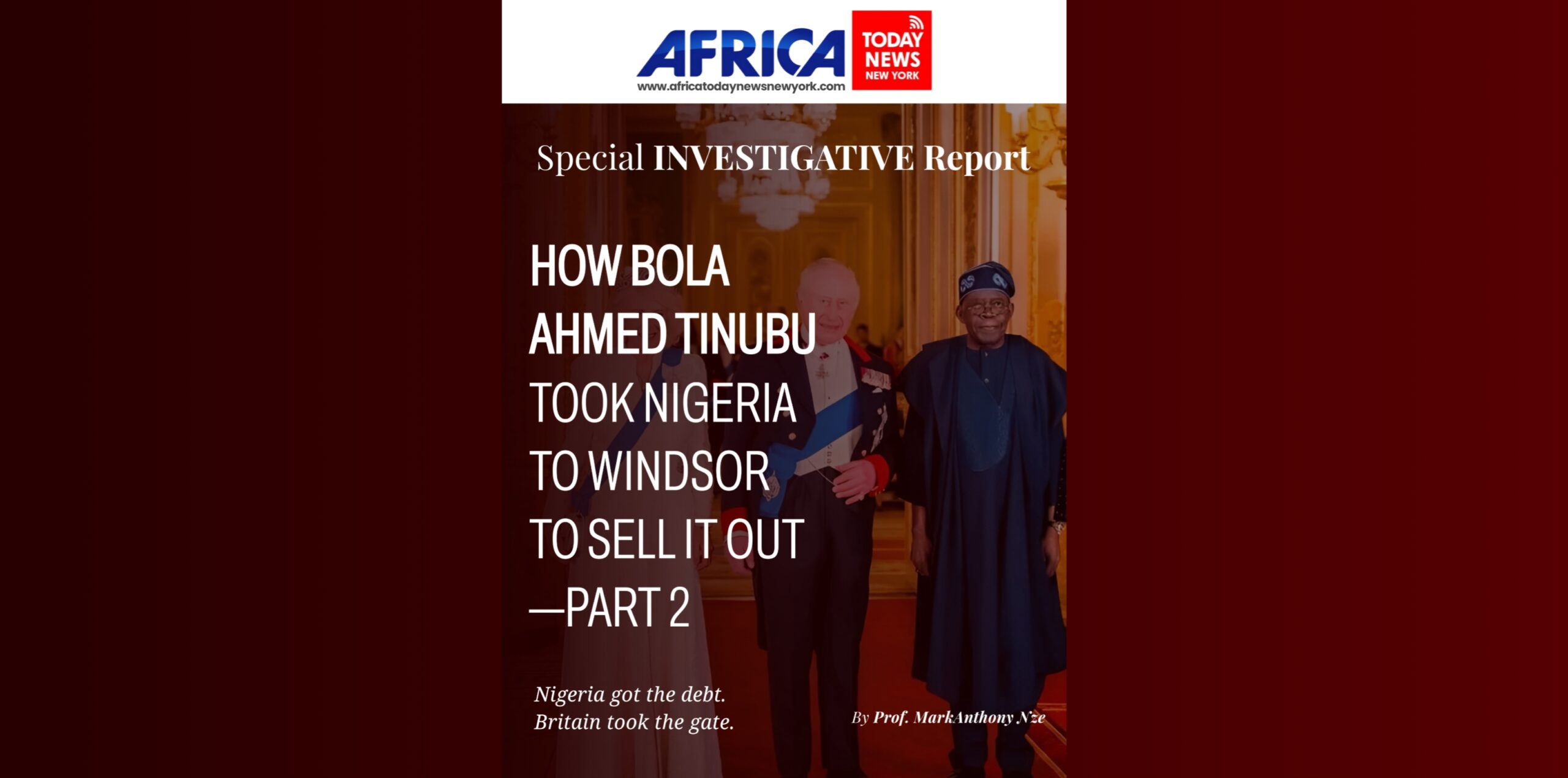
Nigeria got the debt. Britain took the gate.
The Port Deal Was Sold as Development. Britain Sold It as a Win for Britain
The most revealing document of Bola Tinubu’s March 2026 visit to Britain was not a speech, a toast, or a royal photograph. It was a financing announcement. Strip away the pomp of Windsor, the choreography of state ceremony, and the carefully managed language of partnership, and what remains is a £746 million export-finance deal tied to the redevelopment of the Lagos Port Complex and Tin Can Island Port Complex. Nigeria was invited to see modernization. Britain invited its own public to see something simpler and more honest: a major commercial victory for Britain.
That fact alone should sober the exuberance in Abuja. States do not finance major overseas infrastructure because they are moved by sentiment. They do so because they expect return, leverage, and industrial benefit. Britain’s own language was revealingly blunt: this was a “record-breaking order” for British Steel and a landmark deal for UK exporters. The British state, through UK Export Finance, behaved exactly as a serious state behaves. It used public instruments to advance domestic commercial interests. There is nothing mysterious about that. The real question is the Nigerian one: what exactly did Tinubu secure for Nigeria beyond the right to celebrate what Britain openly described as its own win?
Ports are never merely construction projects. They are systems of power. They shape the tempo of trade, the cost of goods, the flow of customs revenue, the efficiency of imports, and the routes through which national value is either retained or drained. A port is not just steel, concrete, and dredging; it is a gate. Whoever influences the gate influences the terms on which an economy breathes. That is why the language of “refurbishment” can be politically comforting and strategically misleading at the same time. The question is not whether Nigeria needs better ports. It plainly does. The question is who benefits first, who assumes the long-tail risk, and who acquires the strategic advantage that comes from financing, equipping, and structuring the arteries through which commercial life moves.
The mechanics of the deal matter here. The financing is being delivered through UK Export Finance’s Buyer Credit Facility and coordinated by Citibank’s London branch. That structure is not neutral. UKEF exists to support UK exports by backing loans used to procure UK goods and services. In plain English, it is a state-backed mechanism for making British companies more commercially competitive abroad. Nigeria is not being handed a gift. It is entering a structured financing arrangement designed, by definition, to channel commercial value toward British suppliers. Once that is understood, the celebratory rhetoric surrounding the agreement begins to look less like development policy and more like branding layered over dependency.
This is where the phrase “re-colonization of logistics,” though provocative, begins to acquire analytical meaning. Not in the crude sense of formal imperial rule returning with flags and governors, but in the subtler sense in which sovereign infrastructure becomes increasingly shaped by external financing logic, foreign supplier interests, and institutional arrangements that normalize outside advantage as domestic progress. When the steel is British, the finance is British-backed, and the project framework is coordinated through London-based banking channels, the issue is no longer whether Nigeria has nominal title to the port. The deeper issue is who shaped the terms of modernization, who captures the associated industrial upside, and who remains dependent on foreign underwriting to do what a more strategically governed state would strive to finance on less compromising terms.
The problem, then, is not that Britain pursued Britain’s interest. That is what states are supposed to do. The problem is that Tinubu appears ready to package Britain’s gain as proof of his own developmental seriousness without first answering the forensic questions that any sober public should be asking. What are the detailed loan terms? What sovereign commitments or contingent liabilities sit behind the arrangement? What local-content guarantees exist beyond the ceremonial language of partnership? What procurement processes will govern contractor selection and oversight? What long-term operational or technological dependencies will be embedded in the project by virtue of the financing structure itself? Those questions are not obstructionist. They are the minimum standards of democratic accountability in a country that has too often been taught to celebrate announcements before understanding obligations.
Read also: How Bola Tinubu Took Nigeria To Windsor To Sell It Out — Part 1
Tinubu’s defenders will call this a ports story because that is the safest way to shrink the scandal. It is not. It is a presidency story. It is the story of an incumbent so hungry for foreign validation that he is willing to dress external advantage up as national progress and then demand applause from the people who will bear the cost. The Lagos ports deal is not troubling merely because Britain profits from it; powerful states always pursue profit. It is troubling because Tinubu appears determined to convert Nigeria’s strategic infrastructure into a stage on which he can perform international relevance while leaving the public in the dark about the deeper obligations buried beneath the headline. That is not confidence. That is political insecurity in a tailored suit.
And this is what makes the arrangement more sinister than the government’s publicity suggests. Tinubu is not simply rebuilding ports; he is rebuilding his own image through foreign-backed projects whose immediate propaganda value may exceed their demonstrated national transparency. The louder the celebration, the more urgent the questions become. Who negotiated the deeper terms? Who carries the hidden risk? Who benefits first? Who controls the standards, the supply chains, the tempo, and the leverage that come once a nation’s busiest commercial arteries are rebuilt through external finance on externally advantageous terms? In a serious republic, those questions would come before the ribbon-cutting. Under Tinubu, they are treated as an inconvenience to the branding exercise.
What Nigerians are watching, then, is not just infrastructure policy but the moral method of this presidency laid bare. Tinubu’s instinct is to seek prestige abroad when trust weakens at home, to pursue endorsement before explanation, and to present dependency in the language of development. That is why this deal feels less like a sovereign modernization program than a political transaction engineered to make one man look stronger while the country becomes more exposed. He may call it legacy. History may call it something colder: the moment a desperate presidency mistook foreign applause for national interest.
Read more: King Charles Hosts First Nigerian State Visit In Decades
This is what makes the Tinubu pattern increasingly difficult to ignore. He does not merely want projects. He wants endorsement-bearing projects, projects that can be held up as evidence of foreign confidence even when domestic legitimacy is under strain. He wants the optics of arrival more than the discipline of explanation. The arrangement can then be sold as proof that powerful states and institutions still believe in his presidency, while the Nigerian public is asked not to dwell too long on the balance sheet beneath the ribbon-cutting. This is not reform in its highest sense. It is narrative management. And narrative management becomes most elaborate when governments feel most vulnerable.
Seen in that light, the port deal begins to look less like a clean developmental win and more like an exchange shaped by political desperation. Tinubu returned from Windsor with a headline, a ceremony, and a financing package that allowed him to perform international relevance. Britain returned with export orders, industrial support, and a stronger foothold in the logistics infrastructure of Africa’s largest economy. One side came away looking celebrated. The other came away plainly rewarded. The asymmetry is the story.
This is why Nigerians should resist the seduction of official language. “Modernization” can be true and still incomplete. “Partnership” can be real and still unequal. “Development” can be announced and still serve someone else first. In the forensic light of 2026, the £746 million arrangement is not merely a ports story. It is a test of whether Nigeria still knows how to distinguish between infrastructure that strengthens sovereignty and infrastructure that quietly rearranges it. If the gates of a nation are upgraded on terms that disproportionately enrich the financier’s country, entrench foreign supplier advantage, and remain opaque in their sovereign implications, then what is being modernized may not just be the port. It may be the machinery through which dependence is made to look like progress.
And that, is why this deal should trouble anyone who still believes public office carries a duty beyond political survival. A government serious about national development would have treated such an agreement as something to explain in painful detail, not simply celebrate in broad slogans. It would have anticipated the hard questions because it would understand that ports are not decorative projects. They are sovereign instruments. But Tinubu’s political instinct appears different. He seems to value the endorsement embedded in the deal as much as, if not more than, the infrastructure itself. That is why the arrangement now reads not simply as modernization, but as a warning: the gate is being rebuilt, yes—but Nigerians must ask, with far more urgency than the palace photographs permit, for whose advantage.
This port deal is not development; it is the concealed plumbing of a generational heist—a survival bargain in which Nigeria’s minerals are the currency and the King is expected to serve as intercessor against the approaching Trump storm. Tinubu did not travel to Windsor as a statesman guarding a republic. He went as a political debtor ready to auction the nation’s lithosphere. In that transaction, the future of Nigeria’s children has been offered up for a second term and a royal appeal for mercy.
Selected Sources
Reuters. (2026, March 19). UK, Nigeria agree billion-dollar export finance deal to refurbish ports.
UK Department for Business and Trade. (2026, March 19). Record-breaking order for British Steel as UK and Nigeria sign landmark £746 million ports deal.
UK Government. (2026, March 16). UK-Nigeria enhanced trade and investment partnership ministerial dialogue communiqué.