
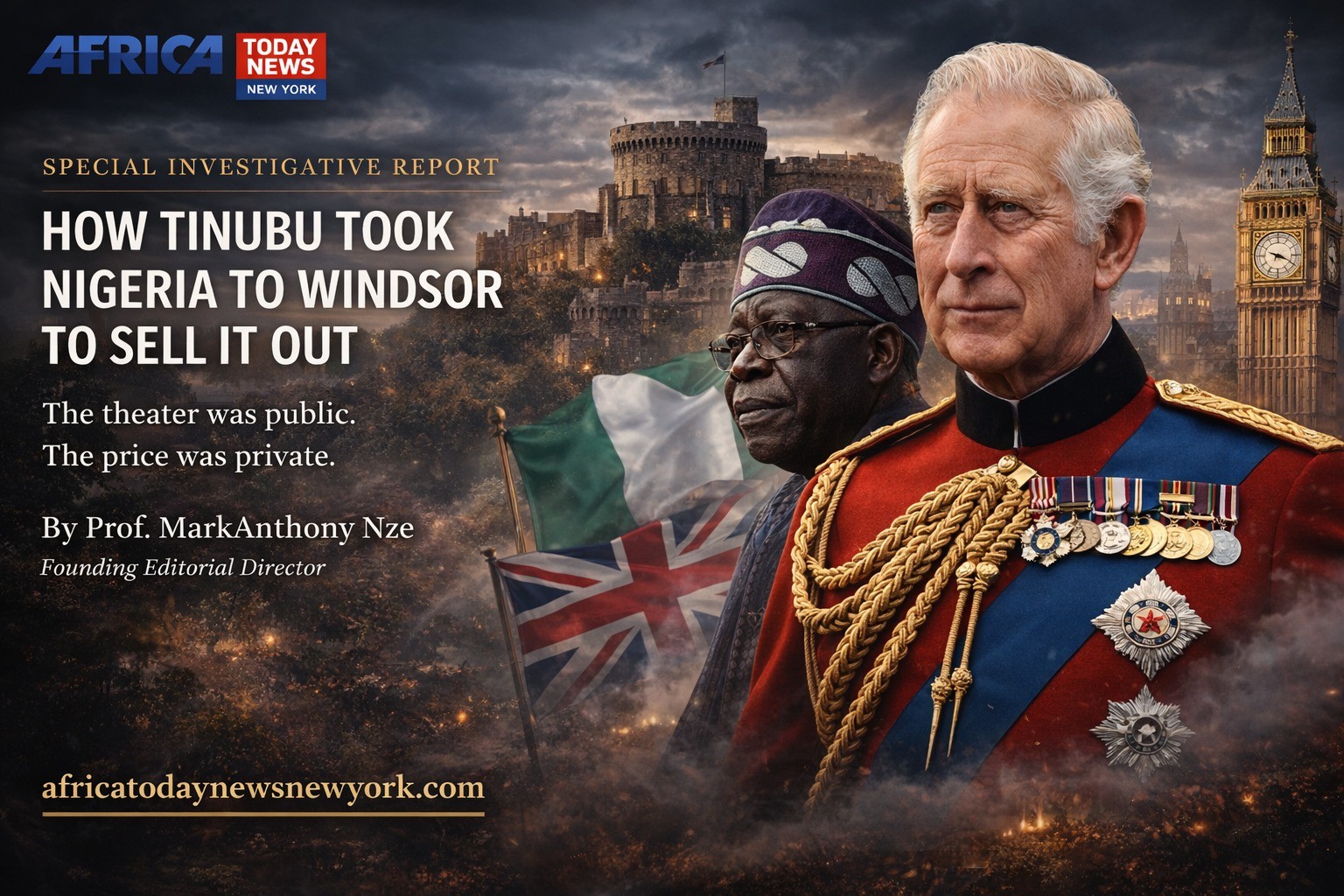
𝘛𝘩𝘦 𝘵𝘩𝘦𝘢𝘵𝘦𝘳 𝘸𝘢𝘴 𝘱𝘶𝘣𝘭𝘪𝘤. 𝘛𝘩𝘦 𝘱𝘳𝘪𝘤𝘦 𝘸𝘢𝘴 𝘱𝘳𝘪𝘷𝘢𝘵𝘦.
There are moments in politics when ceremony is not diplomacy but camouflage. The carriages, the polished brass, the choreography of smiles, the staged intimacy beneath chandeliers—all of it can function as a cosmetic shield for a government whose authority is eroding where it matters most: at home. Bola Ahmed Tinubu’s March 2026 state visit to Britain had that unmistakable smell. It was presented as prestige. It looked more like rescue. A presidency battered by domestic hardship, haunted by insecurity, and already calculating the dangerous arithmetic of 2027 suddenly found itself draped in royal pageantry at Windsor Castle, basking in the reflected legitimacy of the former imperial power. That was not a coincidence. It was a strategy. And Nigerians should read it for what it was: not a triumph of statecraft, but a distress signal dressed as grandeur.
By the time Tinubu arrived in Britain, the home front was already telling a harsher story than the one his handlers preferred. Nigeria’s food inflation had jumped back into double digits, reaching 12.12% in February 2026, even as overall inflation barely eased. This was not a technical fluctuation confined to economists and spreadsheets. It was the kind of number that translates directly into thinner market baskets, angrier households, and a widening sense that whatever “reform” was being sold from Abuja, ordinary Nigerians were being asked to finance it with their nerves, their hunger, and their diminishing faith. Inflation is not merely an economic indicator in such moments; it is political testimony. It records, more honestly than speeches do, whether a government has made life more bearable or more punishing.
And then there is the security question, which no amount of ceremonial glitter can safely obscure. Reuters reported during the visit that insecurity has remained a defining burden of Tinubu’s presidency, with multiple armed crises still grinding through the country. A government facing such conditions should understand that legitimacy cannot be imported. It must be earned in the lives of citizens who feel safer, eat better, and trust more. But that is precisely what makes Windsor so revealing. Tinubu did not go there from a position of settled strength. He went there because international respectability is politically useful when domestic confidence is thinning. The visit offered what local praise singers cannot manufacture on their own: the image of a president still acceptable in elite global rooms, still bankable to foreign capitals, still embraced by the kind of establishment whose approval sends signals to investors, diplomats, and Nigeria’s own anxious ruling class.
Read also: King Charles III Inaugurates World’s Longest Coastal Trail
This is why the sentimental reading of the trip is the least serious one. The issue is not whether Britain was courteous. Britain was strategic. It knew exactly what it was doing. The state visit coincided with the announcement of a £746 million export-finance package for the refurbishment of the Lagos Port Complex and Tin Can Island Port Complex. And London did not pretend this was an act of abstract goodwill. Reuters reported that the deal would generate £236 million in supplier contracts for British firms, including a £70 million contract for British Steel, while the British government itself hailed the arrangement as a boost for jobs and industrial demand in the UK. Serious states do not subsidize sentiment. They use state finance to move their own commercial interests. Britain behaved like a state that understands power. The question Nigerians should ask is why Tinubu seemed so eager to present Britain’s gain as Nigeria’s glory.
Ports are not neutral assets. They are strategic arteries. They determine how goods move, how customs function, how trade bottlenecks are managed, and how value is either retained or siphoned. When foreign-backed finance enters such infrastructure, the correct public response is not applause but scrutiny. What are the sovereign obligations? What leverage sits behind the financing? How much local industrial value is guaranteed? Who captures the long-term upside of modernization, and who simply carries the political burden of announcing it? Those are not anti-development questions. They are the minimum questions a self-respecting country asks when its most vital logistics corridors are being refurbished through an arrangement openly structured to serve foreign suppliers. But Tinubu’s political style has always preferred headline optics to institutional clarity. He does not merely want deals; he wants photographable deals, endorsement-bearing deals, deals that can be displayed as proof that powerful people abroad still consider him good business.
That instinct becomes even more troubling when placed beside the wider UK-Nigeria Enhanced Trade and Investment Partnership, whose inaugural ministerial dialogue took place just before the royal visit. The official communiqué is full of the smooth language of modern commercial diplomacy: regulatory cooperation, investor support, market access, and policy dialogue. None of this is sinister by definition. But anyone who has watched how influence works between unequal states knows that such language often marks the soft opening of harder realities. Access is normalized before it is fully understood. “Clarity” for investors can become opacity for citizens. A government under domestic pressure begins to value foreign reassurance too highly, and soon enough long-term sovereignty is being negotiated in the soothing grammar of partnership. Tinubu did not need a signed document titled “Sell Out Nigeria” to create that danger. All he needed was the political desperation to seek ballast abroad while Nigerians absorbed the cost at home.
Read more: Philippians 3:10 And The Crisis Of Faithful Living
That is the real scandal of Windsor. Not that Britain pursued advantage—that is what powerful states do—but that Tinubu arrived there needing the performance so badly. He needed the carriage procession, the photographs, the state banquet, the royal association, the impression that despite the strain of his record, he remained a man the old empire was still willing to decorate. For a president already thinking ahead to 2027, that matters. It tells nervous elites that he is not isolated. It tells foreign investors that doors remain open. It tells domestic power brokers that the international establishment has not turned away. In short, it converts foreign ceremony into local political currency. And when that currency is purchased while Nigerians are paying higher food costs and living under persistent insecurity, the proper word for it is not diplomacy. It is extraction by other means.
What remains unstated in the official communiqués is the most devastating dimension of the Windsor Pact: the silent handover of Nigeria’s solid mineral future. Reliable intelligence suggests that the £746 million port refurbishment is merely the logistical plumbing for a much larger extractive heist. By anchoring British-backed finance into the Apapa and Tin Can arteries, Tinubu has effectively signed an Unlimited Mineral Access Accord, granting UK-backed firms—such as those now circling the Nasarawa lithium fields—unprecedented “regulatory priority.”
This is the ultimate “City Boy” betrayal. To secure a “Royal Shield” against the looming threat of a Trump-led “Maduro fate” and to bypass the restless Fulani oligarchy at home, Tinubu has treated the Nigerian soil as a private bank account. He did not go to London to lead a nation; he went to auction its lithosphere. He has traded the “green gold” of the next generation for a second term in 2027, proving once and for all that in the transactional universe of this presidency, the nation is always the product, and the survival of the incumbent is the only bottom line. This act is not statecraft; it is generational sabotage.
The true genius—and the true danger—of this visit lies in its internal political signaling. For decades, the road to the Nigerian presidency ran through the “Fulani oligarchy,” the traditional northern power brokers who held the keys to the “political source.”
Tinubu has rewritten that map. By heading straight to Windsor to negotiate with King Charles III, he has wrestled the scepter of international legitimacy away from the domestic gatekeepers. He has replaced the “Northern nod” with the “Royal Seal.” Reliable sources indicate the Fulani establishment is feeling the chill of being sidelined; Tinubu has signaled that his 2027 mandate no longer requires their permission, provided he has the backing of the former imperial power.
But there is a darker motivation for this “Royal Shield.” In the forensic calculus of 2027, Tinubu knows that only two things can stop him: Death or Donald Trump. With the 47th U.S. President already demonstrating a willingness to topple “uncooperative” regimes—evidenced by the aggressive stance toward the Maduro administration in early 2026—Abuja is in a state of diplomatic fever. Tinubu is terrified of a “Maduro fate,” where his related narcotics history and domestic human rights record could make him a target for a Trump-led “intervention.”
The visit to the King was a move to secure a Global Intercessor. He is betting that King Charles, as the head of the Commonwealth, will use “closed-door, encrypted channels” to act as a “Trump-Whisperer.” The mission is simple: convince the White House that Tinubu is a “stabilizing ally” for Western resource interests, thereby insulating him from the legal and military reach of a Washington that currently views him with profound suspicion.
So Part 1 leaves us with a blunt conclusion. Tinubu did not go to Windsor because Nigeria was secure enough, prosperous enough, or respected enough to make the trip an uncomplicated victory lap. He went because a vulnerable incumbent needed external polish, and Britain was willing to provide it at a price that served Britain first. The pageantry was the wrapping. The politics was the product. And the more carefully Nigerians study the choreography, the clearer the central truth becomes: this was never primarily about national honor. It was about political survival.