
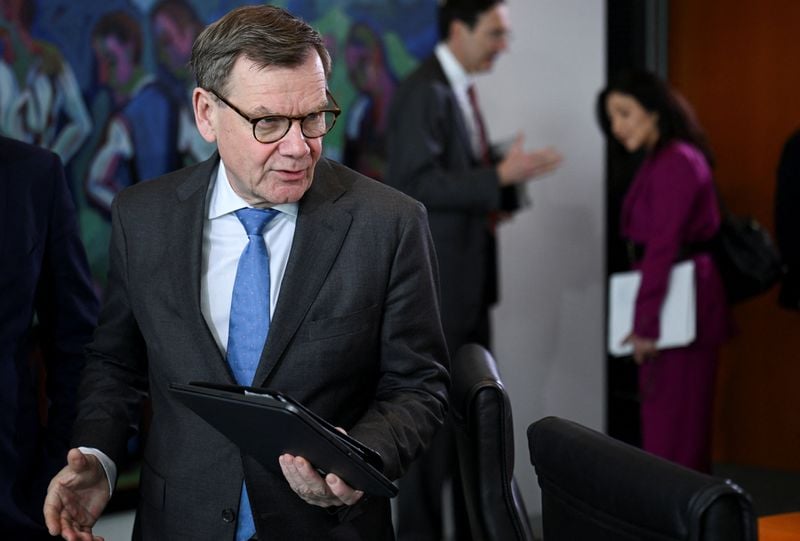
Germany’s foreign minister expressed support on Wednesday for American diplomatic efforts to end the war with Iran, as competing signals from Washington and Tehran deepened uncertainty over whether a negotiated settlement remained within reach. The same day, Iran’s state media reported that Tehran had formally rejected a 15-point U.S. ceasefire proposal delivered through Pakistani intermediaries, while simultaneously issuing its own counter-conditions for ending hostilities.
German Foreign Minister Johann Wadephul, speaking alongside his Tunisian counterpart Mohamed Ali Nafti at a joint appearance in Berlin, welcomed what he described as a decision by President Donald Trump to step back from an ultimatum to Iran and pursue talks instead.
“It is commendable that the U.S. President has postponed his ultimatum to the Iranian regime for a few days and is now seeking negotiations,” Wadephul said. “Iran’s regime would be well-advised to respond to this now. So, if there is a window of opportunity for diplomacy, we should definitely give talks a chance.”
His remarks came amid rapidly shifting developments on the diplomatic track. The United States has developed a 15-point proposal aimed at ending the war with Iran, with several Middle Eastern officials confirming the plan offered extensive sanctions relief to Iran in return for the removal of all its enriched uranium material, the abandonment of enrichment processing capabilities, limits to Tehran’s ballistic missile program, and the cessation of support to militant groups in the region, including Hezbollah, the Houthis, and Hamas.
The proposal was delivered to Iranian officials through Pakistan, though it was not immediately clear whether Iran had agreed to any of the points. Iran’s state-run English-language broadcaster Press TV, citing an anonymous official, reported Wednesday that Tehran had rejected the plan. Iran also put forward its own ceasefire proposal, calling for war reparations and sovereignty over the Strait of Hormuz.
Iran’s military underscored the rejection in pointed terms. In a video statement, Iranian military spokesperson Ebrahim Zolfaqari addressed Washington directly: “The strategic power you boasted of has turned into a strategic defeat. Do not call your defeat an agreement.” Iran’s ambassador to Pakistan separately told state media that no direct or indirect negotiations had taken place between the two countries, directly contradicting Trump’s public assertions.
Read Also: Turkey Shuttles Messages Between U.S. & Iran To End War
Iran’s public posture, however, appeared to leave some room for interpretation. The Iranian Foreign Ministry acknowledged it was reviewing a proposal received from the United States, even as senior military figures publicly dismissed the talks. Iranian-aligned media suggested the negotiation narrative was a U.S. attempt to sow internal discord within Iran.
Trump, speaking in the Oval Office on Tuesday, struck an optimistic tone. “We’re actually talking to the right people, and they want to make a deal so badly, you have no idea how badly they want to make a deal,” he said, adding that Iran had already agreed to halt its pursuit of nuclear weapons. “There won’t be any nuclear weapons. Iran has agreed to that.” Iran has consistently denied seeking nuclear weapons capability.
Pakistan has emerged as the central intermediary in the diplomatic effort. Prime Minister Shehbaz Sharif said in a post on social media that his country was willing to facilitate talks, and Trump shared Sharif’s statement on his Truth Social account. Neither Washington nor Tehran publicly commented on the offer to host formal negotiations. The head of the International Atomic Energy Agency, Rafael Mariano Grossi, told the Italian newspaper Corriere della Sera that talks between Iran and the United States in Pakistan could come as soon as this weekend.
Read Also: Trump: Diplomacy Ongoing Despite Iran-Israel Strike Volleys
Wadephul signaled that Berlin was monitoring those prospects, if from a remove. “We must, of course, wait and see what these talks in Pakistan, in which we are not participating but which are now apparently taking place, will yield, which is certainly welcome,” he said.
The broader military picture remains volatile. Major combat operations against Iran were launched on February 28 through joint U.S.-Israeli strikes targeting military and government installations. Iran has since responded with missile and drone attacks against Israel, regional U.S. bases, and multiple Gulf nations, while also attempting to restrict shipping through the Strait of Hormuz. Trump has approved the deployment of more than 1,000 soldiers from the 82nd Airborne Division to the Middle East, though the troops had not yet departed the United States as of Wednesday.
UN Secretary-General Antonio Guterres on Wednesday called on both the United States and Israel to end the war, and urged Iran to stop attacking other countries in the region.
“My message to the United States and Israel is that it is high time to end the war, as human suffering deepens, civilian casualties mount, and the global economic impact is increasingly devastating,” Guterres told reporters.
The White House said Tuesday that military operations under the mission designated Operation Epic Fury would continue regardless of diplomatic activity. Whether any talks in Pakistan proceed, and on what timeline, was not confirmed by either the U.S. or Iranian governments as of Wednesday evening.