
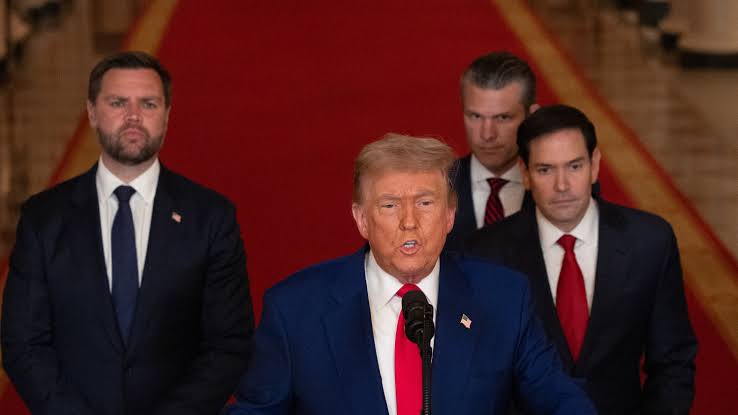
The disconnect between Washington’s diplomatic signals and the battlefield reality defined a day of acute confusion over whether the conflict was approaching resolution or deepening into a new phase. Trump told reporters that his Middle East envoy Steve Witkoff and son-in-law Jared Kushner had held “very, very strong talks” on Sunday with a senior Iranian figure he declined to name, and that Vice President JD Vance and Secretary of State Marco Rubio had both become directly involved. “They’re talking to us and they’re making sense,” Trump said during an Oval Office appearance.
Iran’s parliament speaker Mohammad Bagher Qalibaf denied any such contact had occurred. “No negotiations have been held with the US,” he wrote on social media, characterising Trump’s claims as an effort to manipulate energy markets and disguise American and Israeli difficulties in the conflict. Iran’s foreign ministry and the Revolutionary Guard-aligned Tasnim news agency issued similar denials, with Tasnim calling Trump’s statements “psychological warfare.”
Read also: US Seals Migration Deal Allowing Costa Rica Deportations
The New York Times reported late Tuesday that Washington had delivered a 15-point proposal to Tehran through Pakistan, covering maritime routes, Iran’s nuclear programme and its ballistic missile capabilities. Pakistan’s army chief, Field Marshal Syed Asim Munir, has emerged as the key intermediary between the two sides, according to officials briefed on the diplomacy. Pakistan’s prime minister said Tuesday his country stood ready to “facilitate meaningful and conclusive talks.” White House press secretary Karoline Leavitt declined to confirm or deny specifics, saying the discussions were sensitive and that “speculation about meetings should not be deemed as final until they are formally announced.”
Trump added a cryptic note to the day’s proceedings, telling reporters he had received a significant “gift” from the Iranian side that he said confirmed the administration was “dealing with the right people.” He described it as “oil- and gas-related” without elaborating. The remark gave markets little to work with and left analysts uncertain whether it signified a genuine diplomatic gesture or a performative flourish.
The terms Trump has publicly outlined for any agreement are demanding. He said the United States requires a complete end to Iran’s nuclear weapons capability — “not even close to it” — and suggested American personnel would physically remove Iran’s stockpile of enriched uranium if a deal is reached. “We’re going down and we’ll take it ourselves,” he said.
Read more: China Steps Up Major Ocean Floor Mapping For Submarines
While the diplomatic signals accumulated, the military dimension continued without pause. Israeli authorities reported that Iranian missiles struck Tel Aviv and other areas, injuring six people and damaging at least three residential buildings. In Iraq’s Kurdish region, a volley of six Iranian ballistic missiles killed six Kurdish fighters and wounded 30 others. Bahrain reported that an Iranian missile killed a Moroccan contractor working for the Emirati armed forces and wounded five Emirati service members. Kuwait’s army said it had faced multiple drone and missile attacks overnight.
Iran’s military spokesman showed no sign of a force preparing to stand down. “Iran’s powerful armed forces are proud, victorious and steadfast in defending Iran’s integrity, and this path will continue until complete victory,” the spokesman told state television.
On the Israeli side, the war’s geographic scope expanded further. The Israeli military issued new evacuation warnings for southern Lebanon on Tuesday, hours after the country’s defence minister indicated Israel planned to control more Lebanese territory — language the New York Times said suggested Israel was preparing to remain in large parts of the country beyond any ceasefire timeline. A woman was killed and two others injured in northern Israel by rocket and drone fire from Lebanon. Israeli forces have been striking Hezbollah targets since the group launched rockets into northern Israel following the initial US-Israeli strikes on Iran on February 28, breaking a ceasefire that had held since November 2024.
Benjamin Netanyahu, meanwhile, offered no suggestion that Israeli operations were contingent on diplomatic progress. “We will preserve our vital interests in every situation,” the prime minister said.
The appointment of a new Iranian security chief added another variable. Mohammad Bagher Zolghadr, a hard-line former deputy commander in the Revolutionary Guard, took over as the country’s top security official after an Israeli strike killed his predecessor Ali Larijani last week. The elevation of a Guard-aligned figure to a senior security role is not, on its face, the profile of a government preparing to offer significant concessions.
Rubio will travel to Paris on Friday to meet G7 foreign ministers and discuss the war — a multilateral consultation that reflects both the conflict’s global economic impact and the limits of what bilateral American diplomacy has achieved so far. Whether the conversations Washington says are underway will have produced anything concrete by the time those meetings convene is the question the next several days will answer.
Trump, asked directly whether he trusted the Iranians his administration claimed to be talking to, pointed to the gift rather than offering a direct response. “If I were a betting man, I’d bet for it,” he said of a deal’s prospects. “But again, I’m not guaranteeing anything.”