
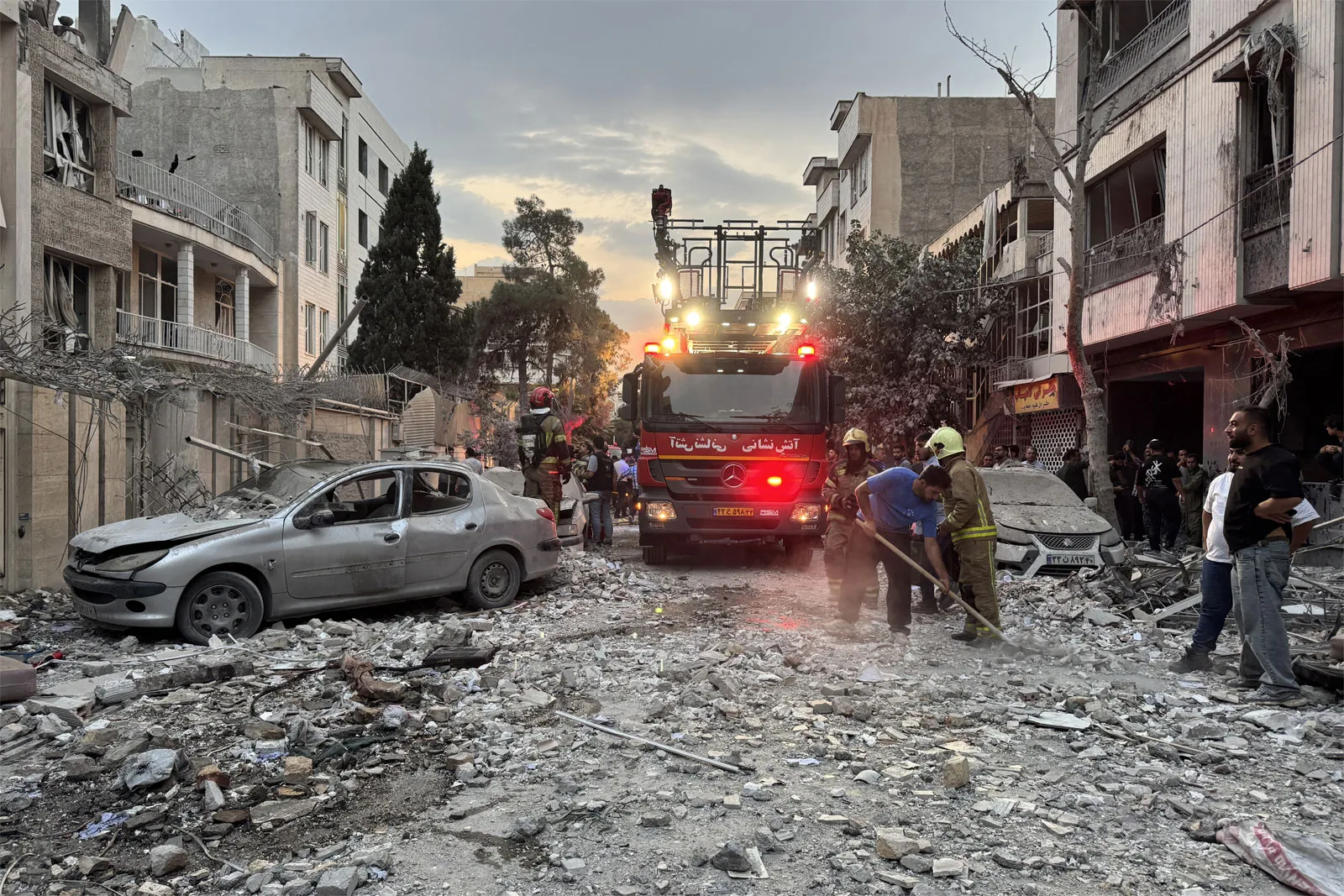
Tehran is not a city under siege in the conventional sense. There are no front lines running through its streets, no trenches dug across its parks. But the Iranian capital has been reorganised around war in ways that are visible at every hour — in the masked men at checkpoints, the pick-up trucks with machine guns mounted in their beds, the loudspeakers moving through residential neighbourhoods at midnight summoning residents to mosques to denounce America and Israel and reaffirm their loyalty to a republic now in its 47th year of existence and its 28th day of conflict.
The Islamic Revolutionary Guard Corps and its Basij paramilitary network have turned Tehran’s streets into an apparatus of control that operates simultaneously as a security measure, a show of force and a mobilisation campaign. Checkpoints that were static have been made mobile — drone strikes have killed people manning fixed positions, so the positions move. They appear on highways, inside tunnels, beneath overpasses, in spaces that offer cover from above. The men operating them are sometimes uniformed, sometimes plainclothes, sometimes masked. All of them are armed.
A resident of western Tehran described to Al Jazeera what passed through his neighbourhood late one recent night: a convoy of roughly 40 vehicles, horns sounding, hazard lights flashing, escorting a pick-up truck mounted with large speakers from which a voice broadcast religious slogans into the dark. It was not an organic expression of anything. It was organised, choreographed, mobile propaganda moving through streets where people lay in their homes listening and deciding, in the way civilians in war zones always decide, how much of what they were hearing reflected genuine sentiment and how much was the sound power makes when it is unsure of itself.
The residents of that neighbourhood have been invited, through those same loudspeakers, to gather at the local mosque. Similar gatherings are being held in mosques, squares and streets across the city — managed demonstrations of loyalty to a government that has survived internal and external challenge for nearly five decades and is now attempting to demonstrate that even an American-Israeli military campaign cannot loosen its grip on the population it governs.
Read also: Two Vessels Vanish From Cuba Aid Convoy, Mexico Searches
The attempt is complicated by what the other side is broadcasting. American and Israeli messaging urges Iranians to remain indoors, to wait, to watch for what has been described only as a “clear signal” — the moment at which they should take to the streets to overthrow the Islamic Republic. It is the language of regime change offered to a population that has not been consulted about whether it wants to be liberated on those terms, at that cost, by those particular liberators. How many Iranians are receiving that message, and what they make of it, is not something that can be reliably assessed from outside the country.
What is assessable is the IRGC’s response to the possibility that some might be listening. The organisation’s deputy for cultural affairs in Tehran, Rahim Nadali, appeared on state television Wednesday to announce that the age threshold for participation in intelligence and security patrols had been lowered. Children of 12 and 13, he said, are now being incorporated into the surveillance and checkpoint network. The statement was delivered as a demonstration of depth — of reserves, of commitment, of a state willing to draw on every layer of its population to maintain order. It read, to outside observers, as something closer to desperation measured in years of age.
Iranian state media has been releasing footage of armed civilians — including women carrying weapons — maintaining positions across the city. The imagery is deliberate. It is meant to communicate that the Basij is not a thin crust of professional soldiers that precision strikes can systematically eliminate, but a distributed network embedded in neighbourhoods, families and communities that cannot be surgically removed without touching the civilian population itself.
Read also: Palestinian US Activist: FBI Stopped My Assassination Attempt
Meanwhile the strikes continue. New air raids on Friday afternoon hit what Iranian authorities identified as a civilian nuclear site, power infrastructure and production lines for steel and other industrial factories. The targeting pattern suggests a campaign moving steadily toward the economic and energy foundations of the state — the systems that keep factories running, electricity flowing, and the apparatus of governance operational. Washington has simultaneously deployed thousands of additional soldiers to the region, and American officials have signalled that an operation to seize one or more islands along Iran’s southern coastline may be approaching.
Iranian commanders have promised a response to any such landing that would extend beyond Iran’s own borders — strikes on critical infrastructure across the Gulf region, pressure on the Strait of Hormuz that is already barely functioning, escalation of the attacks on American bases in Iraq and Syria that have already killed 13 US service members.
The war is 28 days old. The checkpoints keep moving to stay alive. The children are 12. The loudspeakers move through the neighbourhood at midnight, and behind the closed windows of western Tehran, people listen and make their calculations in the dark.