
The two sailboats left Isla Mujeres on Mexico’s Caribbean coast on March 20 as part of the Nuestra America Convoy, a solidarity flotilla organised in response to what the group describes as the American stranglehold on Cuba — the oil blockade, the severed supply lines, the accelerating humanitarian deterioration on an island where electricity has become a luxury and hospitals are struggling to keep patients alive. The boats were expected to dock in Havana by Tuesday or Wednesday. By Friday, neither had been heard from.
Cuba’s President Miguel Díaz-Canel broke from official silence to express anxiety publicly. “We express our particular concern regarding the two Mexican vessels transporting solidarity aid to Cuba,” he wrote on social media, adding that the Cuban government was doing everything possible to assist in the search and rescue.
The US Coast Guard complicated the picture briefly on Friday when it told AFP the vessels had been located, then retracted the statement — an error that briefly raised hopes before dashing them. The Coast Guard subsequently told Reuters it remained prepared to assist if Cuba and Mexico, who are leading the search, made a formal request. “We remain vigilant and prepared to provide support if requested,” it said.
The convoy told international media it was confident the crews would be found. Both sailboats were led by experienced sailors equipped with signalling and safety equipment, the organisation said. “We are cooperating fully with the authorities and remain confident in the crews’ ability to reach Havana safely.” Whether that confidence reflects genuine intelligence about the vessels’ status or an effort to manage public alarm in the absence of information was not clear from the statement.
Read also: GOP Kills Bill To Compensate Federal Airport Employees
On the streets of Havana, the uncertainty registered differently. “They were coming to help, and now they are missing,” said Yudisel Otto, a 45-year-old taxi driver. “It’s sad.”
The convoy’s broader mission reflects the severity of what Cuba is living through. The island has faced two island-wide blackouts in the space of a single week, the second occurring on March 21. Medical professionals have warned that patients are dying as hospitals lose the electricity needed to sustain critical care. Cuba’s energy grid, long considered antiquated and heavily dependent on fossil fuels, has been pushed past its limits by the collapse of oil supplies that began in January.
The supply collapse followed directly from a sequence of American actions. The Trump administration abducted then-Venezuelan President Nicolás Maduro in a military operation in January, after which Trump announced that Venezuela would no longer provide Cuba with oil or money. He declared Cuba a national security threat on January 29 and threatened tariffs against any country supplying the island with fuel, a warning designed to deter even third-party suppliers from filling the gap Caracas left behind. The United Nations has warned of a humanitarian collapse on the island.
Secretary of State Marco Rubio, a Cuban American who has long advocated for maximum pressure on Havana, restated the administration’s position Friday with characteristic bluntness. “Cuba’s economy needs to change, and their economy can’t change unless the system of government changes. It’s that simple,” he said. “Who’s gonna invest billions of dollars in a communist country run by incompetent communists?”
Read more: Trump Pledges To Demolish Iran’s Premier Gas Field
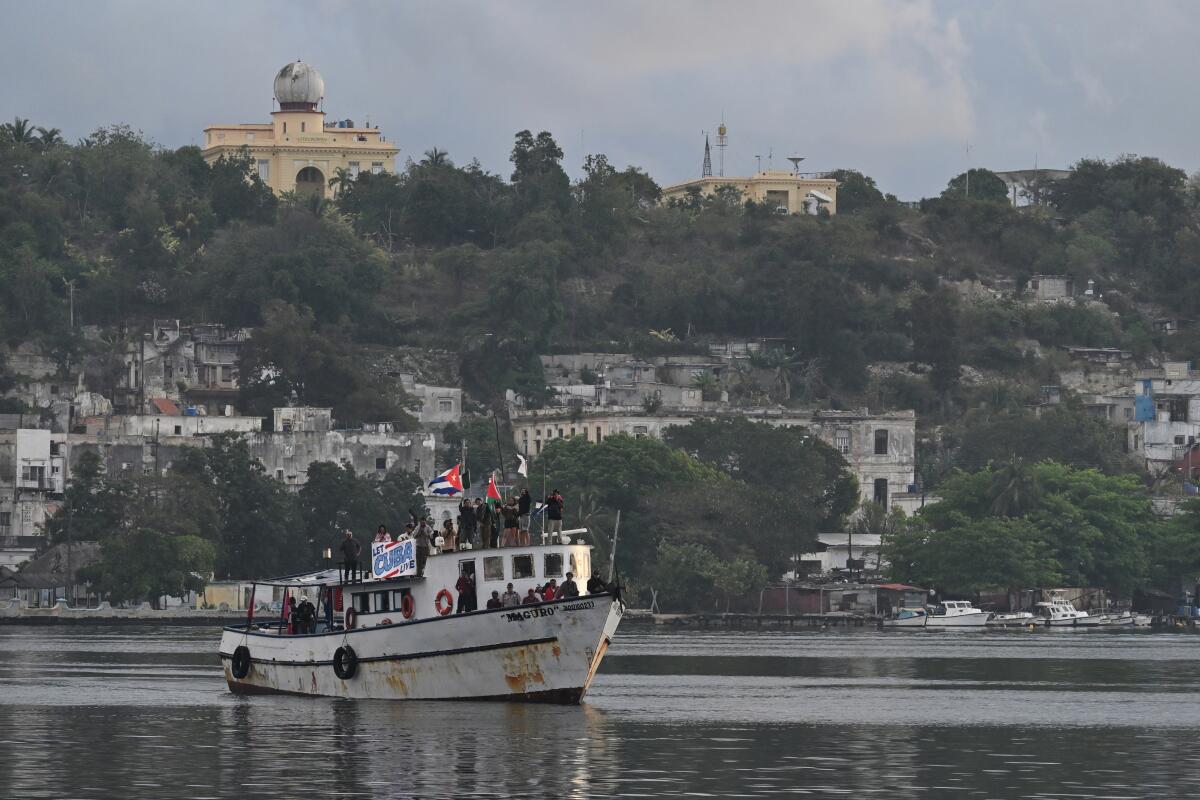
Against that political backdrop, the Nuestra America Convoy set sail. Its first vessel, a converted fishing boat, completed the crossing safely and arrived in Havana on Tuesday carrying 14 tonnes of food and medicine, 73 solar panels and around a dozen bicycles — small against the scale of the crisis, but real. It had been accompanied by the Mexican Navy for part of the voyage. The two missing sailboats departed as part of the same flotilla.
Mexican President Claudia Sheinbaum has positioned her government as a counterweight to American pressure on Cuba, dispatching ships loaded with supplies and maintaining diplomatic ties that Washington has made clear it considers unhelpful. The search for the missing vessels is being coordinated between Mexican and Cuban authorities, with the US Coast Guard offering support from a distance that reflects both the geographic reality of the Caribbean and the political reality of who is welcome to help.
What happened to the two sailboats and the nine people aboard them remained unknown as of Friday evening. The Caribbean in late March can produce weather conditions that challenge even experienced crews. Equipment failures, navigation errors and the particular vulnerability of small sailing vessels to sudden squalls are all possibilities that search coordinators will be working through. The convoy’s confidence in the crews’ experience and equipment provides some grounds for hope. The week that has passed since their last known position provides rather fewer.