
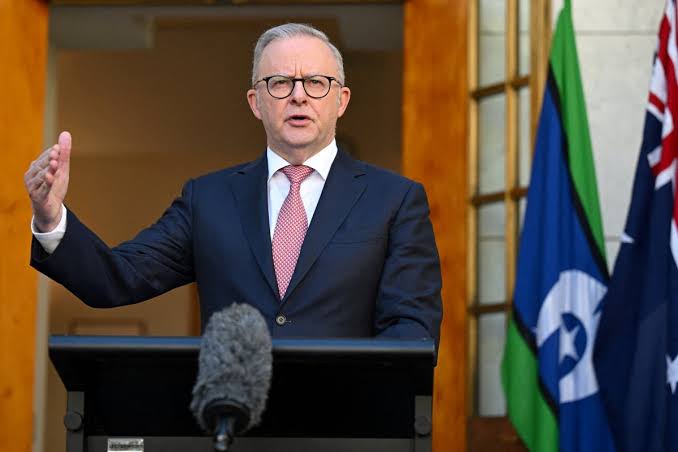
Australia will halve its fuel excise from Wednesday, cutting the pump price by 26 cents a litre for three months, as Prime Minister Anthony Albanese and state leaders agreed on a four-stage national fuel security plan that stops short of rationing but acknowledges the country is managing a genuine energy crisis driven by the war in the Middle East.
The measure, announced Monday after a national cabinet meeting in Canberra, will reduce the excise from 52.6 cents to 26.3 cents a litre and run until the end of June. The heavy vehicle road user charge will be reduced to zero for the same period, a parallel measure aimed at keeping freight moving as transport operators absorb costs that are beginning to cascade through the supply chain. Together, Treasurer Jim Chalmers said, the two measures will cost $2.55 billion.
The excise cut will reduce the cost of filling a standard 65-litre tank by nearly $19, the government said. Chalmers has written to the Australian Competition and Consumer Commission directing it to monitor whether petrol stations are passing the reduction on to consumers rather than absorbing it as margin — a concern that has attended every excise cut in recent memory and that the government is clearly determined to preempt publicly this time.
Albanese framed the decision as a response to real household pressure. “We are making fuel cheaper today because we understand that Australians are under serious pressure,” he said, while also encouraging people who could use public transport to do so — directing whatever fuel savings the excise cut produced toward regional areas and industries whose dependence on fuel has no public transit alternative.
The politics around the decision carry a particular awkwardness. Opposition leader Angus Taylor had called for halving the excise last week, costing it at $1.5 billion. Chalmers told parliament just last Tuesday that cutting the excise was “not something that we have been considering.” The reversal within a week, under the pressure of a worsening crisis, has handed Taylor the argument that the government acted only when forced to — though Taylor’s own response on Monday was to question whether the cut was accompanied by offsetting spending reductions and whether it would actually get fuel to petrol stations that have run dry.
Read also: UK Launches Social Media Ban Trial For 300 Teenagers
Economists have long argued that fuel excise cuts are poorly targeted policy — the savings flow disproportionately to wealthier households who drive more, while the inflationary risks of stimulating fuel demand cut against the broader economic management objectives a government fighting inflation would normally pursue. The political calculus, as fuel prices bite across the country and business groups call for emergency support, has apparently overridden those objections for now.
The national fuel security plan agreed Monday operates on four escalating levels. Australia is currently at level two — “keeping Australia moving” — which focuses on securing additional supply through trading partners, underwriting urea and fuel reserves, and ensuring equitable distribution of existing national reserves. Albanese said the country was “substantially away” from moving to level three, which would involve more directive guidance on fuel use and demand reduction. Level four, the most severe, would allow government intervention to protect critical services if supply disruptions became sustained.
The framework’s implicit message is that things could get worse and the government has prepared for that possibility, while reassuring the public that the current moment does not require the most intrusive responses. The four-stage structure gives political cover for escalation if needed while signalling that rationing — though not explicitly ruled out — is not imminent.
Read also: Australia’s Critical Minerals Draw French Investment Interest
State responses have been uneven. Victoria and Tasmania moved to make public transport free to reduce fuel demand. New South Wales and Western Australia declined to follow, producing exactly the kind of national inconsistency that premiers had been criticising before Monday’s meeting and that the meeting has only partially resolved. Taylor noted the divergence as evidence that the plan, whatever its architecture, would not necessarily produce consistent outcomes at the servo level.
The business community was vocal ahead of the meeting with overlapping demands. The National Farmers Federation called for tax breaks and government support for fertiliser purchases — a pressure point that reflects how quickly the disruption to global fertiliser markets, concentrated in the Black Sea region and now compounded by Middle Eastern supply chain chaos, flows into Australian agricultural costs. Care workers, tradespeople and transport operators have all flagged that rising fuel costs are threatening their operating viability in ways that a pump price cut alone will not resolve if the underlying supply picture does not improve.
The Iran war’s disruption to global energy markets is the cause that Albanese’s government is managing the symptoms of. Hormuz remains effectively closed to most commercial shipping. Oil is trading above $110 a barrel. Australia, which imports most of its refined fuel despite being a significant oil producer, is absorbing the full price exposure of that disruption while its government reaches for instruments — excise cuts, road user charge reductions, public transport nudges — that address affordability without touching supply.
The supply chain challenges Albanese said he would address in the coming days are the harder problem. Getting fuel to regional petrol stations that have run dry requires logistics and prioritisation decisions that a price cut at the excise level cannot fix. That is the question Taylor was pointing at on Monday, and it is the one the government has not yet answered.