
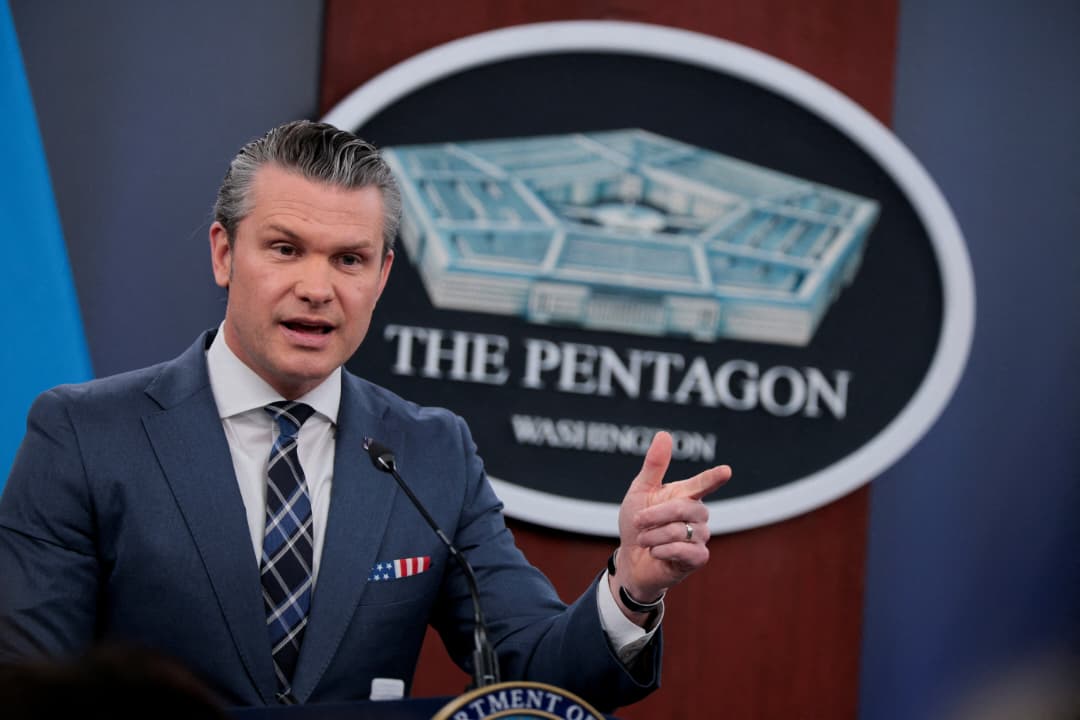
The Pentagon demanded Monday that the Financial Times retract a report alleging that a wealth manager for Defence Secretary Pete Hegseth attempted to make a multimillion-dollar investment in defence industry stocks in the weeks before the United States and Israel launched their war on Iran — a demand the newspaper had not complied with by the time of reporting.
Pentagon spokesman Sean Parnell called the story “entirely false and fabricated” and described it as “yet another baseless, dishonest smear designed to mislead the public.” He said neither Hegseth nor any representative acting on his behalf had approached BlackRock about the investment described in the report. The retraction demand was issued publicly on social media rather than through the normal channels of press communication — a choice that signals the administration’s preference for fighting this battle in the open rather than through editors and legal letters.
The Financial Times reported, citing three unnamed sources, that a broker at Morgan Stanley managing Hegseth’s wealth made contact with BlackRock about investing in an exchange-traded fund whose holdings include Lockheed Martin and Northrop Grumman, two of the largest defence contractors in the United States. The approach allegedly occurred in the weeks preceding the February 28 strikes on Iran. The investment was ultimately not made — not, the newspaper reported, because anyone decided against it on ethical grounds, but because the specific fund was not yet available for purchase at the time.
BlackRock declined to comment. Morgan Stanley and the Financial Times had not responded to requests for comment at the time of reporting. The Defence Department did not immediately answer a separate inquiry sent outside business hours.
The story, contested as it is, lands in a context that gives it particular weight. Since the war began, scrutiny has been building around financial market movements that preceded or immediately followed the strikes — trades in equity markets, commodity futures and prediction markets that some analysts and journalists have characterised as suspiciously well-timed. The speculation centres on whether individuals with access to information about the war’s timing, targets or duration used that knowledge, directly or indirectly, to position themselves financially before the information became public. No charges have been filed. No formal investigation has been publicly confirmed. But the pattern of trades has attracted enough attention that each new allegation connecting senior officials to pre-war financial activity arrives into an already charged atmosphere.
Read also: Hegseth Claims Iran’s Supreme Leader Khamenei Disfigured
The specific fund in question presents a complication for the narrative the Financial Times was constructing. The iShares Defense Industrials Active ETF has gained more than 25 percent over the past year — a strong performance driven by the global rearmament wave that preceded the Iran conflict. But since the US-Israeli strikes began on February 28, the fund has fallen nearly 13 percent. Anyone who had successfully purchased it in the weeks before the war, expecting defence stocks to surge on the back of the conflict, would have lost money rather than made it. The war’s actual market impact on the defence sector — counterintuitive given the volume of munitions being expended — reflects a broader investor anxiety about the conflict’s economic disruption, energy price spike and geopolitical uncertainty outweighing any direct commercial benefit to weapons manufacturers in the near term.
That context does not resolve the ethical question the Financial Times was raising, which is not primarily about whether the investment succeeded but whether it was attempted. A defence secretary whose broker is allegedly seeking exposure to defence industry stocks in the weeks before a war the secretary was helping to plan would face serious questions about the separation between his official role and his personal financial interests — regardless of whether the trade generated a profit. The question of insider trading does not turn on whether the trader made money. It turns on whether non-public information was used to make financial decisions.
Read more: Trump: Iran World Cup Presence ‘Inappropriate’ For Safety
Parnell’s categorical denial — neither Hegseth nor any representative approached BlackRock — is framed in terms specific enough to be either a definitive refutation or a carefully bounded statement. The distinction between approaching BlackRock and approaching a fund manager about a BlackRock product, for instance, is the kind of gap that legal and journalistic scrutiny tends to examine closely when official denials are this precise.
Hegseth has been a figure of persistent controversy since his confirmation as defence secretary, a nomination that cleared the Senate by the narrowest possible margin after a contentious hearing process. He has continued to attract scrutiny over his management of the Pentagon and his role in the administration’s military decision-making during the Iran campaign. The Financial Times report adds a financial dimension to a profile already marked by questions about judgment and conduct.
The newspaper’s sources are unnamed. The Pentagon’s denial is categorical. BlackRock is silent. Morgan Stanley has not responded. The investment, if attempted, was never completed. And the fund that would have been purchased has lost value since the war that allegedly prompted the interest began.