
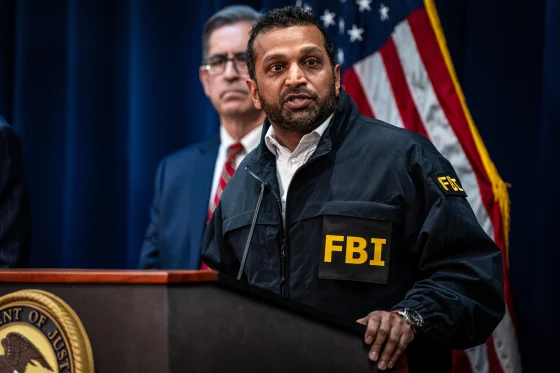
Three FBI agents who investigated Donald Trump after his first term have sued the Justice Department in a class-action lawsuit arguing their dismissals were unconstitutional acts of political retribution — and warning that if successful, the case could force the reinstatement of at least 50 similarly fired colleagues.
The lawsuit, filed in federal court in Washington, names Attorney General Pam Bondi and FBI Director Kash Patel as defendants, accusing both of exploiting their positions to settle scores that predated their appointments. The complaint notes that Bondi and Patel “were personally embroiled, as fact witnesses or attorneys representing Trump, in investigations brought by the FBI through the FBI’s career employees” — meaning the officials now running the agencies responsible for those investigations were themselves subjects or defenders in the proceedings they are now punishing people for conducting.
“And now, by virtue of presidential appointment to the pinnacle of federal law enforcement, Defendants are abusing their positions to claim victories that eluded them on the merits,” the suit says. “Defendants’ mission — in their own words — is retribution.”
Read also: ISIS-Inspired Terror Probe Opened After NYC Mayor’s Home Bombed
The three agents each worked on the 2020 election case and collectively bring decades of FBI experience to a complaint that is as much a statement about institutional integrity as it is a personal legal remedy. All three say they were dismissed without explanation and without any opportunity to respond to the charges against them — a process the lawsuit characterises as a violation of the due process protections that govern federal employment. FBI policy, the agents note, required them to accept all lawful assignments based on the bureau’s needs and explicitly prohibited refusing assignments on political or personal grounds. They were, in other words, doing what the rules required, and were fired for it.
Bondi and Patel, the complaint alleges, began their tenures by compiling lists of FBI employees they regarded as enemies — defined capaciously enough to include people whose only offence was being assigned to investigate Trump, holding private views that displeased the new leadership, maintaining personal friendships with disfavoured colleagues, or possessing what the lawsuit calls “immutable characteristics.” The firings, it says, proceeded “on a rolling basis, without due process.”
The Justice Department’s broader purge of FBI agents who worked on Trump-related investigations has generated multiple separate lawsuits from agents who say they were unconstitutionally dismissed as part of a systematic effort to remove from the bureau anyone who investigated the president or was believed to be insufficiently aligned with his political agenda. The class-action mechanism in Tuesday’s filing is designed to aggregate those individual grievances into a single proceeding capable of establishing a precedent broad enough to cover all affected agents at once.
Read more: US-Israel Month-Long Iran Offensive Brings Guns To Streets
The investigations at the centre of the dismissals were among the most significant in recent American law enforcement history. Special Counsel Jack Smith pursued two criminal cases against Trump following his first term — one arising from his retention of classified documents at Mar-a-Lago after leaving office, and one from his alleged efforts to reverse the results of the 2020 election. The classified documents case was dismissed by a Trump-appointed federal judge who ruled that Smith’s appointment as special counsel was constitutionally invalid, in part because he had not been confirmed by the Senate. Smith withdrew the election interference case after Trump won the 2024 presidential election and returned to the White House.
Both cases are closed. The agents who built them are fired. The officials who were subjects of those investigations are now running the agencies that conducted them. The lawsuit argues this sequence is not coincidence but design — that the dismissals represent the executive branch weaponising law enforcement institutions against the career officials who tried to hold a president accountable.
The FBI declined to comment. The Justice Department had not responded publicly to the filing by the time of publication.
Whether a federal court will agree that the firings were unconstitutional depends on questions that courts have been grappling with throughout Trump’s second term — the scope of presidential authority over executive branch personnel, the due process rights of federal employees facing dismissal, and the degree to which courts will scrutinise the stated rationale for mass firings when the unstated rationale appears plainly political. Prior rulings in related cases have produced conflicting outcomes, and the class-action nature of this filing means its resolution will carry consequences well beyond the three named plaintiffs.
The agents are asking to be reinstated. The case they are making is that a law enforcement agency cannot function if its agents understand that conducting lawful investigations of powerful people creates personal professional risk when those people later assume power over the agency itself. That argument is not only legal. It is institutional. And it will be tested, now, in court.