
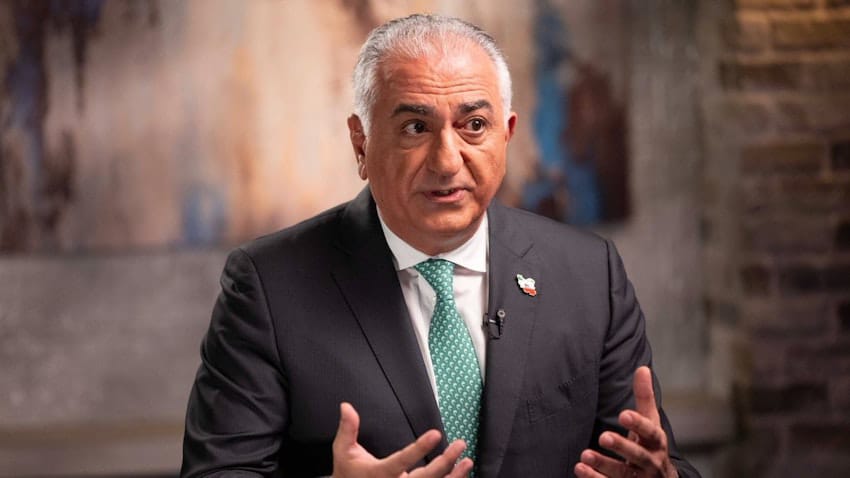
Reza Pahlavi stood before a cheering crowd of American conservatives in Texas on Saturday and argued that any deal struck with Iran’s current leadership would simply defer the threat rather than resolve it — positioning himself, without quite saying so directly, as the only alternative that actually ends the problem.
The exiled son of Iran’s last shah received a standing ovation when he took the stage at the Conservative Political Action Conference, drawing rounds of applause from Republican activists and Iranian Americans who filled the room. The reception was the kind that politicians spend careers trying to manufacture and rarely achieve organically. For Pahlavi, 65, who has spent nearly five decades in exile waiting for a moment that has repeatedly failed to materialise into the thing he has been preparing for, the warmth in the room was both genuine and strategically significant.
Read also: US-Israel Month-Long Iran Offensive Brings Guns To Streets
His core argument was a direct counter to the diplomatic track that has been tentatively forming around the Iran war. Negotiations with the Islamic Republic’s surviving leadership, he said, would produce exactly the cycle Donald Trump claimed he wanted to break when he cited the desire to stop confronting Iran’s threats “every two years” as a rationale for launching the strikes. “The only thing that the remnants of this regime can be relied on to do is to buy time, to cheat and to steal,” Pahlavi told the audience. “It will buy time, it will pretend to negotiate, and then it will return to its old jihadist ways of threatening America, its security and its interests.”
The formulation is designed to close off the exit ramp that a ceasefire deal would provide — to persuade an American audience and, through them, an American president that the only negotiation worth having is the one that ends with the Islamic Republic replaced by something else entirely. Pahlavi has been making versions of this argument for years. What has changed is the context: a war is actually underway, Iran’s military and nuclear infrastructure has absorbed significant damage, and Washington is genuinely debating what kind of endgame it is willing to accept.
He linked his cause to American economic self-interest as much as security, asking the crowd to imagine an Iran that traded the chant of “Death to America” for “God bless America” — a line that drew raucous applause. A free Iran, he promised, would offer vast economic opportunities for the United States. The argument is the classic opposition-in-exile pitch: regime change is not just morally right, it is commercially profitable. Whether it lands with the administration is a different question from whether it lands with CPAC.
Trump has been publicly sceptical of Pahlavi specifically, suggesting at various points that a leader from inside Iran might carry more legitimacy than someone who has been absent from the country for 47 years. The internal opposition is fragmented across ideological factions and rival groups with incompatible visions of what a post-Islamic Republic Iran would look like. The gap between the ovation at a Texas convention centre and the political infrastructure required to actually govern a nation of 90 million people emerging from war is one that Pahlavi’s supporters prefer not to dwell on.
Read more: Two Vessels Vanish From Cuba Aid Convoy, Mexico Searches
He addressed the protest question carefully, saying that “when the right moment arrives” he would call on Iranians to rise up and reclaim their homeland, their dignity and their future. He had issued a similar call in January. The response inside Iran — where the Basij patrols the streets, where checkpoints have been made mobile to avoid drone strikes, where children as young as 12 are being incorporated into neighbourhood surveillance networks — has not yet produced the mass uprising that Pahlavi and the US-Israeli campaign have been signalling Iranians to attempt.
At several points in the speech, Iranian Americans in the audience chanted “long live the king” — a phrase that carries its own complicated freight, invoking a monarchy whose record was itself contested before the revolution that replaced it. The chant reflects the particular nostalgia of a diaspora community that has spent decades processing a loss, and it tells you something true about that community’s feeling. What it tells you about the political preferences of the 90 million people currently living inside Iran under bombardment is considerably less clear.
Trump, meanwhile, is navigating the choices that a month of war has produced without resolution: accept a deal that may not hold, or escalate toward a ground operation that every military analyst describes as the beginning of something much longer and costlier than anything the administration has publicly acknowledged planning for. His approval ratings are slipping as energy prices rise. The economic pressure that was supposed to force Iran to capitulate is being felt as acutely in American petrol stations and European factories as it is in Tehran.
Pahlavi’s argument, stripped to its simplest form, is that there is a third option — regime change achieved through internal uprising, supported by continued external pressure, led by a transitional government he is ready to head. It is the option that avoids both a fragile deal and a ground war. It is also the option that has been theoretically available for 47 years and has not yet happened.
The crowd in Texas gave him another standing ovation as he left the stage. The war continues regardless.