
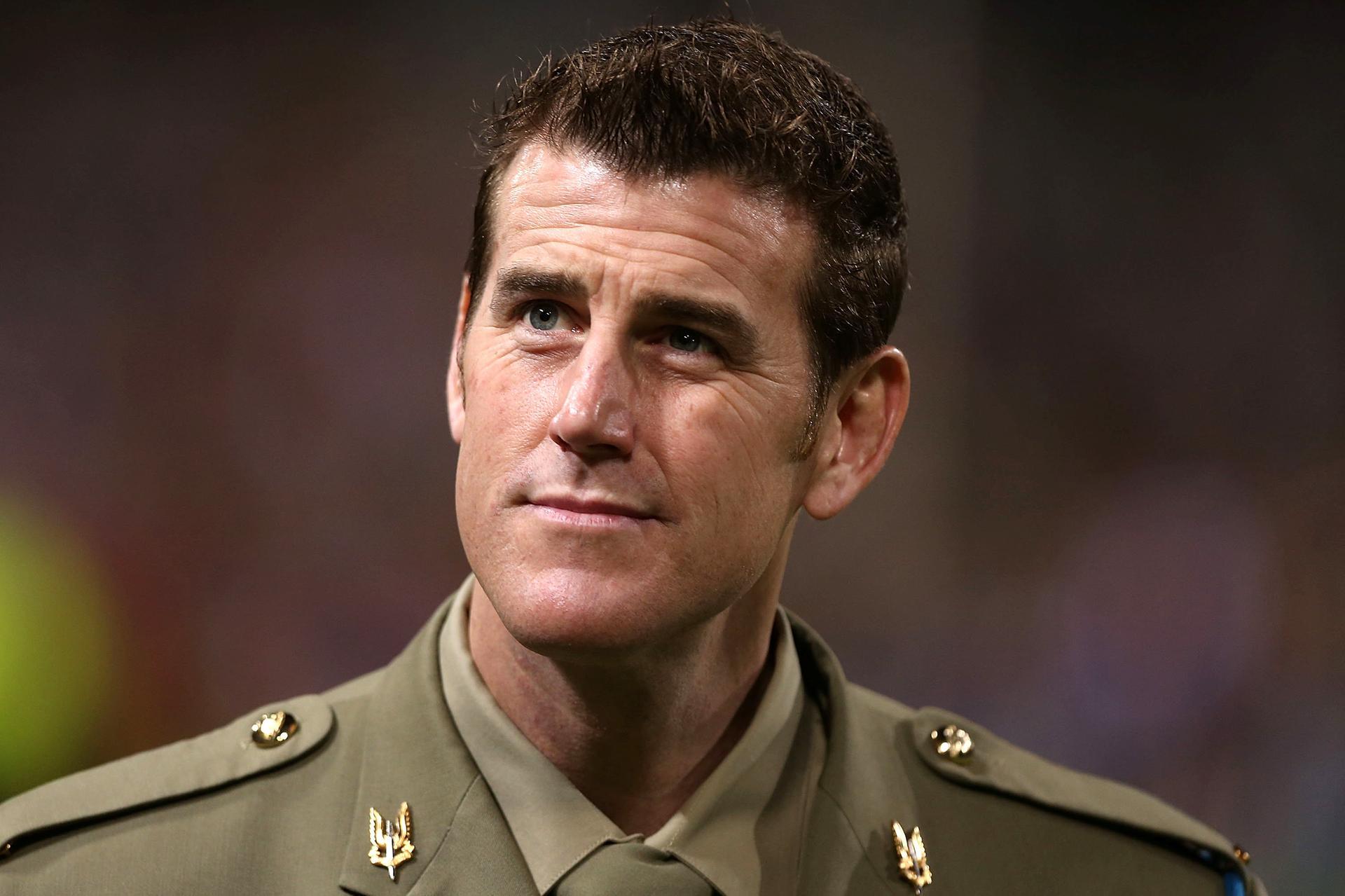
Australia’s most decorated living soldier was arrested at Sydney airport Tuesday and charged with five counts of war crimes murder, facing criminal prosecution for killings of unarmed Afghans that a civil court already found, on the balance of probabilities, that he committed.
Ben Roberts-Smith, 47, a Victoria Cross recipient and former Special Air Service corporal who left the defence force in 2013, was taken into custody and will spend the night in a cell before a bail hearing Wednesday. He faces one charge of murder, one of jointly commissioning a murder, and three of aiding, abetting, counselling or procuring murder — allegations covering killings of unarmed detainees while he served in Afghanistan between 2009 and 2012.
Australian Federal Police Commissioner Krissy Barrett said at a Sydney news conference that it would be alleged the victims “were shot by the accused or shot by subordinate members of the ADF in the presence of, and acting on the orders of, the accused.”
Roberts-Smith denies all wrongdoing. He has previously described the allegations against him as “egregious” and “spiteful,” and during his defamation proceedings argued the alleged killings either occurred legally during combat or did not happen at all.
Read also: Iran’s Neighbors Prepare As War Looms, Refugee Wave Feared
The criminal charges follow a seven-year defamation battle that Roberts-Smith initiated in 2018 after Nine newspapers published allegations about his conduct in Afghanistan. The case, described by some as Australia’s trial of the century, ended in a Federal Court finding in 2023 that Roberts-Smith had participated in at least four murders. Justice Anthony Besanko found he had twice ordered unarmed men shot dead to “blood” rookie soldiers, was involved in the death of a handcuffed farmer he kicked off a cliff, and participated in the killing of a captured Taliban fighter whose prosthetic leg was subsequently taken as a trophy and used by troops as a drinking vessel. Roberts-Smith lost an appeal against that finding last year.
That civil judgment established liability on the balance of probabilities — a lower threshold than the criminal standard of beyond reasonable doubt that prosecutors must now meet.
The charges emerge from the Office of the Special Investigator, a specialist body established in the wake of the 2020 Brereton Report — a landmark inquiry that found credible evidence Australian elite soldiers unlawfully killed 39 people in Afghanistan and recommended 19 current or former ADF members be investigated for prosecution. Roberts-Smith is only the second person the OSI has charged.
Ross Barnett, the OSI’s director of investigations, acknowledged the difficulty of building criminal cases from events that occurred in a war zone 9,000 kilometres away. “We can’t go to that country, we don’t have access to the crime scenes,” he said. “We don’t have photographs, site plans, measurements, the recovery of projectiles, blood spatter analysis. We don’t have access to the deceased.” Despite those constraints, he described Roberts-Smith’s arrest as “a significant step.”
Read more: Analysts: US Iran ‘No Quarter’ Stance Violates War Laws
Prime Minister Anthony Albanese declined to comment, saying it was “very important that there not be political engagement” with matters before the courts.
The Australian War Memorial said Tuesday it would again review its Roberts-Smith exhibit. The display of his uniform and medals has been updated multiple times over the years to reflect the evolving legal proceedings against him — a visible record of how a figure who was considered a national hero when the allegations first emerged in 2018 has since become the subject of the country’s most consequential military accountability case.
Barrett was careful to note that the alleged misconduct was confined to “a very small section of our trusted and respected ADF” and that the majority of defence force members “do our country proud.” The qualification is standard in cases of this kind and does nothing to diminish what Roberts-Smith now faces: a criminal trial that will test, at the highest evidentiary standard the law requires, whether Australia’s most decorated living soldier is also a war criminal.